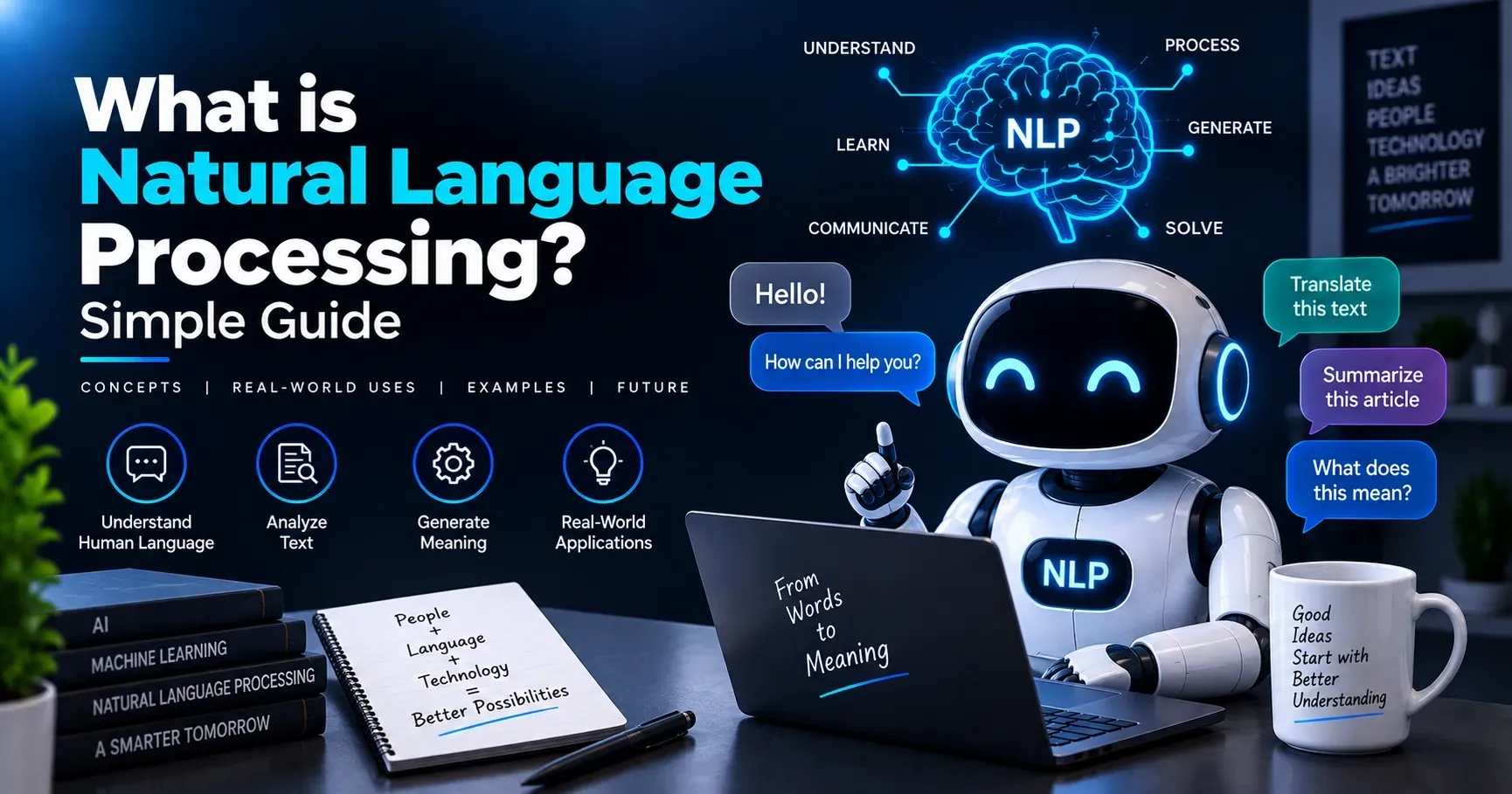
What is Natural Language Processing? A Simple Guide
Natural Language Processing, often shortened to NLP, is one of the most exciting branches of artificial intelligence. It is the technology that allows computers to read, understand, interpret, and even generate human language. Every time you talk to a voice assistant, use a translation app, or notice that your email automatically sorts spam, you are witnessing Natural Language Processing at work. In this guide, we will break down what NLP is, how it works, why it matters, and where it is heading in the future, all explained in simple and easy to understand language.
Understanding the Basics of Natural Language Processing
Human language is messy. It is full of slang, sarcasm, grammar mistakes, regional accents, idioms, and multiple meanings for the same word. For a human being, understanding language comes naturally because we grow up learning it through conversation, culture, and context. For a computer, however, language is nothing more than a string of characters unless it is taught how to interpret it.
Natural Language Processing is the field of computer science and artificial intelligence that focuses on giving machines the ability to process and understand text and speech in a way that mimics human comprehension. It sits at the intersection of linguistics, computer science, and machine learning, combining rules about grammar and meaning with statistical models that learn from massive amounts of text data.
In simple terms, NLP tries to answer one core question. How can a computer make sense of the words we use every day, and how can it respond in a way that feels natural to us?
Why Natural Language Processing Matters
Language is the primary way humans communicate, and an enormous portion of the world's information exists in text form. Emails, social media posts, customer reviews, news articles, medical records, and legal documents are all written in natural language. Without NLP, computers would be unable to extract meaning from any of this data, and businesses would lose access to insights buried inside millions of documents.
NLP matters because it bridges the gap between human communication and machine understanding. It allows organizations to automate customer support, analyze public sentiment, translate content instantly, summarize long reports, and much more. As the amount of digital text and voice data continues to grow every year, the importance of NLP only increases.
A Brief History of Natural Language Processing
The roots of Natural Language Processing go back to the 1950s, when researchers first attempted machine translation between languages such as Russian and English. Early systems relied heavily on hand written rules created by linguists. These rule based systems could handle simple sentences but struggled badly with ambiguity and complexity.
In the 1980s and 1990s, statistical methods began to replace purely rule based approaches. Instead of relying only on grammar rules, researchers started using probability and large collections of text, known as corpora, to teach systems how language typically behaves.
The real breakthrough came in the 2010s with the rise of deep learning. Neural networks, especially a type called transformers, dramatically improved the ability of machines to understand context and meaning. This led to the powerful language models we see today, including the technology behind chatbots, translation tools, and virtual assistants.
How Does Natural Language Processing Work
NLP works through a series of steps that convert raw text or speech into something a computer can analyze and act upon. While the exact process varies depending on the task, most NLP systems follow a similar general pipeline.
1. Text Preprocessing
Before any analysis can happen, raw text needs to be cleaned and organized. This includes removing unnecessary symbols, correcting formatting issues, and breaking the text into smaller, manageable pieces.
2. Tokenization
Tokenization is the process of splitting text into smaller units called tokens. These tokens are usually words or phrases. For example, the sentence "NLP is fascinating" would be split into the tokens "NLP", "is", and "fascinating".
3. Removing Stop Words
Stop words are common words such as "the", "is", and "and" that usually do not carry significant meaning on their own. Many NLP systems remove these words to focus on more meaningful content, although some advanced models keep them for context.
4. Part of Speech Tagging
This step involves labeling each word with its grammatical role, such as noun, verb, adjective, or adverb. Part of speech tagging helps the system understand sentence structure and relationships between words.
5. Named Entity Recognition
Named Entity Recognition, often called NER, identifies and classifies key information in text, such as names of people, organizations, locations, dates, and monetary values. For example, in the sentence "Apple was founded in California in 1976", NER would recognize "Apple" as an organization, "California" as a location, and "1976" as a date.
6. Parsing and Syntax Analysis
Parsing examines the grammatical structure of a sentence to understand how words relate to one another. This helps the system figure out subjects, objects, and actions within a sentence.
7. Semantic Analysis
Semantic analysis focuses on meaning rather than just structure. It helps the system understand what a sentence actually means, including handling situations where a single word might have multiple meanings depending on context.
8. Sentiment Analysis
Sentiment analysis determines the emotional tone behind a piece of text, classifying it as positive, negative, or neutral. Businesses often use this to analyze customer reviews and social media posts.
Key Techniques Used in Natural Language Processing
Several core techniques form the foundation of modern NLP systems. Understanding these techniques helps explain how machines achieve such impressive language capabilities.
Bag of Words
The bag of words model represents text by counting how often each word appears, ignoring grammar and word order. While simple, it is useful for basic text classification tasks.
TF IDF (Term Frequency Inverse Document Frequency)
TF IDF is a statistical method that measures how important a word is within a document compared to a larger collection of documents. It helps identify words that are meaningful rather than just frequent.
Word Embeddings
Word embeddings represent words as numerical vectors in a way that captures their meaning and relationships. Words with similar meanings end up located closer together in this vector space, allowing machines to understand similarity and context far better than simple word counting.
Recurrent Neural Networks and LSTMs
Recurrent Neural Networks, along with a more advanced version called Long Short Term Memory networks, were designed to process sequences of text while remembering information from earlier in a sentence. These models were widely used before the rise of transformer architectures.
Transformers
Transformers revolutionized NLP by allowing models to consider the entire context of a sentence at once, rather than processing words strictly in order. This architecture powers most modern language models, enabling them to understand long range relationships between words with impressive accuracy.
Real World Applications of Natural Language Processing
Natural Language Processing has moved far beyond research labs and is now embedded in countless everyday tools and services.
Virtual Assistants and Chatbots
Voice assistants and customer service chatbots rely heavily on NLP to understand spoken or typed requests and generate appropriate responses.
Machine Translation
Translation tools use NLP to convert text from one language into another while attempting to preserve meaning, tone, and grammar.
Sentiment Analysis for Businesses
Companies use NLP to scan reviews, surveys, and social media mentions to understand how customers feel about their products and services.
Spam Detection
Email providers use NLP techniques to identify patterns commonly found in spam messages and automatically filter them out.
Text Summarization
NLP can automatically condense long articles or reports into shorter summaries while preserving the most important information.
Search Engines
Search engines rely on NLP to interpret the intent behind a search query, going beyond exact keyword matching to understand what a user actually wants to find.
Healthcare Documentation
Medical professionals use NLP tools to extract useful information from patient records, clinical notes, and research papers, saving significant time compared to manual review.
Grammar and Writing Assistants
Writing tools use NLP to detect grammar mistakes, suggest style improvements, and even rewrite sentences for clarity.
Benefits of Natural Language Processing
NLP offers a wide range of advantages across industries. It saves time by automating tasks that would otherwise require manual reading and analysis. It improves customer experience through faster and more accurate responses. It enables businesses to extract valuable insights from massive volumes of unstructured text data. It also allows for better accessibility, such as converting speech to text for individuals with hearing impairments or generating text to speech for those with visual impairments.
Challenges Facing Natural Language Processing
Despite remarkable progress, Natural Language Processing still faces significant challenges.
Ambiguity
Words and sentences often have multiple possible meanings depending on context, making it difficult for machines to always interpret them correctly.
Sarcasm and Tone
Detecting sarcasm, humor, or emotional tone remains one of the hardest problems in NLP, since these often rely on cultural knowledge and subtle cues.
Language Diversity
There are thousands of languages and dialects spoken around the world, many of which lack sufficient digital text data to train accurate models.
Bias in Data
Since NLP models learn from existing text data, they can unintentionally absorb biases present in that data, leading to unfair or inaccurate outputs.
Resource Requirements
Training advanced NLP models requires massive computing power and large datasets, which can be costly and environmentally intensive.
The Future of Natural Language Processing
The future of NLP looks incredibly promising. Models are becoming better at understanding context, nuance, and even multiple languages at once. Multimodal systems that combine text, images, and audio are expanding what NLP can accomplish. Businesses are increasingly integrating NLP into everyday workflows, from automated report writing to advanced virtual assistants capable of holding complex conversations.
As research continues, we can expect NLP systems to become more accurate, more efficient, and more capable of understanding the subtle and creative ways humans use language.
Conclusion
Natural Language Processing is transforming the way humans interact with technology. By enabling machines to read, interpret, and generate human language, NLP powers everything from voice assistants and translation apps to sentiment analysis tools and search engines. While challenges such as ambiguity, bias, and language diversity remain, ongoing advances in machine learning and deep learning continue to push the boundaries of what is possible. As NLP technology keeps evolving, it will play an even bigger role in shaping how we communicate with the digital world around us.