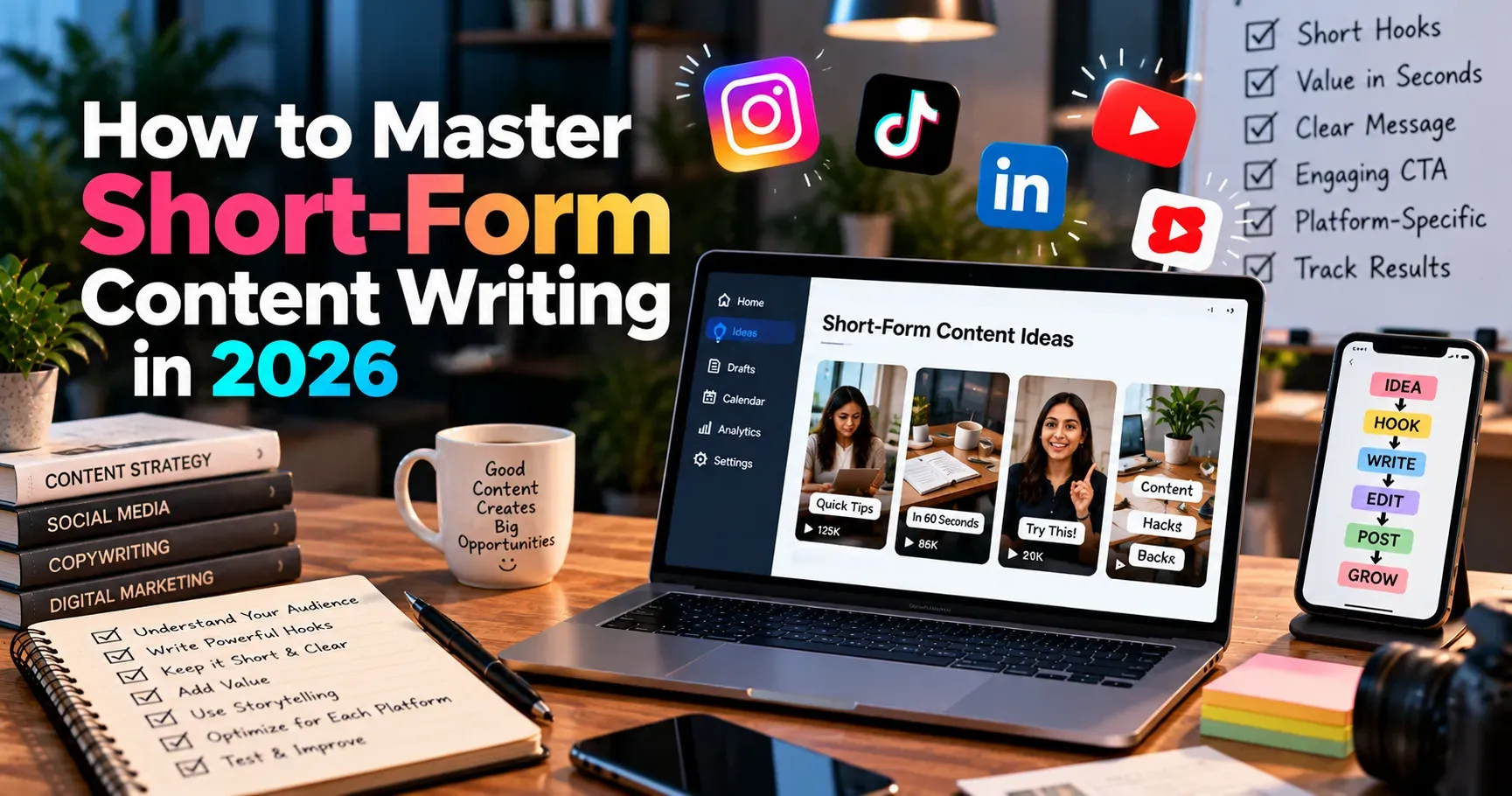
How to Master Short Form Content Writing in 2026
Attention is the scarcest resource online. In the time it takes you to read this sentence, thousands of posts, videos, and messages have been published somewhere in the world. Your reader decides in a second or two whether to keep watching, reading, or scrolling. That tiny window is where short form content writing lives, and it is why the skill has become one of the most valuable abilities in marketing, publishing, and personal branding.
Short form writing looks easy because it is small. A caption, a hook, a script for a fifteen second video, a post of a hundred words. But writing something short that is clear, memorable, and persuasive is much harder than writing something long. Every word must earn its place. There is nowhere to hide weak ideas or padding.
This guide will show you how to master short form content writing in 2026. You will learn what makes short content work, how to write hooks that stop the scroll, which frameworks to use, how to edit ruthlessly, how to adapt to each platform, how to use AI without losing your voice, and how to build a simple routine that improves your skills week after week.
What Is Short Form Content Writing?
Short form content is any piece of writing or scripted media that delivers its message quickly, usually in a few sentences, a few seconds, or a small block of text. It includes social media posts, captions, video scripts for reels, shorts, and TikTok, email subject lines, ad copy, product descriptions, push notifications, text messages, and short newsletter items.
The goal is not to say less for the sake of it. The goal is to say the right thing in the smallest amount of space, so the reader gets value immediately. Great short form writing feels effortless to read, even though it takes careful thought to create.
Why Short Form Writing Matters More Than Ever in 2026
Several trends make this skill especially important right now.
Feeds Are Faster and More Crowded
Every major platform is built around endless scrolling. Content that does not grab attention quickly disappears. Writers who can hook readers in the first line have a huge advantage.
Video Scripts Are Now Writing Jobs
Short videos may look casual, but the best ones are carefully scripted. Someone has to write the opening line, the flow of ideas, the on screen text, and the final call to action. Writers who understand video pacing are in high demand.
AI Has Made Average Content Easy
Anyone can now generate a passable caption in seconds. That means passable content is everywhere and easy to ignore. What stands out is a clear point of view, real experience, and a distinct voice. Mastering short form writing helps you rise above the flood of generic posts.
Small Pieces Drive Big Results
A single strong post can attract new followers, clients, or customers. A powerful headline can double click rates. A better subject line can lift email opens. Small improvements in short copy often lead to large gains in business results.
It Trains Every Other Writing Skill
Learning to write short forces you to think clearly, cut clutter, and focus on your reader. These habits improve your long articles, emails, reports, and presentations as well.
The Core Principles of Great Short Form Writing
Before you learn techniques, keep these guiding ideas in mind.
- One idea per piece. If you try to say three things, the reader remembers none.
- Clarity beats cleverness. If people must decode your message, they will scroll past.
- Write for one person. Imagine a single reader with a specific problem or wish.
- Show value fast. The reader should know within seconds what is in it for them.
- Be specific. Details, numbers, and examples are more believable than vague claims.
- Sound human. Write the way people speak, not the way brochures speak.
- End with purpose. Every piece should leave the reader with a thought, a feeling, or a next step.
Step 1: Know Your Audience and Your Goal
Strong writing starts before the first word. Ask two questions every time.
Who Am I Talking To?
Define your reader in simple terms. What do they struggle with? What do they want? What words do they use to describe their problem? The closer your language is to theirs, the more your content feels personal and relevant.
What Do I Want This Piece to Do?
Every post needs a job. It might teach something, entertain, build trust, drive clicks, start a conversation, or promote an offer. When you know the job, decisions about tone, length, and call to action become easier. Content with no clear purpose tends to wander.
Step 2: Write Hooks That Stop the Scroll
The hook is the first line of a post or the first few seconds of a video. If the hook fails, nothing else matters. Spend more time on it than on any other part of your writing. Many professional writers draft ten or more hook options before choosing one.
Proven Hook Types
Here are hook styles that work across platforms, with examples you can adapt.
- The bold claim: Most landing pages fail because of one sentence.
- The question: Why do your best posts get fewer views than your worst ones?
- The number: Three edits that made my captions twice as readable.
- The mistake: I wasted a year writing posts nobody finished reading.
- The contrast: Everyone talks about posting daily. Almost nobody talks about editing daily.
- The story opener: Last Tuesday, a client deleted my entire first draft. She was right.
- The direct promise: Here is a simple way to write a hook in under two minutes.
- The curiosity gap: The smallest change in this caption tripled the replies.
Hook Writing Rules
- Lead with the most interesting part, not the background.
- Use plain words and short sentences.
- Speak to the reader with you where it fits.
- Avoid warm up phrases such as In today's post or Let me tell you about.
- Make sure the rest of the content delivers on the promise. Misleading hooks lose trust.
Test Your Hook
Ask yourself whether a stranger would understand it instantly and feel a reason to continue. If the answer is not a clear yes, rewrite it.
Step 3: Use Simple Frameworks to Structure Short Content
Frameworks are shortcuts that keep your writing organized. They do not replace creativity, but they help you finish faster and avoid rambling.
Problem, Agitate, Solution
Name a problem, explain why it hurts, and offer a solution. Example: Your emails are not getting opened. Every unopened message is a missed sale. Try a subject line that promises one clear benefit.
Before, After, Bridge
Describe the current painful situation, paint the improved future, and explain how to get there. This works well for transformations, case studies, and product benefits.
The Three Part Story
Tell a tiny story with a beginning, a turning point, and a lesson. For instance: I used to write long intros. My engagement was flat. Then I cut the first three lines and results jumped. Start where the action begins.
Hook, Value, Call to Action
This is the simplest structure for most posts and video scripts. Open with the hook, deliver the main value in a few tight lines, and close with a clear next step such as reply, save, share, or visit a link.
The List Format
Lists are easy to scan and easy to finish. A post such as Five tools I use every day gives readers a clear expectation and a natural stopping point. Make sure every item is genuinely useful, not filler.
Myth and Truth
State a common belief and then correct it. Example: Myth, short posts are easy to write. Truth, they are easy to read and hard to write. This format creates instant interest because it challenges what people think they know.
Step 4: Write Tight, Then Cut Even More
Editing is where good short form writers separate themselves. Start by getting your ideas on the page, then trim with purpose.
Editing Rules That Work
- Cut words that add no meaning, such as very, really, just, actually, and in order to.
- Replace long phrases with short ones. Use because instead of due to the fact that.
- Prefer active voice. Write We launched the update, not The update was launched by us.
- Use strong verbs instead of weak verbs with adverbs.
- Break long sentences into two.
- Remove any sentence that repeats an earlier one.
- Read the piece aloud. If you stumble, your reader will too.
An Example of Editing
Before: I just wanted to take a moment to share that we are really excited to announce that our brand new course is now available for everyone to enroll in.
After: Our new course is open. Enroll today.
The second version is shorter, clearer, and more direct, and it gives the reader an obvious next step.
Use White Space
Short lines and paragraph breaks make content easier to read on small screens. Give your ideas room to breathe.
Step 5: Adapt Your Writing to Each Platform
Each platform has its own culture and format. The same idea may need a different shape depending on where you publish it.
Instagram Captions
Place the hook in the first line, since only the beginning shows before the caption expands. Keep the tone conversational, use line breaks, and end with a question or a clear call to action. Match the caption to the visual so they support each other.
TikTok, Reels, and YouTube Shorts Scripts
Write for the ear, not the eye. Use short spoken sentences and plan visual changes every few seconds. Open with the hook in the first second, deliver one main point, and end with a reason to follow, comment, or watch again. Add on screen text and captions, because many people watch without sound.
LinkedIn Posts
Professional audiences appreciate insight, lessons learned, and practical advice. Start with a strong opening line, use short paragraphs, and share experience rather than empty motivation. Invite thoughtful discussion in the comments.
X Posts
Brevity and sharpness are essential. Make one clear point, use precise language, and let your personality show. Threads can expand on an idea, but the first post must earn the click to continue.
Email Subject Lines and Preview Text
Aim for clarity and curiosity in a few words. Mention the benefit, avoid spammy words and excessive punctuation, and use the preview text to add a second reason to open.
Ads and Landing Page Snippets
Focus on one benefit and one action. Use the words your customers use, include proof where possible, and make the button text specific, such as Get the free checklist instead of Submit.
Push Notifications and Text Messages
Space is extremely limited. Lead with the most important information, be respectful of the reader's time, and always provide real value.
Step 6: Develop a Voice People Recognize
With so much similar content online, voice is what makes readers remember you. Voice is the personality behind the words.
- Write down three to five words that describe how you want to sound, such as direct, warm, witty, or practical.
- Collect samples of your best writing and notice common patterns in vocabulary and rhythm.
- Use real stories, opinions, and examples from your own experience.
- Avoid copying another creator's style. Learn from others, but express ideas your own way.
- Stay consistent so your audience knows what to expect.
A strong voice does not mean being loud. It means being recognizable, honest, and useful.
Step 7: Write Calls to Action That Feel Natural
A call to action tells the reader what to do next. Without one, even a great post can end in silence.
Keep It Simple
Ask for one action only. Save this post, reply with your biggest challenge, or click the link to download the guide. Multiple requests confuse people.
Make the Benefit Clear
Explain why the action is worth taking. Instead of saying Follow me, say Follow for one practical writing tip every day.
Match the Ask to the Relationship
Readers who are new to you are more likely to like or comment than to buy. Build trust with helpful content before making bigger requests.
Step 8: Use AI as an Assistant, Not a Replacement
AI tools are now part of many writing workflows, and they can be genuinely helpful when used wisely.
Good Ways to Use AI
- Brainstorm topics, angles, and hook variations.
- Turn a long piece into several short drafts that you then rewrite.
- Check for clarity, wordiness, and grammar.
- Generate headline options to compare and improve.
- Summarize research so you can find the key points faster.
What to Keep Human
Your opinions, stories, examples, and humor should come from you. Readers can often sense generic text, and platforms and audiences are becoming less patient with it. Always edit AI drafts so they sound like you, verify facts, and remove clichés. Use the tool to speed up the process, not to replace your thinking.
Step 9: Build a Sustainable Content Routine
Mastery comes from practice. A simple system helps you write consistently without burning out.
Keep an Idea Bank
Save questions from customers, interesting observations, lessons from your work, and posts you admire. When you sit down to write, you will never face a blank page.
Batch Your Writing
Set aside one or two blocks each week to write several pieces at once. Draft in one session and edit in another. Working in batches saves time and improves quality.
Repurpose Smartly
Turn one idea into several formats. A single lesson can become a LinkedIn post, a short video script, an email tip, and a carousel. Adapt the structure to each platform instead of copying it word for word.
Keep a Swipe File
Save examples of headlines, hooks, and captions that caught your attention. Study why they worked, but use them for learning, not for copying.
Step 10: Measure, Learn, and Improve
Data shows you what your audience actually values.
- Track views, watch time, saves, shares, comments, clicks, and follows, depending on your goal.
- Compare your top and bottom performing pieces. Look at the hook, topic, format, and length.
- Test one variable at a time, such as two different opening lines for similar posts.
- Pay attention to comments and messages. Your audience often tells you exactly what they want to see next.
- Keep a short notebook of lessons learned and review it monthly.
Numbers do not replace judgment, but they help you spot patterns and stop repeating mistakes.
Quick Before and After Examples
Example One: A Product Post
Before: We are proud to introduce our newest product, which has been designed with quality and innovation in mind for modern customers.
After: Meet the bottle that keeps water cold for twenty four hours. Fits every cup holder.
Example Two: A Business Insight
Before: Consistency is very important in the process of building an audience over a long period of time.
After: Post once a week for a year and you will beat most people who post daily for a month.
Example Three: A Video Opening
Before: Hi everyone, today I want to talk about some tips for writing better captions.
After: Your caption has three seconds to work. Here is how to make them count.
Common Mistakes to Avoid
- Burying the hook behind a long introduction.
- Trying to cover too many ideas in one piece.
- Using jargon, buzzwords, or corporate language that sounds robotic.
- Copying trends without adding your own perspective.
- Writing clickbait that the content does not deliver on.
- Ignoring readability on mobile screens.
- Forgetting a clear call to action.
- Publishing raw AI output without editing.
- Quitting before you have posted enough to see progress.
Your Short Form Writing Checklist
- Do I know exactly who this is for and what it should achieve?
- Does the first line create curiosity or promise value?
- Is there only one main idea?
- Have I used specific details, numbers, or examples?
- Did I cut filler words and repeated points?
- Does it sound like a real person speaking?
- Is it easy to read on a phone screen?
- Does it end with a clear next step?
- Does it fit the culture of the platform?
A Thirty Day Practice Plan
Skills grow through repetition. Follow this plan to build real confidence in one month.
- Week one: Write ten hooks every day for a topic you know well. Choose your best one and publish a short post with it.
- Week two: Practice three frameworks, such as problem, agitate, solution, before, after, bridge, and the three part story. Write one post with each.
- Week three: Write and record two short video scripts. Read them aloud and trim every line that feels slow.
- Week four: Review your analytics, choose your top three performing posts, and write improved versions using what you learned.
By the end of the month, you will have a set of proven hooks, a repeatable process, and a clearer sense of your voice.
Final Thoughts
Mastering short form content writing in 2026 is about respect. You respect your reader's time by getting to the point. You respect their intelligence by being clear and honest. You respect your own message by shaping it until it is as strong as it can be.
Begin with the reader, craft a hook that earns attention, structure your message with a simple framework, cut everything that does not help, and adapt to the platform you are writing for. Use AI as a helper while keeping your voice and experience at the center. Then practice, measure, and improve. Small pieces of writing, done well and done often, can build a large audience, a strong brand, and real business results.