How AI Is Transforming Business Automation in 2026
Introduction
We are living through the most consequential shift in how businesses operate since the internet went mainstream. Artificial intelligence is no longer a futuristic promise sitting in a technology roadmap. It is actively redesigning how companies hire, sell, serve customers, manage supply chains, and make decisions. And in 2026, that transformation has accelerated into something few business leaders predicted even two years ago.
The numbers tell a clear story. Gartner projects that by the end of 2026, 40% of enterprise applications will include task-specific AI agents. OneReach The agentic AI market is growing at a staggering 43.84% CAGR, from $5.25 billion in 2024 and on track toward $199 billion by 2034. Landbase Worker access to AI rose by 50% in 2025 alone, and the number of companies with significant AI projects in production is set to double within six months. Deloitte
This is not incremental improvement. This is a structural reorganization of how work gets done. This blog breaks down exactly what that transformation looks like across the key areas of business, what the data says about ROI and adoption, and what it means for the companies navigating it right now.
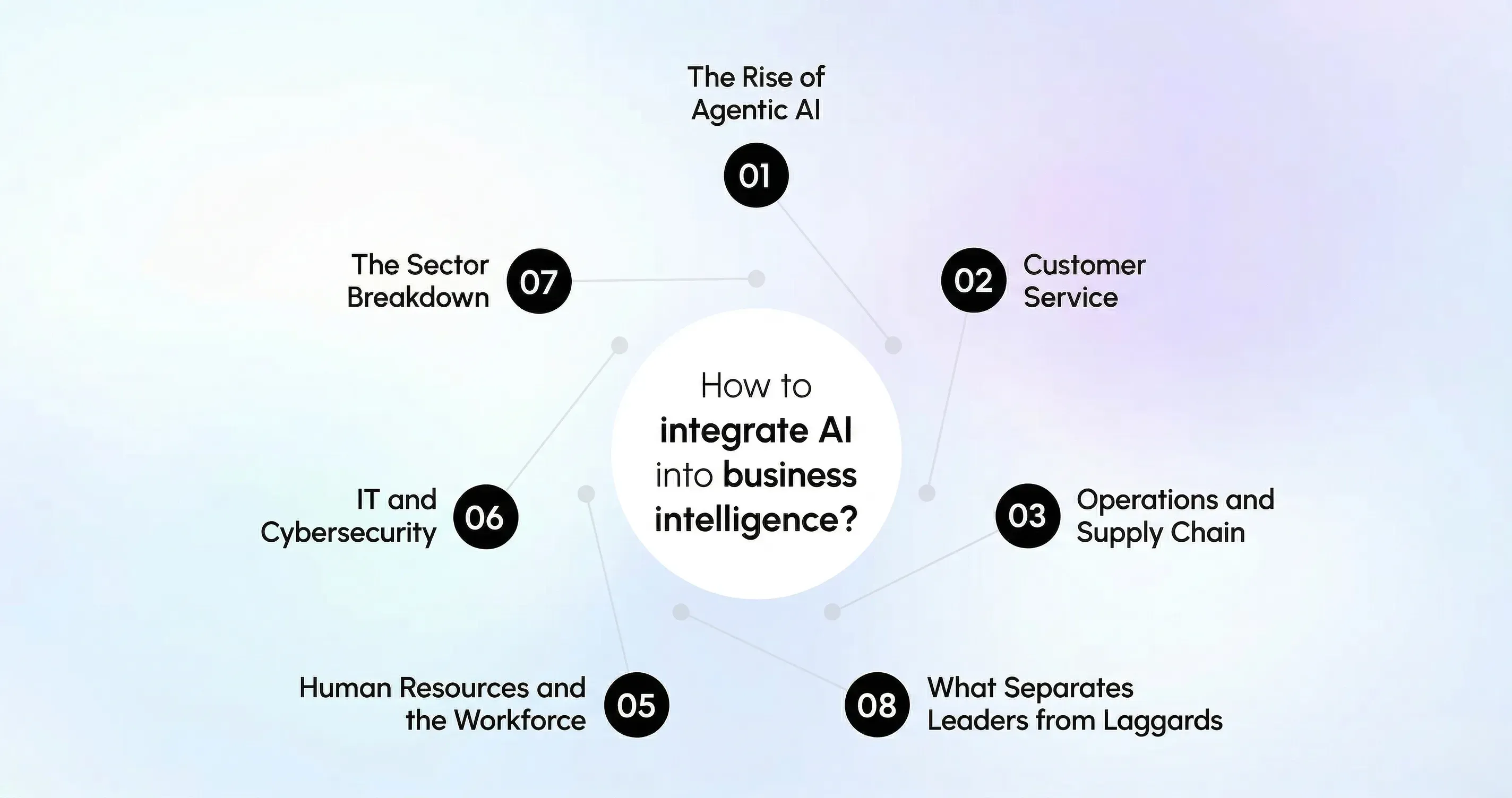
1. The Rise of Agentic AI: From Tools to Autonomous Teammates
What Changed and Why It Matters
For years, AI in the enterprise meant dashboards, recommendations, and predictions. A system would analyze data and surface an insight. A human would then act on that insight. That loop is now breaking apart.
In 2026, most enterprises are no longer asking whether AI belongs in their automation strategy. That debate is effectively over. The harder questions are now about trust, resilience, and value: Can automation adapt when reality does not follow the plan? Redwood Software
Agentic AI represents a fundamentally different paradigm. These systems do not just analyze. They plan, decide, and execute sequences of tasks across multiple tools and systems, with minimal human intervention. A financial services firm is no longer using AI to flag anomalies in transactions. It is deploying AI agents that automatically investigate the anomaly, cross-reference compliance records, draft a response memo, and route it to the appropriate team, all without a human touching the process until final review.
By 2028, 38% of organizations will have AI agents as team members within human teams. Blended teams where humans and AI agents collaborate are becoming the norm, driving productivity and innovation. SS&C Blue Prism
The ROI Is Real and It Is Compounding
Skepticism around AI ROI has largely evaporated in 2026. Organizations deploying agentic systems report exceptional returns, averaging 171% ROI, with U.S. companies achieving 192%. These returns substantially exceed traditional automation, validating that autonomous AI represents a step-change in value creation rather than incremental improvement. Landbase
In PwC's 2025 Responsible AI survey, 60% of respondents said AI boosts ROI and efficiency, and 55% reported improved customer experience and innovation. PwC Perhaps more telling: 88% of executives plan to increase AI budgets specifically because of agentic AI initiatives, and 66% of companies using AI agents have already seen measurable productivity gains. Accelirate
2. Customer Service: The First Sector Fully Transformed
Autonomous Support at Scale
Customer service was always a natural candidate for automation. High volume, repetitive queries, predictable workflows. But what AI is delivering in 2026 goes far beyond the scripted chatbots of a few years ago.
By 2029, AI agents are expected to resolve 80% of common customer service issues without human help, according to Gartner. Already, Salesforce resolves 83% of around 32,000 weekly customer conversations using AI agents. Bayelsa Watch
81% of individuals now acknowledge that AI is a core part of customer service, up 11 points year over year. Early adopters are 128% more likely to report high ROI in customer experience than companies sticking with traditional approaches. Master of Code
The impact compounds across the organization. Fewer escalations mean customer service teams spend more time on genuinely complex issues. AI agents handle routine inquiries around the clock without fatigue, staffing constraints, or inconsistency. For businesses with high customer contact volumes, this is not a cost-saving measure. It is a customer experience upgrade that happens to reduce costs.
Hyper-Personalization at Scale
Beyond deflection and resolution, AI is transforming how businesses engage customers proactively. Modern customers expect tailored experiences, and AI makes that possible. By analyzing user behavior, purchase history, and preferences, AI helps businesses deliver personalized recommendations, targeted marketing campaigns, and real-time support. Industries such as retail, healthcare, and fintech are already leveraging predictive analytics to understand customer intent and provide proactive solutions. Talent500
3. Operations and Supply Chain: Intelligence Meets Execution
From Insight to Action in Real Time
For decades, enterprise resource planning platforms have been treated primarily as systems of record. That is changing. In 2026, as AI adoption expands and agentic systems move beyond chat and analysis into execution, the ERP will still be at the center of the business. But its value will increasingly come from how effectively it drives action. Redwood Software
The shift from passive data repository to active orchestration engine is one of the most significant operational changes happening inside large enterprises right now. AI does not just report that inventory is running low. It identifies the shortfall, compares supplier options, places an order within pre-approved parameters, and updates the relevant financial forecasts, all autonomously.
Logistics is one of the first places where embodied and agentic AI will scale significantly. Autonomous loading and sorting robots, inspection drones, and AI systems quietly rerouting shipments and managing inventory without needing a human in the loop are becoming standard deployments rather than pilots. AI Business
Manufacturing and Physical AI
About 58% of global business leaders surveyed by Deloitte indicated they are currently using physical AI to some extent in their operations for smart monitoring or production alongside humans. That number grew to 80% when asked about their plans over the next two years. Manufacturing Dive
Physical AI, meaning robotic systems capable of reasoning, adapting, and operating in uncontrolled real-world environments, reached an inflection point in 2026. As carmakers like Audi and BMW pilot humanoids within their operations, the movement is set to go from niche to mainstream. Manufacturing Dive For manufacturers facing persistent labor shortages, this is not a distant aspiration. It is an active procurement decision happening this year.
4. Finance and Decision-Making: Speed, Accuracy, and Autonomy
AI in the Finance Function
A financial services company is building agentic workflows to automatically capture meeting actions from video conferences, draft communications to remind participants of their commitments, and track follow-through. Deloitte That single use case illustrates how deeply AI has penetrated the finance function, not just for number-crunching but for the administrative and coordination work that consumes significant time at every level of an organization.
According to McKinsey, companies that implement AI technologies report a revenue increase ranging between 3% and 15%, along with a 10% to 20% boost in sales ROI. Some have also slashed marketing costs by up to 37%. Master of Code
For CFOs specifically, the implications are structural. More than half of CFOs say AI agents are changing how they evaluate ROI, measuring the success of technology investments beyond traditional metrics to encompass a broader range of business outcomes. OneReach When AI reduces a 5-hour task to 30 minutes, or a 3-day audit to a few hours, the traditional cost-per-unit calculations no longer capture the true value being created.
Smarter Decision-Making Across the Business
In 2026, organizations will stop focusing on what AI could do and start prioritizing what individual agents should achieve. The winners will be the companies that align their AI architecture to the desired outcome: building dozens of small, specialized agents that each automate an aspect of their business efficiently and accurately. AI Business
Around 15% of day-to-day business decisions could soon be made autonomously by AI agents. Businesses are starting to trust AI not just to assist, but to actually make routine decisions. Accelirate For repetitive, high-confidence decisions with clear parameters, removing the human from the loop entirely increases speed and consistency without sacrificing quality.
5. Human Resources and the Workforce: Redesign, Not Replacement
The Real Impact on Jobs
The debate around AI and jobs has shifted considerably in 2026. The catastrophic displacement narrative has given way to a more nuanced and accurate picture: most roles will change substantially, but fewer will disappear entirely than feared.
Task automation does not equal job loss. Most roles will remain but will change substantially. BCG The more accurate framing is that AI handles the automatable components of a role, freeing humans to focus on the judgment-intensive, creative, and interpersonal aspects that AI cannot replicate reliably.
The impact of AI on business will fundamentally change the nature of human input. Emerging skills like prompt engineering, where those who can guide agentic AI systems to produce accurate and relevant results will be in high demand. Traditional roles like data engineers and analysts are shifting as large language models simplify development and business automation. SS&C Blue Prism
The Skills Gap Is the Real Challenge
The AI skills gap is seen as the biggest barrier to integration, and education was the number one way companies adjusted their talent strategies due to AI. Deloitte The bottleneck in most organizations is not the technology. It is the internal capability to deploy, govern, and continuously improve AI systems at scale.
Technology delivers only about 20% of an initiative's value. The other 80% comes from redesigning work, so agents can handle routine tasks and people can focus on what truly drives impact. PwC This is perhaps the most underappreciated insight in enterprise AI right now. Companies investing heavily in tooling but not in workflow redesign and capability building are leaving the majority of the value on the table.
6. IT and Cybersecurity: Automation as a Defense Mechanism
AI-Powered Security at Scale
As companies lean further into automated software, sensor technologies, and robots to fill labor gaps and remain competitive, they are also using AI tools to bolster their cybersecurity. About 59% of respondents from the manufacturing, supply chain, and transportation sectors say they are adopting AI to augment cybersecurity capabilities. Manufacturing Dive
The threat landscape has become more automated, so the defense must become more automated in turn. AI systems can monitor network behavior, flag anomalies, and isolate compromised systems in milliseconds, far faster than any human security team.
The Governance Imperative
Just as shadow IT emerged during the early days of cloud adoption, shadow AI appears when teams deploy AI tools and agents outside enterprise guardrails. These initiatives often move quickly but operate in isolation, creating fragmentation, unpredictable downtime, and security exposure from tools never designed for mission-critical use. Redwood Software
Governance has moved from a compliance checkbox to a strategic priority. Enterprises where senior leadership actively shapes AI governance achieve significantly greater business value than those delegating the work to technical teams alone. True governance makes oversight everyone's role, embedding it into performance rubrics so that as AI handles more tasks, humans take on active oversight. Deloitte
7. The Sector Breakdown: Who Is Leading and Who Is Catching Up
Healthcare
Healthcare is leading AI agent adoption, with 68% of organizations already using AI agents. Benefits reported include greater staff efficiency at 61%, enhanced customer service at 48%, cost reductions at 56%, and increased business growth at 48%. Master of Code
AI in healthcare is not just administrative. From clinical decision support to predictive maintenance of medical equipment, the applications are saving time, reducing errors, and in some cases, saving lives.
Financial Services and Insurance
Insurers moved from 8% full AI adoption in 2024 to 34% in 2025, a dramatic 325% increase. This acceleration aligns with the industry's growing reliance on automated underwriting, claims triage agents, and fraud-detection workflows. Multimodal
Retail and E-Commerce
Telecommunications had the highest rate of adoption of agentic AI at 48%, followed by retail and CPG at 47%. NVIDIA Blog In retail, AI is optimizing inventory, personalizing the shopping experience, automating customer support, and increasingly managing dynamic pricing in real time.
8. What Separates Leaders from Laggards
Strategy Over Technology
The data consistently shows that success with AI automation is not primarily a technology problem. It is a strategy and execution problem. In 2026, more companies are following the lead of AI front-runners, adopting an enterprise-wide strategy centered on a top-down program. Senior leadership picks the spots for focused AI investments, looking for a few key workflows or business processes where payoffs can be big. PwC
The companies reporting the highest returns are not those with the most AI tools. They are the ones with the clearest outcomes, the best governance, and the strongest internal capability to learn, iterate, and scale.
While AI is delivering on efficiency and productivity, and twice as many leaders as last year are reporting transformative impact, just 34% are truly reimagining the business. Deloitte The majority are still optimizing what already exists. The opportunity for genuine business model transformation through AI remains largely untapped.
The 80/20 Rule of AI Value
AI agents can go beyond analysis and automate parts of complex, high-value workflows. But durable, scaled, industrial-strength deployments depend on practical actions, things like testing before release, constant monitoring, and protocols for patches and quick rollbacks if needed. PwC
The companies winning with AI in 2026 are disciplined, not reckless. They start with focused use cases, measure rigorously, build governance infrastructure, and scale what works. The era of exploratory AI investments with vague success metrics is over.
Conclusion: The Automation Imperative
AI-driven business automation is no longer a competitive advantage. It is rapidly becoming the baseline expectation for any organization that wants to remain relevant. Automation is no longer just a nice-to-have for any company. It has become a must for operations looking to navigate and sustain in the future. Automate Show
The businesses that will thrive are not those that adopt every new AI tool that launches. They are the ones that build the internal discipline to identify the right problems, deploy the right solutions, measure outcomes rigorously, and continuously evolve. AI can reduce costs, accelerate decisions, personalize experiences, and free human talent for higher-value work. But only if the strategy behind it is sound.