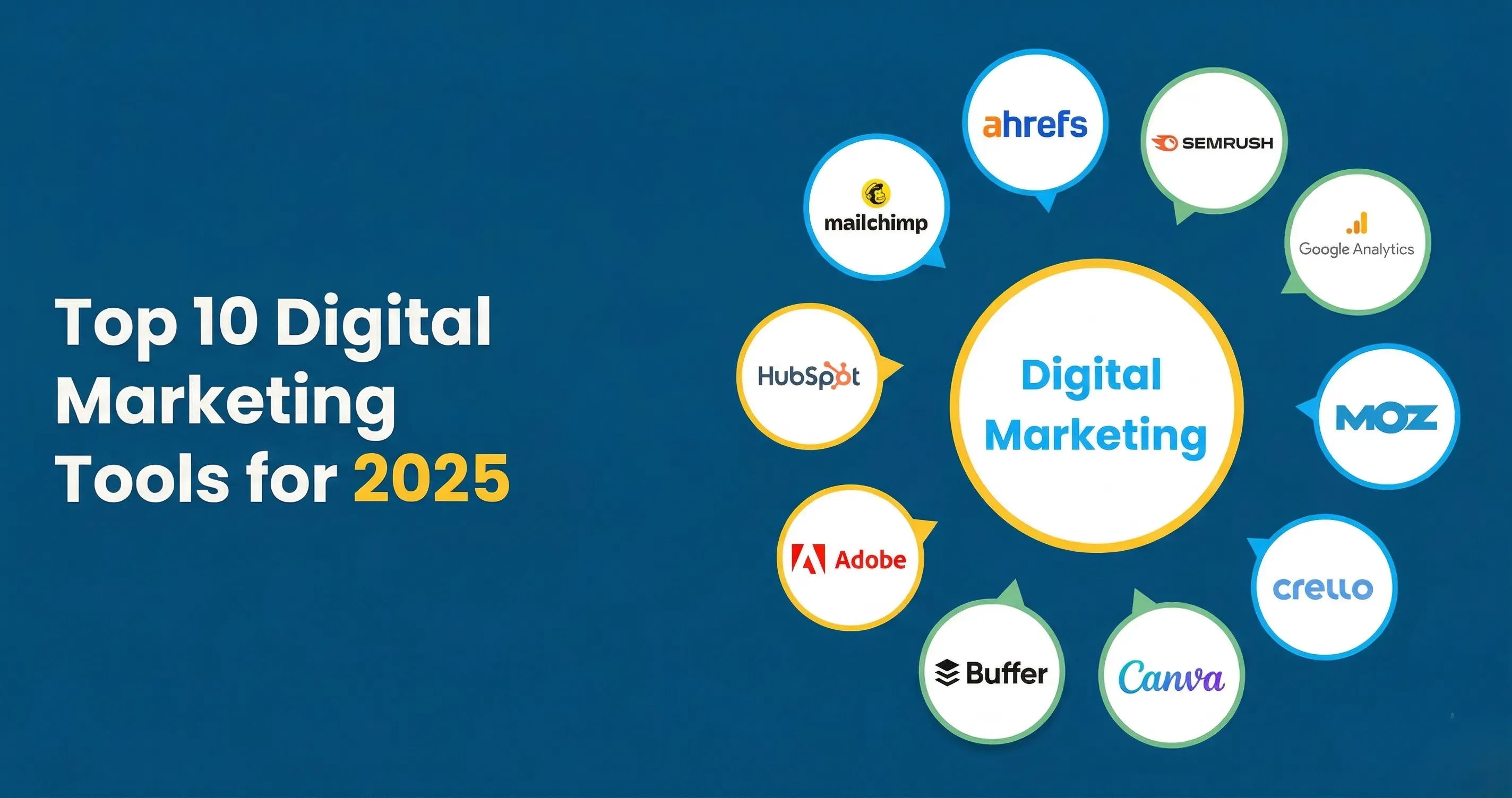
Top 10 Tech Tools Every Marketer Needs Right Now
Introduction
Marketing in 2026 is a contact sport. With over 15,000 solutions crowding the martech landscape, up from a mere 150 just fifteen years ago, choosing the right tools isn't a nice-to-have. It's the difference between scaling efficiently and drowning in complexity.
The best marketers today don't just use more tools. They use smarter tools. Artificial intelligence has shifted from being a flashy differentiator to an expected baseline in virtually every category. The new differentiator is how deeply AI is embedded into a platform's architecture, versus those that simply bolt it on top of a legacy system.
This guide cuts through the noise. Whether you're a solo marketer building your first stack, a CMO rationalizing an enterprise toolset, or a growth team looking to outpace the competition, these are the ten tools commanding attention right now and why they deserve a place in your workflow.
1. Jasper AI
Category: AI Content and Copywriting
Jasper has matured from a novelty content generator into one of the most complete AI writing platforms for marketing teams. Its Brand Voice feature is a game changer: train the model on your existing content and it produces copy that actually sounds like your company, not generic AI prose. From long-form blog articles and email sequences to paid ad copy and social captions, Jasper covers the full content lifecycle.
What makes it indispensable in 2026 is its deep integration with tools like Surfer SEO, WordPress, and Google Docs, allowing content workflows to stay connected end to end. Templates for over 50 use cases, including topic ideation, paragraph rewriting, and press releases, mean even junior marketers can produce senior-level outputs. If content volume is a bottleneck for your team, Jasper is where to start.
Best for: Content teams
2. HubSpot
Category: CRM and Revenue Operations
In 2026, the line between marketing automation and sales CRM has all but disappeared. HubSpot leads this convergence. It unifies marketing, sales, customer service, and revenue operations into a single platform, eliminating the data silos that historically caused a 10 to 13 percent loss in team resources when adtech and martech were disconnected.
HubSpot's AI-powered features now go far beyond basic email segmentation. Predictive lead scoring, smart content personalization, and AI-generated email subject lines are baked into every tier. For marketers who prioritize first-party data, critical in a world where third-party cookies are gone, HubSpot's robust contact database becomes a genuine competitive moat. Start mid-market teams here; it scales to enterprise without a platform switch.
Best for: Growing teams
3. Semrush
Category: SEO and Search Intelligence
Semrush has been a cornerstone of digital marketing for years, but its 2026 iteration is dramatically more powerful. Beyond keyword research and backlink audits, it now tracks AI-generated search results, a critical capability as Google's AI Overviews increasingly push traditional organic results down the page. If you're not monitoring your visibility in AI-generated answers, you're missing a growing share of search real estate.
The platform's Content Marketing Toolkit, competitive intelligence dashboards, and integrated App Center make it a hub rather than a point solution. Teams using Semrush's AI writing assistant alongside its SEO data can collapse the gap between research and execution, reducing content optimization time from three hours per page to under thirty minutes. For any marketer with an organic growth mandate, this is non-negotiable.
Best for: SEO-led growth teams
4. Google Analytics 4 and Looker Studio
Category: Analytics and Attribution
GA4 is the default analytics platform for over 12 million websites globally, and for good reason. Its event-based data model, cross-device tracking, and native integration with Google Ads make it the foundation of any analytics strategy. Paired with Looker Studio, formerly Google Data Studio, you get free real-time dashboards that pull from GA4, Google Ads, Meta, BigQuery, and dozens of other sources, replacing hours of manual reporting with automated, always-on visibility.
The combination covers roughly 80 percent of analytics needs without spending a penny. For marketers earlier in their data journey, this is the right starting point. The caveat: GA4 has a steeper learning curve than Universal Analytics. Invest time in learning its event schema and custom dimension setup. It pays dividends in audience quality and attribution clarity you cannot get from simpler tools.
Best for: All teams
5. Canva and Midjourney
Category: Visual Design and Creatives
The creative bottleneck is dead. Canva's 2026 platform brings AI-powered design suggestions, brand kit enforcement, and one-click resizing across every format a marketer needs, including social posts, email headers, presentations, and video thumbnails. Its Magic Studio suite lets non-designers produce polished, on-brand assets at a pace that would have required a full creative team just a few years ago.
For campaigns requiring truly distinctive imagery, pair Canva with Midjourney. The AI image generator has become a genuine production tool for visual marketers, generating concept art, hero images, and product lifestyle visuals that stand out in crowded feeds. The smart workflow: use Midjourney to generate ten variations quickly, have a human designer select and refine the best, then adapt it across formats in Canva. Speed without sacrificing quality.
Best for: Creative production teams
6. Klaviyo
Category: Email and SMS Marketing
With third-party cookies fully deprecated, owned channels have never been more valuable. Klaviyo is the platform that makes email and SMS a genuine revenue engine rather than a broadcast channel. Its deep e-commerce integrations, particularly with Shopify, allow behavioral triggers at a granularity most email platforms cannot match: abandoned cart sequences, post-purchase flows, browse abandonment, and win-back campaigns, all automated and personalized.
What separates Klaviyo from commodity email tools is its approach to first-party data. Every open, click, purchase, and page view feeds a unified customer profile that improves segmentation over time. AI-powered send-time optimization and predictive lifetime value scoring mean marketers can focus on strategy rather than guesswork. For DTC brands and e-commerce operators especially, Klaviyo is the closest thing to a guaranteed ROI in the stack.
Best for: E-commerce brands
7. Gumloop
Category: Workflow Automation and AI Agents
If Zapier is the workhorse of marketing automation, Gumloop is what happens when you give that workhorse a brain. Founded just a year ago, it has become one of the most talked-about tools among growth marketers. Think of it as a no-code workflow builder that natively integrates any large language model, including Claude, ChatGPT, and Grok, directly into your marketing processes, without needing API keys or developer support.
The use cases are expansive: automatically research prospects and draft personalized outreach, pull competitor intel and summarize it into a Slack digest, generate campaign briefs from analytics data, or build approval workflows for AI-generated content. Teams at Webflow, Instacart, and Shopify are already using it. In a landscape where autonomous AI agents are beginning to run entire campaigns with minimal human intervention, Gumloop is the infrastructure layer that makes it possible for non-technical marketers to participate.
Best for: Operations-savvy teams
8. Hotjar
Category: Conversion Rate Optimization
Quantitative analytics tells you what happened on your website. Hotjar tells you why. Its heatmaps, session recordings, and on-site feedback tools reveal the friction points in your funnel that numbers alone cannot explain, including users clicking elements that aren't links, form fields causing confusion, and critical CTAs sitting below the scroll fold on mobile.
For conversion rate optimization, Hotjar is one of the highest-ROI tools in any stack. Brands using it systematically typically identify five to ten actionable improvements per month. Common discoveries include mobile navigation failures and form abandonment triggers that, once fixed, lift conversion rates significantly. Pair it with an A/B testing platform and you have a complete feedback loop: observe the problem with Hotjar, hypothesize a fix, test it, and measure results in GA4. This is how modern growth teams iterate efficiently.
Best for: CRO and product marketing teams
9. Amplitude
Category: Behavioral Analytics
For product-led growth companies and SaaS businesses, Amplitude is the analytics layer that GA4 cannot provide. While GA4 excels at traffic and campaign attribution, Amplitude maps what users actually do inside your product, where they drop off, which features drive retention, which user segments are expanding, and which are at churn risk.
Its Northstar metric framework helps marketing and product teams align around the metrics that matter most, while the Pathfinder feature visualizes every possible route a user takes through your product. For B2B SaaS companies with complex, multi-stakeholder buying journeys, Amplitude provides insights that no simpler tool can match. Its experimentation platform connects analytics directly to A/B testing decisions, closing the loop between measurement and action. Start with the generous free tier, up to 10 million events per month, and upgrade as your data needs grow.
Best for: SaaS and product-led growth teams
10. Sprout Social
Category: Social Media Management
Social media management has grown far more complex than scheduling posts. The social tools category made up more than 23 percent of global martech revenue in 2025, a figure that reflects just how central social has become to the full marketing funnel. Sprout Social sits at the top of this category for enterprise and mid-market teams, combining scheduling, listening, analytics, and customer care in one platform.
Its AI features are particularly strong on the listening side: real-time sentiment analysis, trend detection, and competitive benchmarking across platforms give social teams the intelligence layer to move from reactive to proactive. The unified inbox alone, consolidating mentions, DMs, and comments from every platform, saves significant time for teams managing active communities. With voice search and audio marketing growing in 2026, Sprout's listening capabilities extend to brand monitoring beyond social, making it a genuine intelligence platform rather than just a scheduling tool.
Best for: Enterprise and agency teams
Final Thoughts: Build Your Stack Intentionally
No single tool transforms a marketing operation. What matters is how your stack fits together, whether data flows cleanly between platforms, whether your team actually uses what you've invested in, and whether each tool solves a specific, well-defined problem.
Start with your biggest constraint. If content is the bottleneck, lead with Jasper and Canva. If you're flying blind on analytics, GA4 and Hotjar come first. If retention is leaking, Klaviyo or Amplitude deserves attention before adding more acquisition tools.
In 2026, the marketers winning aren't using all fifteen thousand tools in the landscape. They're using the right ten, well-integrated, consistently measured, and ruthlessly focused on outcomes.