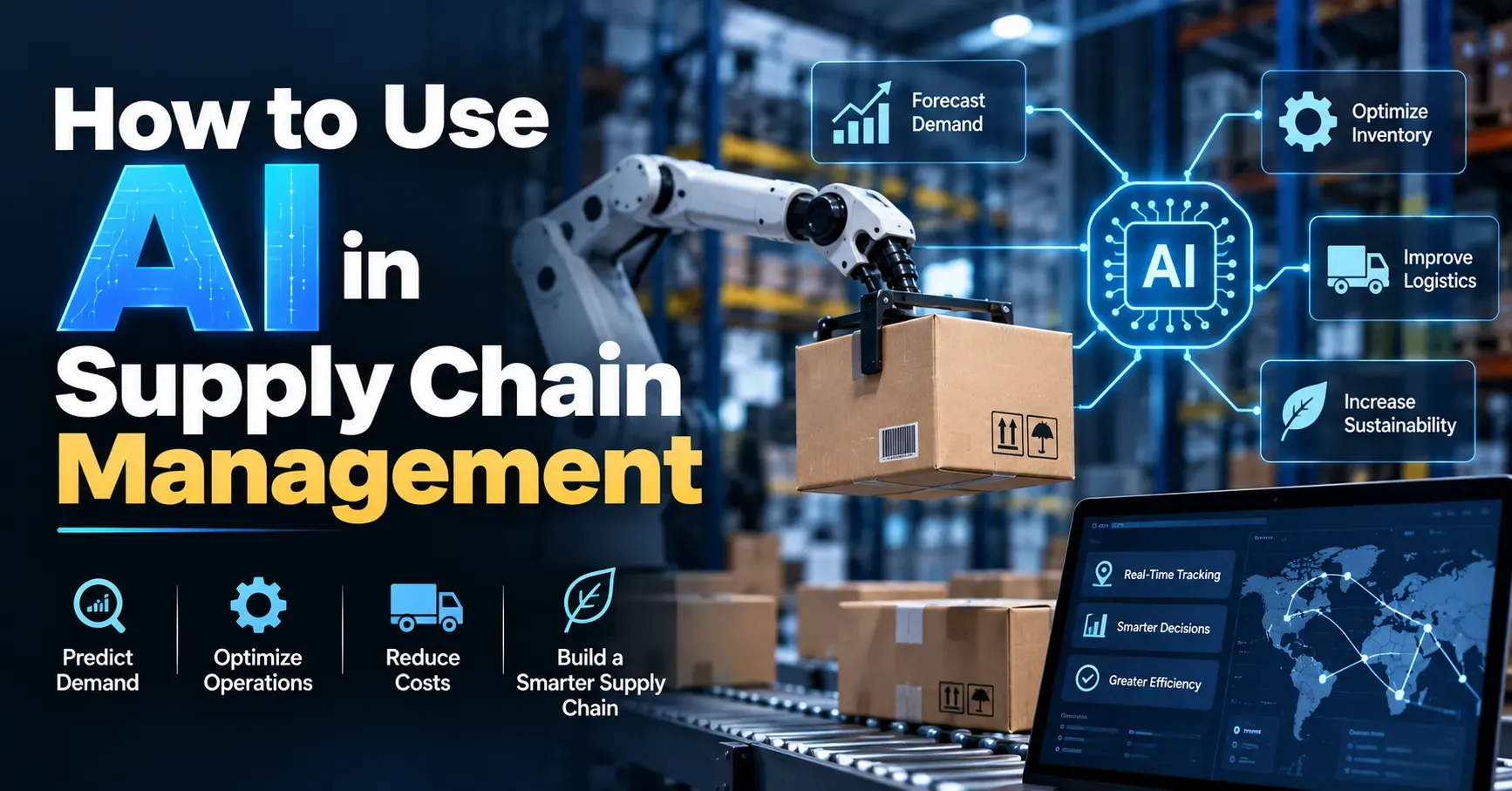
How to Use AI in Supply Chain Management
Supply chains today operate in a world of constant disruption, from shifting trade tariffs and geopolitical tension to unpredictable consumer demand and rising customer expectations. Traditional methods of planning and forecasting, built around spreadsheets and historical averages, simply cannot keep pace with this level of complexity. This is where artificial intelligence has stepped in. In 2026, AI is no longer an experimental add on for supply chains, it is becoming a core operating layer that touches forecasting, procurement, logistics, warehousing, and risk management. In this guide, we will break down exactly how to use AI in supply chain management, the key applications driving results, and how to approach implementation the right way.
Understanding AI in Supply Chain Management
AI in supply chain management refers to the use of machine learning, deep learning, natural language processing, and generative AI within the processes of designing, planning, executing, and optimizing a supply chain. Unlike traditional rule based enterprise resource planning systems, AI systems learn from historical data, real time sensor input, external market signals, and predictive models to support or automate decisions.
Rather than replacing supply chain management outright, AI is best understood as an intelligent layer added on top of existing systems. It analyzes far more data than a human team could manually process, spots patterns and risks earlier, and increasingly takes on repetitive tasks that used to consume hours of manual effort every week.
Why AI Matters for Supply Chains Right Now
The pressure on supply chains has never been higher. Global trade rules continue to shift, tariffs change with little warning, and customer expectations around speed and transparency keep climbing. Artificial intelligence is reshaping supply chain management by improving forecasting, inventory management, logistics planning, and operational visibility, giving organizations faster decision making and stronger responses to disruption.
There is also a workforce dimension driving urgency. A wave of retirements is pulling deep institutional knowledge out of supply chain organizations, and AI agents are increasingly used to handle data reconciliation, exception management, and routine decisions in a way that effectively preserves senior planners' expertise even as teams shrink. In short, AI is becoming less of a competitive advantage and more of a baseline requirement.
Key Applications of AI in Supply Chain Management
1. Demand Forecasting
Demand forecasting is one of the most mature and high value applications of AI in supply chains. Instead of relying purely on historical sales data, AI models can incorporate seasonality, weather patterns, market trends, and even social signals to predict what customers will want and when. This reduces both overstocking and stockouts, two of the most expensive problems in supply chain operations.
2. Inventory Optimization
AI powered systems continuously analyze sales velocity, lead times, and supplier reliability to recommend optimal stock levels across multiple locations. In 2026, this has evolved into real time, self correcting inventory decisions rather than static reorder points reviewed on a weekly or monthly basis.
3. Route and Logistics Planning
AI driven route optimization considers traffic, weather, fuel costs, and delivery windows simultaneously to identify the most efficient paths for shipments. In 2026, real value from AI in logistics often comes from targeted applications such as route optimization, ETA prediction, and resource planning rather than broad, unfocused automation efforts.
4. Predictive Risk and Disruption Management
One of the most valuable uses of AI is early disruption detection. AI powered tracking systems can sense disruptions weeks before they affect performance by analyzing external data sources such as import and export activity, news signals, and supplier behavior, giving teams a head start that manual monitoring simply cannot match.
5. Procurement Automation
AI agents are increasingly used to automate parts of the procurement cycle, from requesting quotes to ranking supplier responses. In some transportation and logistics companies, buyers now initiate agentic workflows where AI requests quotes from approved suppliers and ranks the responses autonomously, significantly reducing manual back and forth.
6. Warehouse Automation and Computer Vision
Computer vision and machine learning are increasingly used to power automation hardware inside warehouses, supporting tasks like quality inspection, inventory counting, and robotic picking. While machine learning already powers much of this automation, broader planning applications like full demand forecasting integration are still maturing in many warehouse environments.
7. Customs and Compliance Documentation
Cross border trade involves a significant amount of paperwork and regulatory complexity. AI is increasingly used to support customs processing by improving the accuracy of documentation and helping businesses navigate complex import and export regulations, which is especially valuable as global trade requirements continue to evolve.
8. Digital Twins and Simulation
Digital twins, virtual models of physical supply chain networks, are being connected to AI driven forecasts to simulate different scenarios before committing real resources. This allows planning teams to test the impact of a supplier delay or demand spike in a simulated environment before it happens in the real world.
How to Start Using AI in Your Supply Chain
Step 1: Assess Your Current State
Before adopting any AI tool, map out existing pain points and evaluate your organization's data maturity. AI systems are only as good as the data feeding them, so this step is critical rather than optional.
Step 2: Define High ROI Use Cases First
Rather than trying to transform everything at once, start with high return areas such as demand forecasting or risk management, where AI has a well established track record and clearer paths to measurable results.
Step 3: Select and Integrate the Right Platforms
Choose AI solutions with strong API support and compatibility with your existing enterprise resource planning systems. Poor integration is one of the most common reasons AI pilots stall before reaching production.
Step 4: Build Internal AI Capability
Train planning, procurement, and logistics teams on basic data literacy and change management. Even the most advanced AI tool will underperform if the people using it do not trust or understand its recommendations.
Step 5: Pilot in One Region or Function
Deploy new AI capabilities in a single region, warehouse, or product line first. This limits risk and gives your team a controlled environment to learn from before scaling further.
Step 6: Measure and Optimize Continuously
Track clear key performance indicators such as inventory turns, on time in full delivery rates, and cost savings, and use those results to refine your approach. AI adoption should be treated as an ongoing process rather than a one time project.
Benefits of Using AI in Supply Chain Management
Organizations that successfully deploy AI at scale across warehouses, transportation networks, and procurement functions are pulling ahead of competitors in profitability, cost efficiency, and operational resilience. Beyond raw efficiency, AI supports stronger visibility across the entire network, which in turn supports better resource allocation, faster response to disruption, and improved service performance at scale. It also frees skilled planners from repetitive manual work so they can focus on strategic decisions that genuinely require human judgment.
Challenges and Limitations of AI in Supply Chains
The Gap Between Marketing and Reality
Every major technology wave produces a period where marketing claims run ahead of operational reality, and AI in supply chain software is currently in exactly that period, making it genuinely difficult for leaders to separate production ready capabilities from features that still only work well in demos.
Data Quality and Governance
AI models are only as reliable as the data behind them. Many organizations are still strengthening fundamentals around planning, logistics, and risk management as a necessary precursor before they can meaningfully scale AI adoption.
Compliance and Human Verification
AI generated data alone is not accepted by major regulatory bodies and large manufacturers as a single source of truth for compliance. Legislation and industry standards still require supplier led data and human verified assurance to satisfy legal requirements, meaning AI should support human oversight rather than replace it entirely in regulated processes.
Formal Strategy Gaps
While nearly all supply chain companies plan to use AI within the next two years, fewer than one in four currently have a formal strategy for doing so, which means adoption without a clear plan can easily lead to wasted investment.
ROI Takes Time
Most organizations do not see satisfactory returns on AI investments for two to four years, so leaders should set realistic expectations rather than anticipating immediate transformation.
The Future of AI in Supply Chain Management
Looking ahead, agentic AI is expected to play a much larger role, automating routine communication and decision making across planning, procurement, and logistics functions. Some industry voices even suggest that AI could eventually resolve the majority of supply chain disruptions without direct human intervention, though this remains a longer term projection rather than a current reality. Organizations are also increasingly pairing physical proximity, such as shortening and localizing supply chains, with AI enabled insights to reduce risk and improve agility. The supply chain management AI market itself reflects this trajectory, with strong projected growth over the next several years as adoption matures from pilot projects into standard operating practice.
Conclusion
Artificial intelligence is reshaping how supply chains are planned, monitored, and executed, from demand forecasting and inventory optimization to procurement automation and disruption detection. The organizations seeing real results are the ones treating AI as a strategic capability built on strong data foundations, not a quick fix layered onto broken processes. By starting with high ROI use cases, piloting carefully, and keeping human oversight in place for compliance critical decisions, supply chain leaders can move from experimentation to measurable, lasting impact.
Frequently Asked Questions
What is AI in supply chain management?
AI in supply chain management refers to the use of machine learning, deep learning, and related technologies to support forecasting, planning, logistics, procurement, and risk management across a supply chain network.
Will AI replace supply chain managers?
No, AI is not expected to replace supply chain management roles entirely. It automates repetitive tasks and improves decision making, but compliance and strategic oversight still require human judgment.
What is the most common use of AI in supply chains today?
Demand forecasting, route optimization, and anomaly detection are among the most mature and widely adopted AI applications in supply chain management.
How long does it take to see ROI from AI in supply chain management?
Most organizations do not see satisfactory returns from AI investments for two to four years, so realistic timelines and phased implementation are important.
What is the biggest challenge in adopting AI for supply chains?
Data quality and governance are among the biggest challenges, since AI systems depend on clean, standardized data to produce reliable forecasts and recommendations.
Can AI fully automate supply chain compliance?
No, regulatory bodies currently require supplier led data and human verified assurance for compliance, meaning AI supports but does not replace human oversight in this area.