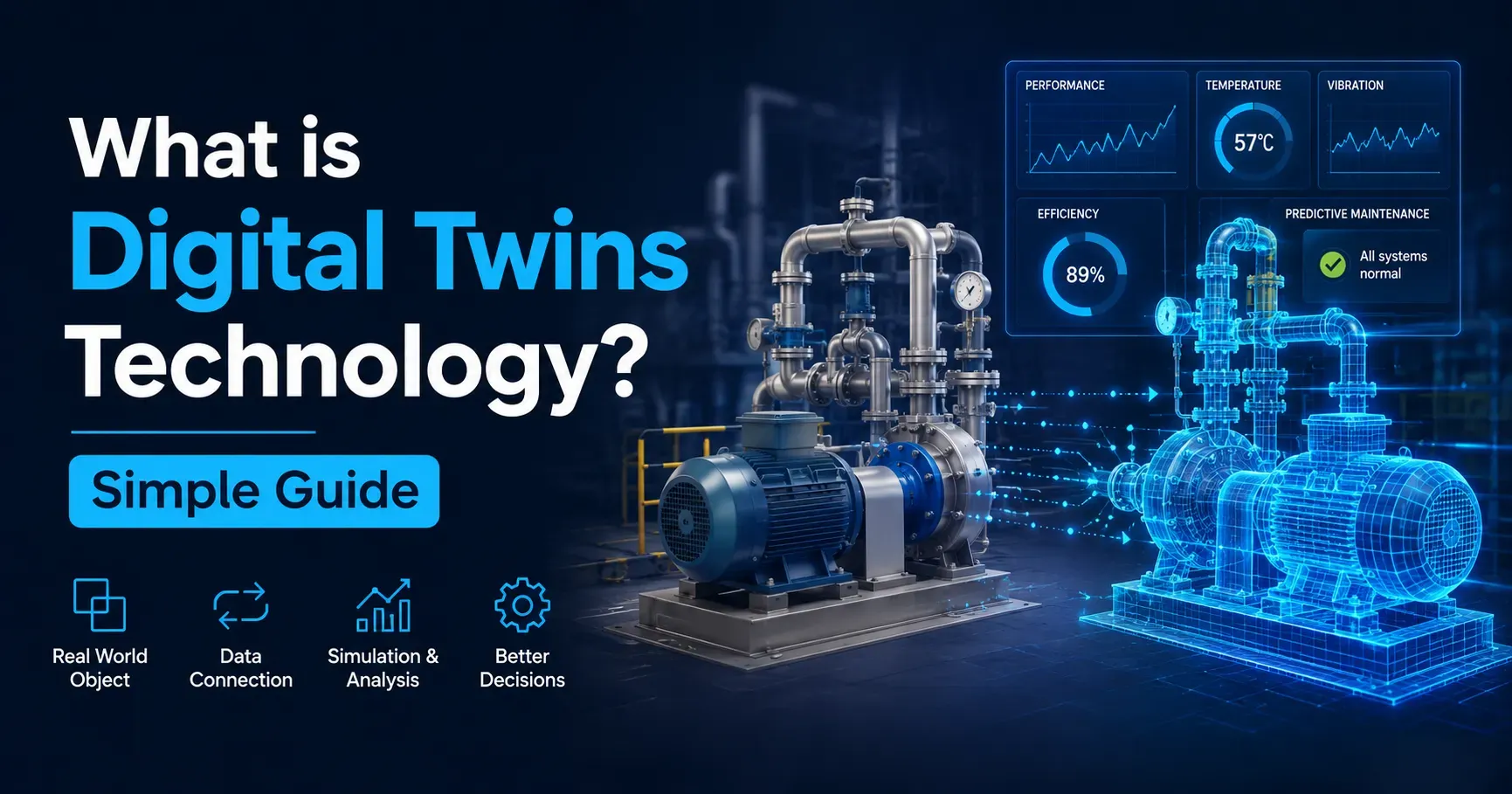
What is Digital Twins Technology Simple Guide
Digital twin technology sounds complicated, but the core idea behind it is actually fairly intuitive once explained clearly. Businesses across manufacturing, healthcare, urban planning and countless other industries are increasingly relying on digital twins to test ideas, predict problems and make better decisions before committing real time and money to a physical change. This guide breaks down digital twin technology in plain, simple language, explaining exactly what it is, how it works, where it is already being used and why it continues gaining momentum heading through 2026.
Digital Twins in One Simple Sentence
A digital twin is a virtual, continuously updated replica of a real world object, process or system, built using real data so it accurately mirrors how the actual physical version behaves and changes over time. Rather than a static model or one time simulation, a true digital twin stays connected to its real world counterpart, updating continuously as new data comes in, allowing it to reflect current conditions rather than a fixed snapshot from the past.
How Digital Twins Differ From Traditional Simulations
Traditional simulations typically model how something might behave under a fixed set of assumptions, run once, and then remain static unless manually rerun with new inputs. A digital twin works differently by maintaining a continuous, live connection to its physical counterpart, usually through sensors and real time data feeds.
This means a digital twin does not just predict how something might behave in theory, it actively reflects how the real object or system is behaving right now, updating automatically as conditions change rather than requiring someone to manually refresh the model each time new information becomes available.
How Digital Twin Technology Actually Works
Step One: Data Collection
The process begins with sensors, cameras or other data collection devices attached to or monitoring the physical object or system, continuously gathering information such as temperature, pressure, movement, usage patterns or countless other relevant measurements.
Step Two: Data Transmission
This collected data is transmitted, often in real time, to a digital platform where the virtual twin exists, creating a continuous flow of information connecting the physical original to its digital counterpart at all times.
Step Three: Virtual Model Updates
The digital twin uses this incoming data to continuously update its virtual representation, ensuring the digital version accurately reflects the current state, condition and behavior of the real world object or system it represents at any given moment.
Step Four: Analysis and Simulation
With an accurate, current virtual model in place, organizations can run simulations, test potential changes or predict future outcomes using the digital twin, without needing to experiment directly on the actual physical object or system, which could be costly, risky or simply impractical to attempt in the real world.
The Three Main Types of Digital Twins
Product Twins
These represent individual physical products, such as a specific piece of machinery, vehicle or piece of equipment, allowing manufacturers to monitor performance, predict maintenance needs and test design changes virtually before implementing them physically.
Process Twins
These model entire workflows or processes, such as a manufacturing production line or a hospital's patient flow, helping organizations identify bottlenecks, test process changes and optimize efficiency without disrupting actual real world operations during testing.
System Twins
These represent larger, more complex interconnected systems, such as an entire city's transportation network or a complete energy grid, allowing planners to model how multiple interacting components behave together as a unified whole rather than in isolation from one another.
Industries Using Digital Twin Technology
Manufacturing
Manufacturers use digital twins extensively to monitor equipment performance in real time, predict maintenance needs before a breakdown actually occurs, and test production line changes virtually before committing to expensive physical modifications on the actual factory floor.
Healthcare
Digital twins are increasingly used to model individual patient physiology, helping doctors test how a specific patient might respond to different treatment options, and to model hospital operations for improved resource planning and patient flow management.
Urban Planning and Smart Cities
City planners use digital twins to model traffic patterns, energy usage and infrastructure needs, allowing them to test the potential impact of new developments, policies or infrastructure changes before implementing them in the real physical city.
Automotive Industry
Vehicle manufacturers use digital twins throughout the design and testing process, simulating how a vehicle will perform under various conditions long before a physical prototype is ever built, significantly reducing both development time and cost involved.
Energy and Utilities
Energy companies use digital twins to monitor and optimize power plants, grids and renewable energy installations, helping predict equipment failures and optimize overall energy distribution and efficiency across complex, interconnected systems spanning wide geographic areas.
Aerospace
Aircraft manufacturers and operators use digital twins to monitor individual aircraft performance throughout their operational lifespan, helping predict maintenance needs and optimize both safety and operational efficiency across an entire fleet of vehicles.
The Role of the Internet of Things in Digital Twins
Digital twin technology depends heavily on the Internet of Things, the broad network of connected sensors and devices that continuously collect and transmit real world data. Without a steady stream of accurate, real time data feeding into the virtual model, a digital twin would essentially become just another static simulation rather than a genuinely live, continuously accurate representation.
As sensor technology continues becoming more affordable, accurate and widespread, digital twin technology becomes increasingly practical and valuable across an ever expanding range of applications and industries that previously could not justify the cost.
Key Benefits of Digital Twin Technology
Predictive Maintenance
By continuously monitoring real world performance data, digital twins can help predict when equipment is likely to fail before an actual breakdown occurs, allowing for proactive maintenance scheduling rather than reactive, costly emergency repairs that disrupt operations.
Risk Free Testing and Experimentation
Digital twins allow organizations to test changes, new processes or potential problems in a virtual environment first, avoiding the cost, risk or disruption that testing directly on physical systems or real world operations would otherwise involve.
Improved Decision Making
Having an accurate, real time virtual representation of a physical system provides decision makers with significantly better information than relying purely on periodic manual inspections or delayed, incomplete reporting that may already be outdated.
Cost and Time Savings
Testing and refining designs or processes virtually before physical implementation can significantly reduce both development time and the costs associated with physical prototyping, trial and error or unexpected operational problems discovered too late in the process.
Challenges and Limitations of Digital Twin Technology
Building an accurate, genuinely useful digital twin requires significant upfront investment in sensors, data infrastructure and specialized software, which can represent a meaningful barrier for smaller organizations with more limited resources available to them.
Maintaining data accuracy and security throughout the continuous data collection and transmission process is also critical, since a digital twin built on inaccurate or compromised data becomes unreliable or even actively misleading rather than genuinely useful for decision making. Additionally, building digital twins for highly complex systems with countless interacting variables remains technically challenging, and the resulting models, while valuable, are never a perfect, complete representation of reality in every possible respect.
How Digital Twins Are Evolving With AI
Artificial intelligence is increasingly being integrated with digital twin technology, allowing these virtual models to not just represent current conditions accurately, but to actively predict future outcomes, identify subtle patterns humans might miss, and even recommend specific optimizations automatically based on the data being continuously collected.
This combination of digital twins and AI is pushing the technology from a purely reactive monitoring tool toward a genuinely proactive, intelligent system capable of meaningfully improving decision making across increasingly complex real world applications and industries.
Getting Started With Digital Twin Concepts
For organizations exploring digital twin technology for the first time, starting with a single, well defined, relatively contained use case, such as monitoring one specific piece of critical equipment, tends to be far more manageable and genuinely valuable than attempting to build an overly ambitious, complex system spanning an entire operation right from the start.
Building organizational familiarity and demonstrating clear value with a smaller, focused digital twin implementation often provides the foundation and confidence needed to expand into larger, more complex applications over time as expertise and infrastructure genuinely mature.
The Future of Digital Twin Technology
As sensor costs continue declining and data infrastructure becomes increasingly sophisticated and accessible, digital twin technology is expected to expand well beyond its current concentration in manufacturing, automotive and aerospace industries into a much broader range of everyday applications.
Growing integration with artificial intelligence, combined with continued advances in real time data processing capabilities, suggests digital twins will become an increasingly standard, accessible tool for understanding and optimizing complex real world systems across nearly every industry, rather than remaining a specialized, niche technology limited to large enterprises alone.
Final Thoughts
Digital twin technology, at its core, is a way of creating a continuously updated virtual replica of something real, allowing organizations to monitor, test and optimize physical systems without the cost, risk or disruption of experimenting directly on the real thing itself. From manufacturing equipment to entire cities, digital twins are already reshaping how countless industries approach planning, maintenance and decision making. Understanding the fundamentals covered in this guide, how digital twins work, their main types and where they are already being used, provides a solid, practical foundation for recognizing this technology's growing role across an increasingly connected, data driven world throughout 2026 and beyond.