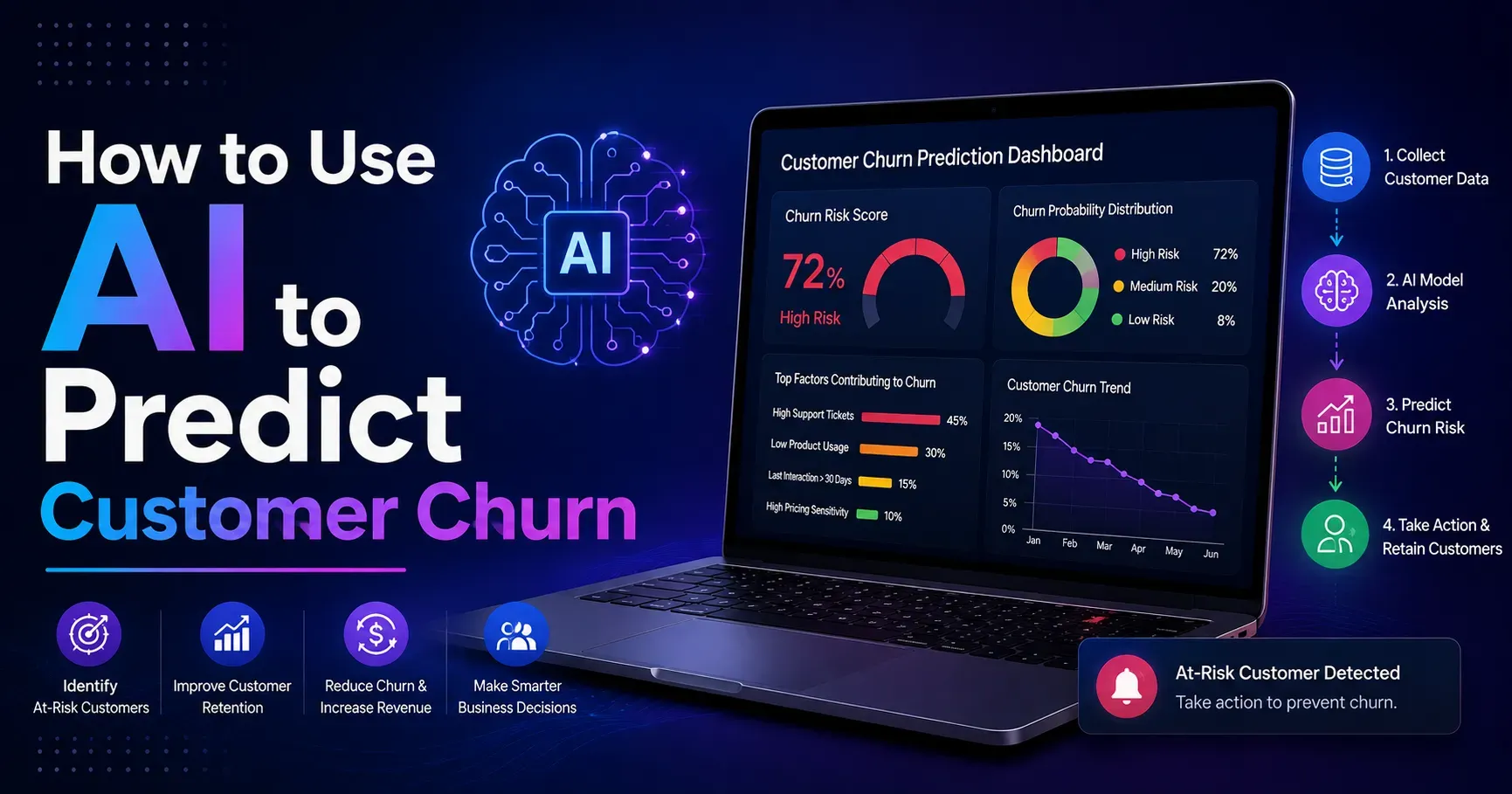
How to Use AI to Predict Customer Churn
Losing a customer rarely happens without warning. In most cases, subtle signals appear well before someone actually cancels, reduces usage or stops purchasing, whether that is declining engagement, slower response times to communication, or a shift in usage patterns. The challenge has always been spotting these signals early enough to act, which is exactly where AI powered churn prediction has become genuinely valuable in 2026. This guide explains how to use AI to predict customer churn, covering the data you need, how prediction models actually work, and how to turn early warning signals into meaningful retention action before a customer is truly gone.
Why Predicting Churn Matters So Much
Acquiring a new customer typically costs significantly more than retaining an existing one, making churn prevention one of the highest leverage areas for improving overall business profitability. Beyond the direct cost of replacing lost revenue, churn also represents a missed opportunity, since existing customers who remain engaged often have significant potential for growth through upsells, renewals or referrals that a departed customer can never provide.
Predicting churn before it happens allows businesses to intervene proactively, whether through targeted outreach, addressing a specific pain point or offering a relevant incentive, rather than only learning about dissatisfaction after a customer has already decided to leave for good.
How AI Powered Churn Prediction Actually Works
AI churn prediction models analyze historical data from customers who have already churned, identifying patterns and characteristics that commonly preceded their departure from the business. The model then applies these learned patterns to your current customer base, calculating a churn risk score for each individual customer based on how closely their behavior resembles patterns previously associated with churn in the past.
This approach allows businesses to move beyond simple, static rules, such as flagging any customer who has not logged in for thirty days, toward a more nuanced, data driven understanding of the many subtle factors that genuinely predict departure for their specific business and customer base.
Key Data Signals Used in Churn Prediction
Engagement and Usage Patterns
Declining frequency of product usage, reduced feature adoption, or shorter session durations often serve as some of the earliest and most reliable indicators that a customer's satisfaction or perceived value is beginning to decline over time.
Customer Support Interaction History
An increase in support tickets, particularly those involving unresolved issues or repeated complaints about the same problem, frequently correlates strongly with elevated churn risk in many businesses across different industries.
Billing and Payment Behavior
Late payments, failed transactions or downgrades to a lower service tier often signal financial pressure or declining perceived value, both of which correlate meaningfully with increased churn likelihood down the line.
Communication and Response Patterns
Declining email open rates, reduced responsiveness to outreach, or disengagement from a customer community or newsletter can indicate a broader weakening of the overall customer relationship worth investigating further.
Customer Satisfaction and Feedback Data
Survey responses, review sentiment or direct feedback, particularly when combined with behavioral data, can meaningfully improve churn prediction accuracy by capturing genuine customer sentiment alongside observed behavior patterns.
Building an AI Churn Prediction Model
Gather and Consolidate Relevant Data
Bring together data from across your various systems, including product usage, customer support, billing and communication platforms, since churn prediction accuracy improves significantly with a more complete, holistic view of each customer's relationship with your business.
Define What Churn Means for Your Business
Clearly define the specific event that constitutes churn for your business, whether that is a subscription cancellation, an extended period of inactivity, or a significant downgrade, since this definition shapes how your model is trained and evaluated going forward.
Train the Model on Historical Data
Use historical data from customers who have already churned, alongside data from customers who have remained, allowing the AI model to learn the genuine patterns that distinguish these two groups within your specific business context and industry.
Validate and Test Model Accuracy
Test the model's predictions against a separate set of historical data it was not trained on, confirming it genuinely identifies at risk customers accurately before relying on it for real world retention decisions and resource allocation across your team.
Turning Churn Predictions Into Retention Action
Segment Customers by Risk Level
Rather than treating every flagged customer identically, segment your at risk customers by both the severity of their predicted churn risk and their overall value to the business, prioritizing intervention efforts accordingly based on where you can have the most impact.
Design Targeted Intervention Strategies
Develop specific outreach or intervention approaches tailored to the particular risk signals a customer is showing, since a customer struggling with product adoption needs a genuinely different response than one showing signs of price sensitivity or billing issues.
Automate Timely Outreach
Where appropriate, automate proactive outreach triggered by churn risk scores, ensuring at risk customers receive timely attention without requiring manual monitoring of every individual account by your team members.
Involve Human Judgment for High Value Accounts
For particularly high value or complex customer relationships, use AI predictions as a starting signal for human account managers to investigate and address personally, rather than relying entirely on automated intervention for your most important customers.
Common Use Cases Across Different Business Models
Subscription and SaaS Businesses
Churn prediction is particularly valuable for subscription businesses, where usage data, feature adoption and billing patterns provide rich signal for identifying customers at risk of cancellation before their next renewal date arrives.
E Commerce and Retail
For businesses without a formal subscription model, churn prediction can identify customers whose purchasing frequency or order value is declining, signaling reduced engagement even without a formal cancellation event to track directly.
Financial Services
Banks and financial service providers use churn prediction to identify customers at risk of moving their accounts elsewhere, often based on declining engagement, reduced product usage or increased customer service friction over time.
Telecommunications
Telecom providers have long used churn prediction to identify customers likely to switch providers, incorporating signals such as call quality complaints, billing disputes and competitive offer awareness into their models to stay ahead.
Best Practices for Effective Churn Prediction
Continuously Update and Retrain Models
Customer behavior and market conditions evolve over time, so regularly retraining your churn prediction model with fresh data helps ensure it remains accurate rather than becoming outdated based on historical patterns that no longer reflect current reality and customer behavior.
Balance Precision With Actionability
A highly accurate model that flags too many customers as at risk can overwhelm your team's capacity to respond meaningfully, so calibrate your model and thresholds to produce a genuinely actionable volume of flagged accounts your team can handle.
Combine Quantitative and Qualitative Signals
While behavioral data provides strong predictive signal, combining it with genuine qualitative feedback, such as survey responses or support interaction notes, often produces a more complete, accurate picture of true churn risk facing each customer.
Close the Feedback Loop
Track the outcomes of your retention interventions, feeding this information back into your model and strategy refinement process to continuously improve both prediction accuracy and intervention effectiveness over time as you learn what works.
Common Mistakes When Implementing Churn Prediction
Many businesses build a churn prediction model but fail to establish clear, actionable processes for responding to flagged customers, resulting in a technically accurate model that produces limited genuine business impact despite the investment made. Avoid relying on a single data source when richer, more holistic data is available, since limited data inputs tend to produce less accurate, less nuanced churn predictions overall.
Do not treat model outputs as infallible, since even well built models can misclassify customers, making some level of human judgment and oversight important, particularly for high value accounts that deserve careful attention. Finally, avoid neglecting model maintenance over time, since customer behavior patterns and business conditions inevitably shift, requiring periodic retraining to maintain genuine prediction accuracy going forward.
Measuring the Success of Your Churn Prediction Program
Track your overall churn rate over time, comparing periods before and after implementing AI powered prediction and intervention to assess genuine impact on customer retention across your business. Monitor the effectiveness of specific intervention strategies, identifying which approaches genuinely succeed in retaining at risk customers versus those that show limited impact despite implementation effort and resources.
Calculate the return on investment of your churn prediction and retention program, weighing the cost of intervention efforts against the value of customers genuinely retained as a direct result of the program's insights and actions taken.
A Simple Framework for Getting Started
Begin by consolidating relevant customer data across your various business systems into a unified, accessible dataset that your team can work with. Clearly define what churn means for your specific business model before building anything. Build and validate an initial churn prediction model using historical data from customers who have already churned and those who have remained.
Establish clear, actionable processes for responding to flagged at risk customers, segmented appropriately by risk level and customer value. Continuously monitor model accuracy and intervention effectiveness, refining your approach based on genuine outcomes observed over time as the program matures.
Final Thoughts
AI powered churn prediction gives businesses a genuine opportunity to shift from reactive customer loss to proactive, informed retention efforts, identifying at risk customers early enough to meaningfully intervene before they actually leave. By building models on comprehensive, relevant data, establishing clear intervention processes, and continuously refining both prediction accuracy and retention strategy based on real outcomes, businesses can meaningfully reduce churn and build stronger, more sustainable customer relationships throughout 2026 and beyond.