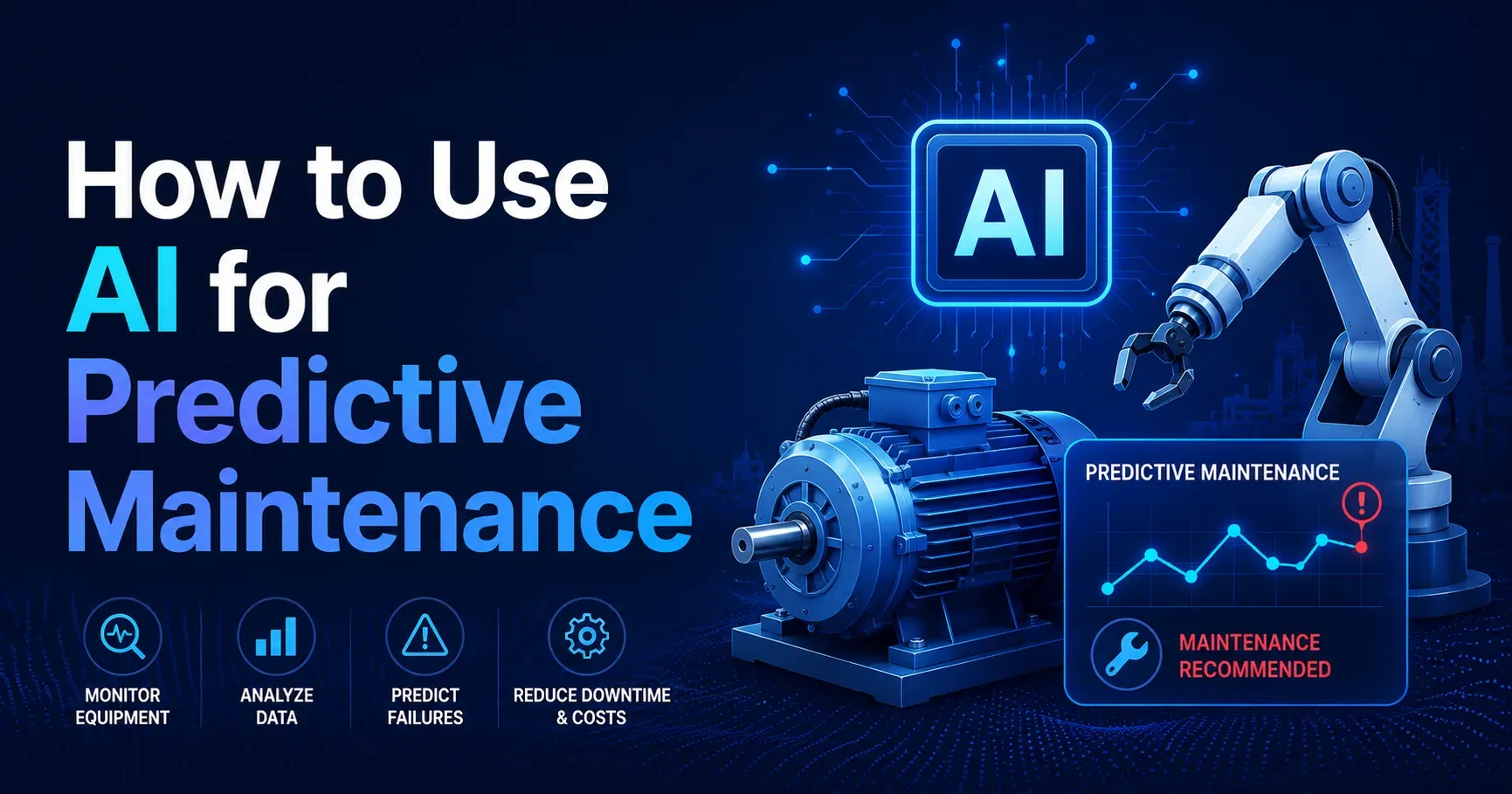
How to Use AI for Predictive Maintenance
Unplanned equipment downtime remains one of the most expensive problems facing manufacturers, energy producers, and asset heavy industries around the world. Traditional maintenance approaches, whether reactive or based on fixed schedules, often waste resources or fail to catch failures before they happen. Artificial intelligence has changed this equation entirely. By analyzing sensor data, historical patterns, and environmental conditions in real time, AI powered predictive maintenance can forecast equipment failures before they occur, saving companies significant time and money. This guide explains what predictive maintenance is, how AI fits into the picture, and the practical steps needed to implement it successfully.
What Is Predictive Maintenance
Predictive maintenance is a strategy that uses data and analysis to predict when equipment is likely to fail, allowing maintenance teams to intervene at exactly the right moment. Unlike reactive maintenance, which only responds after a breakdown, or preventive maintenance, which follows a fixed schedule regardless of actual equipment condition, predictive maintenance relies on real time monitoring and forecasting to determine the true condition of an asset.
This approach reduces unnecessary maintenance work, avoids sudden failures, and extends the useful life of expensive machinery by addressing issues only when they are actually needed.
Why AI Is a Natural Fit for Predictive Maintenance
Traditional predictive maintenance relied heavily on manual analysis and simple threshold based alerts. Artificial intelligence dramatically improves this process by identifying complex, non obvious patterns across massive volumes of sensor data that would be impossible for humans to detect manually.
Pattern Recognition at Scale
Machine learning models can process thousands of data points per second across multiple pieces of equipment simultaneously, identifying subtle warning signs long before a human operator would notice anything unusual.
Continuous Learning and Improvement
Unlike static rule based systems, AI models improve over time as they are exposed to more data, becoming increasingly accurate at distinguishing between normal variation and genuine early signs of failure.
Multivariate Analysis
Equipment failures are often caused by a combination of factors rather than a single variable. AI models can analyze temperature, vibration, pressure, humidity, and usage patterns together to produce far more accurate failure predictions than any single metric could provide alone.
Key Components of an AI Powered Predictive Maintenance System
Sensors and Data Collection
The foundation of any predictive maintenance system is reliable data. This typically comes from vibration sensors, temperature sensors, acoustic sensors, current sensors, and other Internet of Things devices installed directly on critical equipment.
Data Infrastructure
Collected sensor data needs to be transmitted, stored, and organized in a way that machine learning models can access efficiently. This often involves edge computing devices for initial processing combined with cloud based storage and analytics platforms.
Machine Learning Models
At the core of the system are the models themselves, trained to recognize the signatures that precede different types of equipment failure. These models range from relatively simple statistical approaches to advanced deep learning architectures depending on the complexity of the equipment being monitored.
Alerting and Decision Support Systems
Once a model identifies a likely upcoming failure, the system needs to communicate this clearly to maintenance teams, often including a confidence level, an estimated time to failure, and specific recommended actions.
Step by Step Guide to Implementing AI for Predictive Maintenance
Step 1: Identify High Value Equipment to Monitor First
Rather than attempting to instrument every piece of equipment at once, start with assets that have the highest cost of failure, the most frequent breakdowns, or the greatest safety implications. This focused approach delivers faster returns and builds internal confidence in the system.
Step 2: Install the Right Sensors
Work with equipment specialists to determine which sensor types will capture the most relevant data for each asset. Vibration and temperature sensors are common starting points for rotating machinery, while acoustic and current sensors may be more relevant for electrical systems.
Step 3: Establish a Reliable Data Pipeline
Ensure sensor data flows consistently and reliably into your storage and analytics systems. Any gaps or inconsistencies in data collection can significantly undermine the accuracy of downstream predictions.
Step 4: Gather Historical Failure Data
AI models learn from examples, so historical records of past failures, maintenance logs, and equipment conditions leading up to breakdowns are essential training material. Where historical data is limited, synthetic data generation and simulation can help bridge the gap initially.
Step 5: Train and Validate Predictive Models
Work with data scientists or specialized predictive maintenance vendors to train models on your collected data. Validate model accuracy carefully using historical failure events that were not included in the original training data.
Step 6: Integrate Predictions into Maintenance Workflows
Predictions are only valuable if they lead to action. Integrate AI generated alerts directly into your existing maintenance management systems so that teams can schedule interventions efficiently based on model recommendations.
Step 7: Monitor Model Performance Continuously
Track how accurately your models predict actual failures over time. False positives and missed failures should be analyzed and fed back into the training process to continuously improve accuracy.
Step 8: Scale Gradually Across the Organization
Once initial implementations prove successful, expand the program to additional equipment types and facilities, applying lessons learned from earlier deployments to accelerate future rollouts.
Real World Applications Across Industries
Manufacturing
AI powered predictive maintenance helps manufacturers avoid costly production line stoppages by identifying early signs of motor bearing wear, belt degradation, or hydraulic system issues before they cause a full shutdown.
Energy and Utilities
Power generation companies use predictive maintenance to monitor turbines, transformers, and grid infrastructure, reducing the risk of unexpected outages that can affect entire regions.
Transportation and Fleet Management
Airlines, railways, and logistics companies apply predictive maintenance to engines, braking systems, and other critical vehicle components, improving safety while reducing unplanned repair costs.
Oil and Gas
Predictive maintenance in this sector often focuses on pipeline integrity, pump performance, and compressor health, where failures can carry significant safety and environmental consequences.
Benefits of AI Driven Predictive Maintenance
- Reduced unplanned downtime and associated production losses
- Lower overall maintenance costs by avoiding unnecessary scheduled interventions
- Extended equipment lifespan through timely, condition based servicing
- Improved workplace safety by catching dangerous failure conditions early
- Better resource planning through more accurate maintenance scheduling
- Data driven insights that support broader operational decision making
Challenges to Consider Before Implementation
Data Quality and Availability
Many organizations underestimate how much clean, well labeled historical data is needed to train effective predictive models. Poor quality data leads directly to poor quality predictions.
Integration with Legacy Systems
Older equipment may lack the sensors or connectivity needed to feed real time data into modern analytics platforms, sometimes requiring additional investment in retrofitting.
Organizational Change Management
Maintenance teams accustomed to fixed schedules or reactive approaches may need training and support to trust and adopt AI generated recommendations effectively.
Upfront Investment Costs
Sensors, data infrastructure, and model development all require initial capital, though these costs are typically recovered through reduced downtime and maintenance expenses over time.
Best Practices for Long Term Success
- Start small with a clearly defined pilot project before scaling company wide
- Involve maintenance staff early to build trust and gather valuable domain knowledge
- Choose flexible platforms that can adapt as equipment and sensor technology evolves
- Continuously retrain models as new failure data becomes available
- Set clear key performance indicators to measure return on investment accurately
The Future of AI in Predictive Maintenance
As sensor costs continue to decline and machine learning techniques become more sophisticated, predictive maintenance is expected to become standard practice across nearly every asset heavy industry. Emerging trends include the use of digital twins to simulate equipment behavior, edge based AI models that make real time decisions directly on equipment, and increasingly autonomous maintenance systems that can schedule and even initiate certain repairs with minimal human intervention.
Conclusion
AI powered predictive maintenance represents a fundamental shift from reactive firefighting to proactive, data driven asset management. By combining reliable sensor data, robust data infrastructure, and well trained machine learning models, organizations can significantly reduce downtime, cut maintenance costs, and improve overall equipment reliability. Success depends on starting with focused pilot projects, maintaining strong data quality, and continuously refining models based on real world outcomes. Companies that invest in building these capabilities today will be well positioned to operate more efficiently and competitively in the years ahead.
Frequently Asked Questions
What is the difference between predictive and preventive maintenance
Preventive maintenance follows a fixed schedule regardless of actual equipment condition, while predictive maintenance uses real time data and AI models to determine the true condition of equipment and predict when maintenance is actually needed.
What types of sensors are used in AI predictive maintenance
Common sensors include vibration sensors, temperature sensors, acoustic sensors, current sensors, and pressure sensors, chosen based on the type of equipment being monitored.
How much historical data is needed to train a predictive maintenance model
The amount varies by equipment type and failure complexity, but models generally require historical records covering multiple failure events along with corresponding sensor readings leading up to those failures.
Is AI predictive maintenance only suitable for large enterprises
No. While large enterprises often have more resources for initial investment, smaller organizations can also benefit by starting with a small number of critical assets and scaling gradually as value is demonstrated.
How accurate are AI predictive maintenance models
Accuracy varies depending on data quality, equipment type, and model sophistication, but well trained models can achieve high accuracy in forecasting failures well in advance, significantly outperforming traditional threshold based monitoring methods.