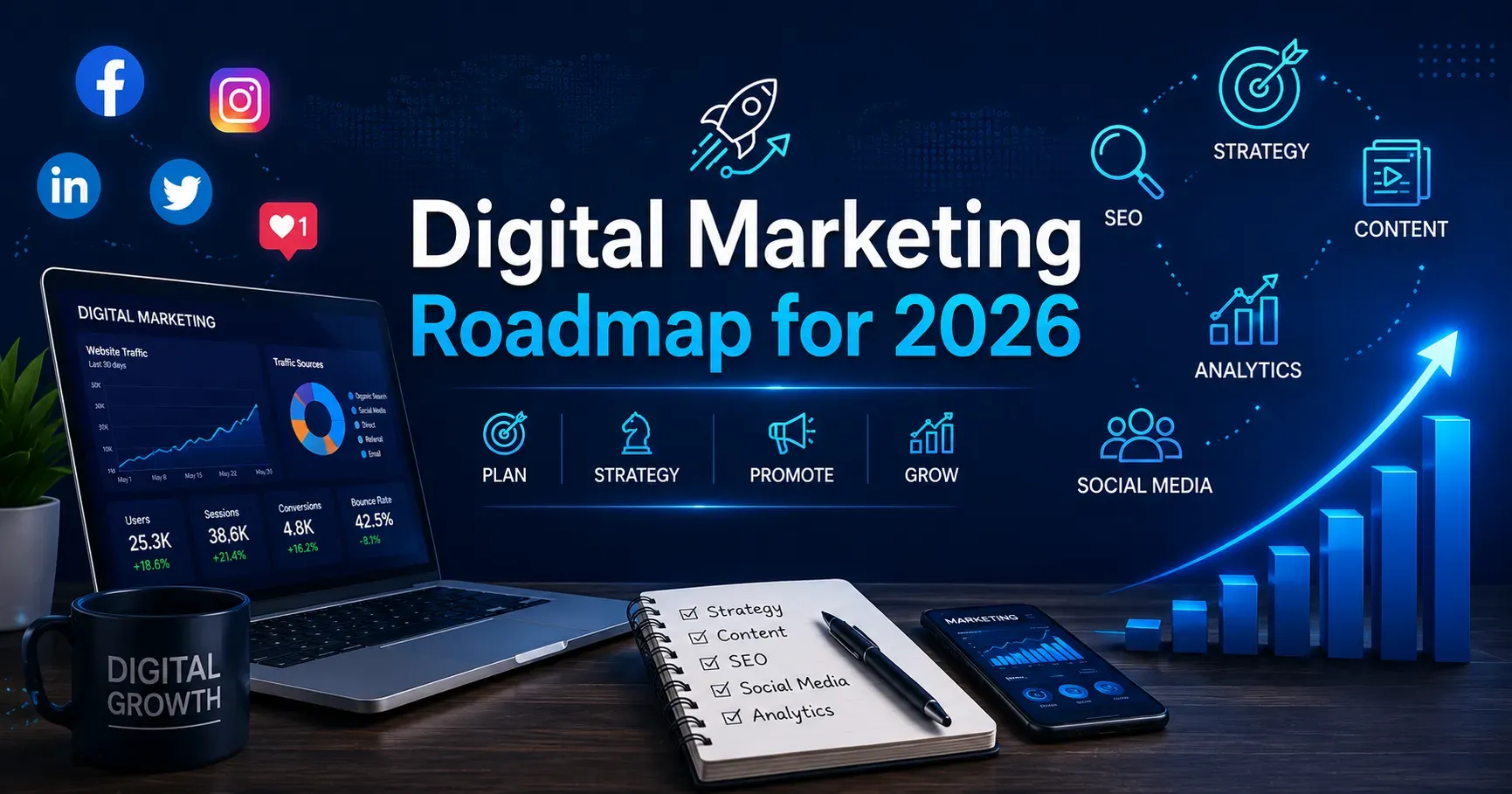
Complete Digital Marketing Roadmap for 2026: The Step-by-Step Guide
Introduction
Most people who start learning digital marketing make the same mistake. They pick a random YouTube tutorial on paid ads, spend three weeks on it, then jump to SEO because someone said it was more important, then abandon that for a content writing course. A month in, they know a little about a lot and can actually do none of it.
Digital marketing in 2026 is not a collection of isolated skills. It is a system. Every channel works better when it connects to every other channel. SEO drives organic traffic that feeds your email list. Your email list amplifies your content launches. Your content builds the topical authority that improves your ad quality scores. Your ad data reveals what messaging resonates organically. The marketer who understands how these pieces connect builds a system that compounds. The one who treats them as separate disciplines builds a stack of tools that never quite works.
A successful roadmap for digital marketing in 2026 goes beyond traditional SEO. To stay competitive, you need to understand how search engines, AI platforms, paid advertising, and social media work together.
This roadmap covers every critical component in the sequence that makes learning most efficient: foundation, then organic, then paid, then AI integration, then measurement, then iteration. Follow this order and each component builds on the one before it.
Phase 1: Build the Foundation Before Touching Any Tool
Every digital marketing failure traces back to a skipped foundation. Marketers launch paid campaigns without conversion tracking. They publish content without knowing who they are writing for. They build social media followings without a strategy to convert them. The foundation work prevents all of these.
Define Goals That Connect to Business Outcomes
Your goals shape your entire marketing strategy. Before logging into any marketing platform, define what success means in business terms.
Revenue targets: what does digital marketing need to generate in the next 12 months? Lead targets: how many qualified leads does the sales team need per month? Traffic targets: what organic search volume represents meaningful progress toward revenue? Customer acquisition cost: what is the maximum you can pay to acquire a customer and remain profitable?
Measurable goals use actual numbers rather than directions. More traffic is not a goal. Ten thousand monthly organic visitors by Q4 is a goal. The specificity creates accountability and makes the measurement phase at the end of the roadmap actually useful.
Know Your Audience Better Than They Know Themselves
Define your target audience with precision before creating a single piece of content or running a single ad. Who is your ideal customer? What problems do they face? What language do they use to describe those problems? What platforms do they use to find information? What content formats do they prefer?
The most important audience research method is studying the exact words customers use in reviews, community discussions, and support requests. Those words become your keyword targets, your ad copy, your content angles, and your email subject lines.
Customer personas make this practical. Build one to three specific persona profiles with role, company size, primary challenge, content preferences, and buying behavior. Every subsequent decision in this roadmap runs through these personas as a filter.
Build Your Digital Foundation
A digital marketing foundation consists of three assets that every other tactic depends on.
Your website is your primary conversion asset. Every marketing channel eventually drives traffic here, and your website's speed, clarity, and conversion optimization determine what percentage of that traffic becomes business. Ensure your website loads in under three seconds, communicates your value proposition within five seconds of landing, has clear calls to action on every key page, and works flawlessly on mobile devices since over 70 percent of traffic is now mobile.
Your analytics infrastructure must be installed and verified before you run your first ad or publish your first blog post. Google Analytics 4 and Google Search Console are the minimum baseline. Both are free and both are non-negotiable for measuring whether any subsequent tactic is working.
Your customer relationship management system stores the leads and customers that every marketing activity generates. Without a CRM, marketing results disappear rather than compound over time.
Phase 2: Master Organic Search and Content Strategy
Organic search is the foundation of sustainable digital marketing because it produces compounding returns. Content published today generates traffic for years. The investment in SEO compounds rather than resetting each time you stop paying.
Understanding the New Search Landscape in 2026
A successful roadmap for digital marketing in 2026 focuses on five key areas: SEO for ranking on search engines, AEO for appearing in AI-generated answers, GEO for visibility across AI search platforms, SMO for social media growth, and SEM for paid traffic.
Traditional SEO remains essential. Google still processes over 8.5 billion queries per day and organic rankings still drive the majority of business discovery for most industries. But the search landscape has expanded beyond Google.
AI Overviews now appear in roughly 20 to 25 percent of searches. ChatGPT processes over 800 million weekly users. Perplexity is the fastest-growing research platform. These AI platforms are now active discovery surfaces that require their own optimization approach.
The marketers winning in 2026 address all three surfaces simultaneously. Their content ranks on Google, appears in AI Overviews, and gets cited in ChatGPT and Perplexity answers. Optimizing for only one surface leaves significant discovery potential on the table.
Keyword Research as the Foundation of Content Strategy
Keyword research is the starting point for content because it tells you what your audience is actually searching for, in the exact language they use, at the volume that makes targeting them worthwhile.
Use a combination of Google Search Console for your current performance data, Semrush or Ahrefs for competitive keyword analysis, and Google's autocomplete for discovering how people phrase questions.
Prioritize keywords based on three criteria. Business relevance measures how closely the keyword's intent connects to your product or service. Search volume confirms people are actually looking for this information. Keyword difficulty assesses whether your current domain authority gives you a realistic path to the first page.
Long-tail keywords, those three to five word phrases with specific intent, are the highest-priority starting point for most sites. They are less competitive, more targeted, and convert at higher rates because they represent more specific intent than broad head terms.
Build Content Clusters for Topical Authority
Publishing random articles targeting isolated keywords is the old SEO. The approach that wins in 2026 is topical authority: building a comprehensive network of related content that signals to Google your site is a genuine expert on a topic.
A topical cluster consists of a pillar page covering a broad topic comprehensively and cluster pages covering specific subtopics in depth, all connected through bidirectional internal links. The structure tells Google your site does not just have one article about email marketing. It has twenty deeply interconnected articles that collectively cover every aspect of the topic.
Sites that transition from keyword-focused SEO to topic cluster models report traffic increases ranging from 50 to 300 percent within 6 to 12 months. The compounding effect means each new cluster page strengthens the entire cluster's authority, making subsequent pages easier to rank.
Technical SEO: The Infrastructure That Makes Content Work
Technical SEO ensures that Google can find, crawl, understand, and index your content. No amount of excellent content compensates for technical problems that prevent it from being discovered.
The technical SEO checklist every site must complete covers site speed with pages loading in under three seconds, mobile optimization ensuring the site functions correctly on all device sizes, HTTPS security confirming your SSL certificate is active, Core Web Vitals passing Google's performance benchmarks, clean URL structure using descriptive, readable URLs, an XML sitemap submitted to Google Search Console, robots.txt configured to allow Google to crawl all important pages, and structured data markup that helps Google understand what your content is about.
Run a technical SEO audit using Screaming Frog or Semrush's Site Audit tool and address every error before investing heavily in content creation. A technically broken site cannot rank regardless of content quality.
Phase 3: Build Social Media Presence Strategically
Social media in 2026 is not about being everywhere. It is about being consistently valuable in the specific places where your audience is most active and most receptive.
Choose Platforms Based on Your Audience and Format
Every business should have a presence on LinkedIn for professional credibility even if it is not your primary acquisition channel. Beyond LinkedIn, choose one to two primary platforms based on where your target audience actually spends time.
For B2B companies, LinkedIn and YouTube are the highest-ROI social platforms. LinkedIn reaches professional buyers in a work mindset. YouTube's search engine properties mean content produced today generates discovery traffic for years.
For consumer brands, the platform choice depends on audience demographics and content format capability. Instagram and TikTok for visual and video content targeting under-40 demographics. Pinterest for purchase-intent discovery in visual categories. Facebook for reaching older demographics with community building.
Trying to master every social media platform at once is the most common social media mistake. It produces consistent mediocrity across all platforms rather than genuine value on any single one.
Content Strategy for Social: The 80/20 Principle
Eighty percent of your social content should provide value without any promotional intent. Twenty percent can be promotional. This ratio is not a guideline. It is the psychological contract that maintains audience trust and engagement over time.
Value content includes educational posts, behind-the-scenes transparency, insights from your work, and commentary on industry developments. Promotional content includes product announcements, offers, and direct calls to action.
Consistency matters more than frequency. Posting three times per week on a consistent schedule outperforms posting daily for two weeks and then disappearing for a month. Every major social algorithm rewards accounts with reliable posting patterns.
Phase 4: Email Marketing and Marketing Automation
Email marketing delivers an average ROI of $36 for every dollar invested, making it the highest-return channel in digital marketing. Yet 79 percent of leads never convert to sales due to poor nurturing and the absence of systematic follow-up.
Build Your Email List From the First Day
An email list is the one audience you own outright. Algorithm changes cannot reduce your reach. Platform shutdowns cannot eliminate your access. Every other marketing channel exists on infrastructure you do not control.
Build your list from the beginning using lead magnets: specific, valuable resources offered in exchange for an email address. A checklist, template, guide, calculator, or mini-course that solves a specific problem your audience has converts significantly better than a generic subscribe to our newsletter prompt.
Place your email capture on every high-traffic page of your website. Exit-intent popups that appear as visitors show signs of leaving consistently produce two to four percent additional email captures from visitors who would otherwise leave without converting.
Build Automation Sequences That Nurture Leads
Marketing automation sends the right message to the right person at the right time without requiring manual intervention for every send. The sequences that produce the highest business value are the welcome sequence, the lead nurturing sequence, and the re-engagement sequence.
Your welcome sequence delivers the promised lead magnet and establishes the relationship with new subscribers through genuine value delivery before any commercial ask. New subscribers who receive a well-crafted welcome sequence are significantly more likely to open future emails and eventually convert.
Automation saves time and allows you to focus on strategy and growth. Once built, a well-designed automation sequence runs continuously generating leads, nurturing them, and identifying sales-ready prospects without any ongoing manual work.
Phase 5: Paid Advertising Strategy
Organic marketing builds long-term sustainable growth. Paid advertising delivers immediate, controllable traffic. The most effective digital marketing strategies use both in parallel: paid advertising for immediate results while organic builds its compound advantage.
Start With Search Ads for High-Intent Traffic
Google Ads search campaigns capture users who are actively searching for what you offer right now. The targeting precision of matching your ad to a specific search query means search ads consistently produce the highest conversion rates of any paid channel because you are reaching people at the exact moment of their highest purchase intent.
The smart bidding strategies that have become standard in 2026 use Google's AI to optimize bids across thousands of auction signals simultaneously. Target CPA bidding for lead generation campaigns and Target ROAS bidding for e-commerce campaigns both significantly outperform manual bidding for most accounts with sufficient conversion data.
Add Paid Social for Awareness and Retargeting
Paid social through Meta, LinkedIn, and TikTok serves two distinct roles in a digital marketing strategy. Upper-funnel awareness campaigns reach audiences who have not yet discovered your brand. Retargeting campaigns re-engage people who have already interacted with your brand, your website, or your content.
The most efficient paid social strategy starts with retargeting before investing in cold audience campaigns. People who have already visited your website, consumed your content, or engaged with your social profiles are dramatically more likely to convert than cold audiences, making retargeting the highest-ROI starting point for most businesses new to paid social.
Message match between your ad and your landing page is the single most important factor in paid advertising conversion rate. The ad's promise must be immediately fulfilled by the landing page experience.
Phase 6: AI Integration Across Every Function
No digital marketing roadmap is complete without AI. While AI will not replace marketers, it helps you research faster, create content more efficiently, and improve your workflow.
The AI tools that deliver the most practical value in 2026 marketing workflows are: ChatGPT for brainstorming, creating outlines, content planning, and rewriting drafts. Claude for long-form content, research, and natural-sounding writing. Google Gemini for research and workflows connected to Google Search, Gmail, and Docs. Perplexity for research that requires cited sources and current information. Surfer SEO for content optimization comparing your content against top-ranking pages.
Remember, AI should be used as a research and productivity tool, not as a replacement for original thinking. The best content combines AI assistance with your own expertise, experience, and insights.
The AI applications that save the most time across a marketing workflow are content first drafts that need expert editing and original insight added, keyword research and topical gap analysis, email subject line variation generation for testing, ad copy variation production, performance data summarization and insight extraction, and competitive research and market analysis.
AI-powered automation in 2026 means entire workflows that previously required daily manual management now run autonomously. 2026 is all about efficiency: automate repetitive tasks using AI and workflow tools. Automation helps maintain consistency while freeing time for strategy and creative work.
Phase 7: Measurement and Analytics
You cannot improve what you do not measure. Analytics are central to your roadmap. Learning how to interpret data is still essential, even when AI provides recommendations.
Set Up Comprehensive Measurement Infrastructure
Google Analytics 4 tracks website behavior, goal completions, and audience insights. Google Search Console shows exactly which queries your site ranks for, which pages generate clicks, and what technical issues Google has identified. Your advertising platforms provide campaign-level performance data. Your CRM connects marketing activity to sales outcomes.
The most important measurement discipline is closing the loop between marketing activity and revenue. Track website traffic, bounce rates, and session durations with Google Analytics 4. Monitor social engagement, click-through rates, and conversions. Optimize campaigns continuously: test headlines, copy, visuals, and CTAs.
Build a Monthly Review Cadence
Marketing decisions made without data are guesses. Marketing decisions made with old data are slightly better guesses. The disciplines that separate high-performing marketing teams from average ones are how frequently they review performance, how honestly they interpret it, and how quickly they act on what they learn.
Run a monthly performance review covering each channel against its target, identifying the highest-performing content and campaigns of the month, identifying what underperformed and hypothesizing why, planning what to test in the following month, and adjusting budget allocation based on performance data rather than plan assumptions.
Phase 8: Continuous Learning and Skill Development
Digital marketing is constantly changing. Stay updated by following industry blogs including Moz, HubSpot, Neil Patel, and Search Engine Journal. Participating in online communities on LinkedIn and in Slack channels keeps you current with algorithm updates.
The March 2026 Core Update was the first core update of 2026, rolling out March 27 and completing April 8. Algorithm updates happen multiple times per year, and each one shifts ranking priorities in ways that affect your content strategy. Marketers who follow algorithm developments adjust their approach proactively. Those who do not discover the changes retrospectively when traffic drops.
Build a Portfolio Alongside Skills
Any honest digital marketing roadmap should include a portfolio-building phase because certificates alone do not demonstrate capability. Start a personal project, a blog, a local business you help, or a mock brand you run campaigns for. Document your results including traffic numbers, conversion rates, and follower growth. Even small wins count.
A student who grew a blog from zero to two thousand monthly visitors in four months will get hired. A student who completed five courses but has nothing to show will struggle. That is the reality of how the market evaluates candidates in 2026.
The Key Channels at a Glance
A complete digital marketing strategy in 2026 integrates these components in a system where each one reinforces the others.
SEO and content marketing builds the long-term organic traffic foundation that reduces dependence on paid channels over time. Email marketing and automation converts that traffic into leads and nurtures those leads into customers without requiring paid re-engagement. Social media builds brand awareness and community that increases the effectiveness of every other channel. Paid advertising delivers immediate traffic and conversion while organic builds and provides the data that reveals what messaging resonates. Analytics and measurement connects every activity to business outcomes and directs resources toward what is actually working.
When these channels work in isolation, each produces limited results at high cost. When they work together as a system, each one amplifies the others.
Common Mistakes to Avoid in 2026
Trying to master every social media platform simultaneously spreads resources too thin to build meaningful presence anywhere. Publishing content without keyword research produces content that does not connect with search demand. Launching paid campaigns without conversion tracking makes it impossible to determine what is working. Ignoring mobile optimization abandons the majority of your traffic. Building content without internal links wastes the authority each piece earns independently. Measuring only vanity metrics like impressions and followers rather than business outcomes like leads and revenue produces misleading performance pictures.
The roadmap for digital marketing in 2026 is not a secret. It is a sequence. Build a blog. Learn on-page SEO. Fix technical SEO. Earn backlinks. Study keyword research. Layer AEO on top. Use Google's free tools. Master one paid tool. Add AI tools where they save time rather than where they replace you. Publish content along the funnel. Run small ad campaigns. Build a real portfolio. Apply for internships. Do this over six months with discipline and you will outgrow the majority of marketers who learned in isolation.
Conclusion
A digital marketing roadmap works like a GPS for businesses. No matter what tools are released and how much the market evolves, a clear strategic plan ensures you do not get lost. The marketers who navigate 2026 most effectively are not the ones with access to the best tools. They are the ones who understand how the tools connect.
With clear planning, optimized content, SEO strategies, social media integration, email automation, and data-driven decision-making, your business can grow sustainably in 2026 and beyond. A strong digital marketing roadmap helps businesses stay consistent, eliminate guesswork, and scale their online presence.
Start with the foundation. Define your goals and your audience before opening any tool. Build your website and analytics infrastructure. Master organic search and content strategy first because compounding organic results reduce your dependence on paid advertising over time. Add social media strategically on the platforms your audience actually uses. Build email automation that nurtures leads without manual intervention. Integrate paid advertising for immediate results. Layer AI tools throughout to multiply your productivity. Measure everything against business outcomes. And never stop learning.
The marketers who follow this sequence consistently generate significantly more results per dollar and per hour than those who treat digital marketing as a collection of unconnected tactics. The system is what makes it work.
Complete Digital Marketing Roadmap for 2026