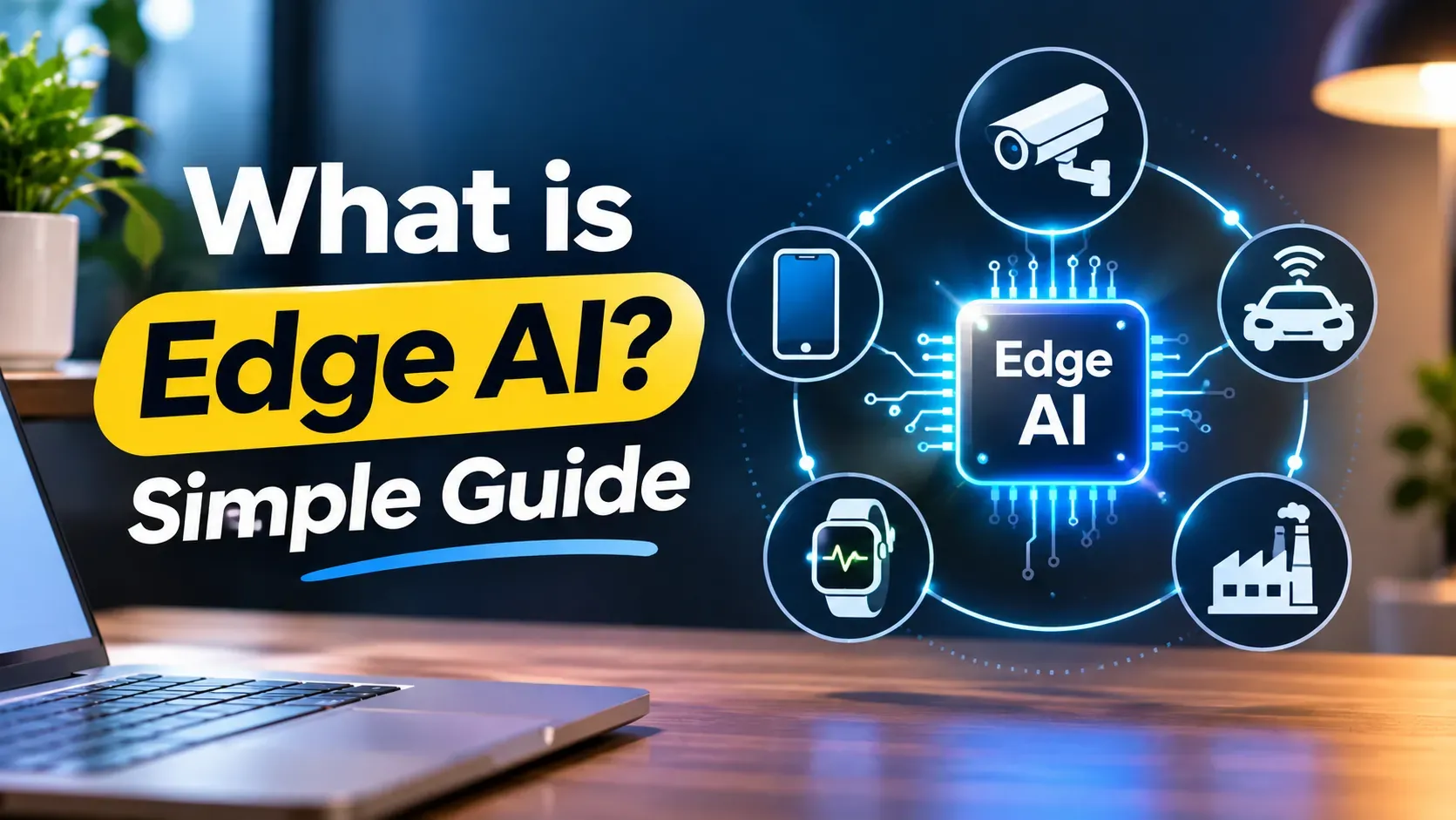
What Is Edge AI? A Simple Guide for 2026
Introduction
Every time your phone unlocks with your face, your car warns you about a pedestrian, or a factory camera spots a defective part, an AI model has made a decision in a fraction of a second. In many of these cases, that decision never left the device. It happened right there, on the phone, in the car, or on the factory floor.
That is edge AI. It is one of the most important shifts in how artificial intelligence is built and used, and it is changing which products are possible, how much they cost to run, and how much of your data stays private.
This guide explains edge AI in plain language. You will learn what it is, how it differs from cloud AI, how it works, the hardware that powers it, where it is used today, its benefits and limits, and how to decide whether it fits a project you care about. No technical background is needed.
What Is Edge AI? The Simple Definition
Edge AI means running AI models directly on local hardware, such as cameras, industrial PCs, IoT gateways, and robots, instead of sending data to the cloud for processing. The “edge” is the place where data is created: the device in your hand, the sensor on a machine, the camera on a street corner.
A helpful way to picture it is a restaurant kitchen. Cloud AI is like phoning a central kitchen across the country, describing your order, and waiting for the meal to be delivered. Edge AI is like having a skilled chef right at your table. The chef can respond immediately, does not need a phone line, and does not need to share your order with anyone.
In technical terms, edge AI inverts the traditional model. In a cloud setup, the server handles all the compute load while the device stays simple and inexpensive. In edge AI, the device itself runs the inference workload using a locally stored model. Many organizations treat edge AI as a simple extension of cloud AI, and that misunderstanding leads to poor deployments, so it is worth understanding that the architecture really is different.
Edge AI vs Cloud AI: What Is the Difference?
The two approaches solve different problems. Understanding the contrast makes it easier to see why both exist.
Where processing happens. Cloud AI sends data over the internet to powerful remote servers, which process it and send back a result. Edge AI processes data near the source, on the device itself or on a nearby gateway.
Speed. Sending data to the cloud and back takes time. For tasks that need an answer in milliseconds, such as detecting an obstacle on the road, that delay can be unacceptable. Edge AI removes the round trip. One guide citing IDC research reports average latency reductions of 85 to 95 percent compared with cloud alternatives, though actual results depend heavily on the application and hardware.
Privacy. With cloud AI, raw data such as images, audio, or sensor readings travels to a server. With edge AI, the data can stay on the device. Only processed insights, not raw data, need to be sent to the cloud, which also reduces network congestion and helps systems scale more cheaply.
Connectivity. Cloud AI needs a reliable internet connection. Edge AI can keep working offline, which matters in remote locations, vehicles, and places where connections are unreliable.
Cost. Cloud inference is usually billed by usage. If your cloud AI bill rises every time a new user signs up, you have already felt the problem edge AI exists to fix. Running models locally can reduce ongoing inference costs, although it shifts spending toward device hardware and engineering.
Power and size. Cloud servers can run enormous models with huge amounts of memory. Edge devices have limited processing power, memory, and battery life, which means models usually have to be smaller and more efficient.
The most important thing to understand is that edge AI is not replacing cloud AI. It complements it. Most modern systems use a hybrid approach in which edge devices handle real time tasks and the cloud handles heavy training, large scale analysis, and storage.
How Edge AI Works
Edge AI involves two key processes: training and inference.
Training
Training is how an AI model learns. It involves feeding the model large amounts of example data, such as thousands of labeled photos, so that it learns to recognize patterns. Training usually requires a lot of computing power, so it typically happens in the cloud or in a data center.
Inference
Inference is when the trained model is used to make predictions on new data, such as identifying a face in a photo it has never seen. This is the step that edge AI moves onto local devices. The trained model is installed on the device, and the device runs it whenever it receives new input.
The Typical Flow
A simple edge AI process looks like this.
- A sensor, camera, or microphone captures data.
- The device prepares the data, for example by resizing an image or filtering noise.
- The local AI model analyzes the data and produces a result, such as a label, a score, or a decision.
- The device acts on the result, such as unlocking, alerting, or adjusting a setting.
- If useful, the device sends a small summary or an unusual case to the cloud for storage, reporting, or model improvement.
Over time, the cloud can retrain the model using data gathered from many devices, and push an improved version back out to them.
How Big Models Fit on Small Devices
If cloud models are huge, how can they run on a phone or a camera? The answer is that engineers shrink them. Model optimization techniques make models small enough to fit on smartphones and IoT devices.
Several approaches are common.
Quantization stores the numbers inside the model with lower precision, which cuts memory and speeds up computation with little loss in accuracy.
Pruning removes parts of the model that contribute little to its results.
Distillation trains a small model to imitate a larger one, capturing most of the capability in a much smaller package.
Efficient architectures are designed from the start to be compact, and keeping a model as simple as possible with fewer layers also helps reduce energy consumption.
Part of the reason edge AI is practical in 2026 is that models themselves are getting smaller and faster, which makes running them locally far more realistic than it was a few years ago.
The Hardware Behind Edge AI
Edge AI depends on chips that can run AI workloads efficiently. The main types of hardware are as follows.
CPUs are general purpose processors. They can run small models but are not the most efficient for heavy AI workloads.
GPUs are good at running many calculations in parallel, which suits AI. They are common in more powerful edge devices such as industrial systems and robots.
NPUs, or Neural Processing Units, are specialized chips designed specifically for AI tasks. They deliver strong performance at low power, which is why they now appear in phones and laptops.
AI accelerators are dedicated chips built to run AI inference quickly and efficiently in devices such as cameras, gateways, and industrial equipment.
By 2026, many consumer and industrial devices ship with built in AI hardware, making edge AI the default rather than the exception in a growing number of products. For example, most premium Android phones in 2026 use chips with on device AI capabilities, and Apple designed Apple Intelligence so that simple requests are processed entirely on the device.
Real World Examples of Edge AI
Edge AI is already part of everyday life. Here are some of the most common places you will find it.
Smartphones and Consumer Devices
Phones use edge AI for face unlock, voice assistants, real time photo enhancement, live translation, text prediction, and background noise removal on calls. These features feel instant because they run locally.
Wearables
Smartwatches and fitness trackers use edge AI to monitor sleep patterns and physical activity, and many of these devices run simple models directly on the device. This lets them track health signals continuously without draining the battery or uploading every reading.
Cars and Autonomous Vehicles
Vehicles need to detect pedestrians, lane markings, and traffic signs in real time. They cannot wait for a cloud response, so the processing has to happen on board.
Manufacturing and Industrial Machines
Cameras and sensors on production lines use edge AI to spot defects, predict equipment failures, and monitor safety, often in environments with limited connectivity. Detecting a problem instantly can prevent waste and downtime.
Healthcare
Medical devices can analyze signals such as heart rhythms locally, which supports quick alerts while keeping sensitive patient data close to its source.
Smart Cities and Retail
Traffic cameras can analyze flow without storing every frame. Retail systems can count foot traffic or monitor shelves using local processing, which reduces bandwidth and helps protect privacy.
Smart Homes
Doorbells, speakers, and security cameras increasingly recognize people, sounds, and events locally. Features such as person detection can work even when the internet connection is slow.
The Benefits of Edge AI
Speed. Local processing removes the delay of sending data to a server and back, which is critical for real time decisions.
Privacy and data control. Keeping raw data on the device reduces exposure and can simplify compliance. For regulated organizations that need fully on premise or air gapped deployments, local processing is often the only acceptable option.
Offline operation. Edge AI can keep working without a connection, which suits remote locations, vehicles, and unreliable networks.
Lower bandwidth costs. Sending only summaries or exceptions instead of raw video or sensor streams reduces data transfer.
Cost control at scale. Running inference locally can reduce usage based cloud charges as the number of users or devices grows.
Resilience. If the network or cloud service goes down, local devices can continue to function.
The Challenges of Edge AI
Edge AI is powerful, but it has real limitations that beginners should understand.
Limited resources. Devices have less processing power, memory, and battery than cloud servers, so models must be small and efficient, and sometimes less capable than their cloud counterparts.
Deployment complexity. Updating models across thousands or millions of devices is harder than updating one cloud service. You need ways to distribute, monitor, and roll back updates safely.
Hardware variety. Different devices have different chips and capabilities, which can make it difficult to build one solution that works well everywhere.
Security of physical devices. Devices in the field can be stolen, tampered with, or attacked, so protecting the model and the data stored on them matters.
Monitoring and governance. Because models run in many places, you need processes to track performance, detect drift, and ensure that deployed models behave as intended.
Upfront costs. Edge deployments can require investment in hardware and engineering, even if ongoing inference costs fall.
Market Outlook
The business case is driving rapid growth. One industry source projects that the global edge AI market will grow from about 30 billion dollars in 2026 to about 118.7 billion dollars by 2033. Forecasts like these vary between sources, but the direction is consistent: more intelligence is moving closer to where data is created.
Several trends are pushing this forward. AI models are getting smaller and faster. The number of connected devices keeps growing. Networks are improving. Businesses want faster, more private, and more resilient systems. And rising data transfer and inference expenses are pushing enterprises toward hybrid models that combine edge and cloud to reduce costs while improving performance.
Should You Use Edge AI? A Simple Decision Guide
Edge AI is not always the right choice. Here is a practical way to think about it.
Edge AI is a strong fit when you need very fast responses, your data is sensitive, connectivity is unreliable, bandwidth is expensive, or you expect usage to scale so far that cloud inference costs would become painful.
Cloud AI is a strong fit when you need the largest and most capable models, your tasks are not time critical, your devices are too limited to run models locally, or you want to iterate quickly without managing hardware.
A hybrid approach is often best when you want real time responses on the device and the power of the cloud for training, analytics, and complex requests. This is the default architecture for many AI driven products in 2026.
Ask these questions before deciding.
- How fast must the response be?
- How sensitive is the data?
- Will the device always have a reliable connection?
- How many devices or users will there be?
- How capable does the model need to be?
- Who will manage updates and monitoring?
How to Start Learning Edge AI
You do not need to be an expert to begin. Start with the basics: what AI is, how data is used, and simple machine learning ideas. Then try small beginner projects, such as face detection, object recognition, or voice commands. Learning by doing is the best way to build confidence.
A practical learning path looks like this.
- Learn the vocabulary: model, training, inference, latency, NPU.
- Experiment with on device features on your own phone or laptop to see what runs locally.
- Try a beginner friendly tool or framework for running small models on a device.
- Build a simple project, such as detecting objects with a camera.
- Learn how to optimize and update models, and how to monitor them in the field.
Conclusion
Edge AI moves intelligence from distant data centers to the devices where data is created. By running trained models locally, it delivers faster responses, stronger privacy, offline capability, and lower bandwidth and inference costs, while leaving the heavy lifting of training and large scale analysis to the cloud.
It is not a replacement for cloud AI. It is a partner to it. The most successful systems in 2026 combine both, placing each task where it makes the most sense.
If you remember one idea, remember this: keep the important action close to the source. When speed, privacy, and resilience matter, edge AI is often the best way to do that. And as chips improve and models shrink, a growing share of the AI you use every day will quietly run on the devices in your pocket, your home, your car, and your workplace.