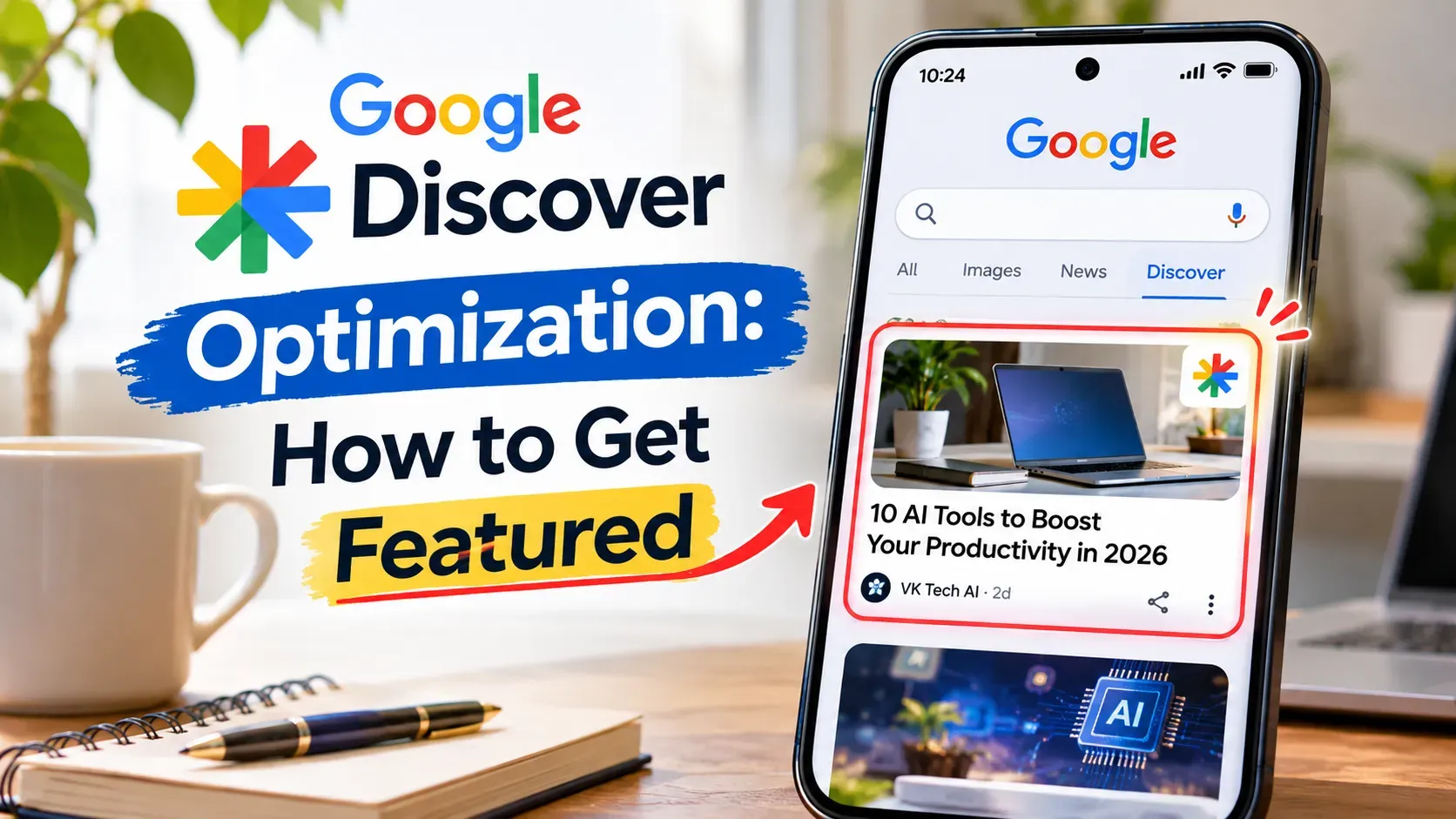
Google Discover Optimization: How to Get Featured in 2026
Introduction
Most SEO work starts with a search. Someone types a query, Google returns results, and your job is to appear near the top. Google Discover works the other way around. There is no query. Google decides what a person might enjoy reading and places it in their feed before they ask.
That makes Discover a different kind of traffic channel. It is a recommendation engine: users find content they like without searching, and because the content is pushed to them, it needs an optimization approach of its own. Publishers that get featured report that Discover traffic can outperform their organic search results in both volume and revenue per thousand views, and it is no longer reserved for news sites.
The channel also changed in 2026. The February 2026 Discover core update significantly changed which content gets featured, so tactics that worked in 2024 or 2025 may now hold you back.
This guide explains how Discover works, what changed, and how to optimize your content, images, site, and publishing routine to earn a place in the feed. It also covers what to avoid, how to measure results, and how to build a strategy that survives the spikes and drops that make Discover unpredictable.
What Is Google Discover?
Google Discover is a personalized, mobile first content feed that appears in the Google app and on the Chrome new tab page on mobile devices. It shows article cards, videos, and other content that Google predicts a particular user will find interesting, based on their interests and behavior. Users can also follow and unfollow topics to shape what they see.
Three characteristics define how Discover behaves.
It is query less. Nobody searches for your page. Google surfaces it because it matches a user’s interests.
It is interest driven. Discover is built around topics and entities rather than keywords. A person who regularly reads about running, personal finance, or home cooking will see more content on those subjects.
It is volatile. Traffic often arrives in sharp spikes and then disappears. Some evergreen content can keep steady traction over time, and some pages show a mix of both patterns, but you should plan for unpredictability.
One publisher guide even argues that Discover is more similar to Facebook than to Google Search in how it behaves, and notes that for many news sites it already delivers more traffic than Search and Facebook.
Discover vs Search vs AI Overviews
Google now operates three distinct discovery channels in 2026, each with different optimization requirements and traffic behavior, and treating them as one channel leaves traffic on the table.
Here is how Discover compares with traditional search in practice.
Area | Traditional SEO | Google Discover |
Targeting | Specific search queries | Broad user interests and entities |
Priority | Search volume | Trending topics and timely analysis |
Content type | Evergreen how to guides | Opinion, original research, news analysis |
Images | Standard featured images | Large, emotive, custom visuals |
Optimization focus | Googlebot and rankings | Semantic understanding and user interest |
Ranking well in Google does not automatically translate into visibility in Discover. A page can sit in position one for a valuable keyword and never appear in the feed, while a page with modest search rankings can earn a spike of Discover traffic. Treat them as separate games that share some fundamentals.
What Changed With the February 2026 Core Update
The February 2026 Discover core update changed what types of content get featured, which means publishers must adapt to new rules. Several themes stand out across analyses of the update.
Topical authority matters more. Sites that consistently cover a subject in depth are favored over sites that publish scattered content across many topics.
Semantic depth matters. To get featured, content should be semantically dense. It should not merely mention the topic but include the related sub entities, concepts, and terminology that prove comprehensive coverage.
Page experience is a visibility factor. Intrusive ads, autoplay videos, and layout shifts can actively hurt Discover visibility, which turns optimization into a design and user experience challenge as well as an editorial one.
Low substance is penalized. Clickbait titles and thumbnails that do not match the content, poor mobile experience, slow Core Web Vitals, and high volume publishing with little substance per article are all patterns that reduce the chance of being featured.
The overall direction is clear. Discover increasingly rewards trustworthy, expert, original content on topics where your site has demonstrated authority, and it increasingly punishes content built purely to attract clicks.
The Foundation: E-E-A-T and Topical Authority
For content to be featured, it has to bring real value to the user, and that means following the E-E-A-T guidelines of experience, expertise, authoritativeness, and trustworthiness. Expertise means the author is skilled in the subject. Trustworthiness means the information is complete, unbiased, and on point.
Practical ways to strengthen these signals include the following.
Show real authors. Publish named authors with biographies that explain why they are qualified to write on the topic. Link to their profiles and other work.
Demonstrate first hand experience. Include original photographs, test results, data, case studies, and observations that could only come from someone who did the work.
Cite credible sources. Link to primary sources for facts and statistics instead of repeating claims without attribution.
Be transparent. Publish clear information about who runs the site, how you make editorial decisions, and how readers can contact you.
Build topic depth. Instead of publishing one article on each of fifty unrelated topics, publish many connected articles on a smaller set of topics so Google can recognize your site as a dependable source for those interests.
Topical authority is the single most durable advantage you can build, because it improves your chances in Discover, in traditional search, and in AI generated answers at the same time.
Content Strategy: What Gets Featured
Choose Topics Based on Interests and Entities
Because Discover targets interests rather than queries, think in terms of what your audience cares about, not what they type. Identify the main topics and entities your audience follows, then create content that adds something new to those conversations.
Favor Timely, Original Angles
Discover favors recent content, so timely articles and updates can improve your chances. Hot topics also help. A post that addresses a current development in your field, such as an algorithm update for an SEO audience, has a better chance of surfacing than a generic evergreen explainer.
That does not mean you should chase every trend. Cover the developments that matter to your audience, and add analysis they cannot get elsewhere.
Prioritize Original Value
Formats that tend to fit Discover well include original research, opinion pieces with a clear point of view, news analysis, in depth explainers, first hand reviews, and visual stories. Generic summaries of information available everywhere add little and are unlikely to be recommended.
Write Headlines That Are Engaging and Honest
Your title should accurately represent the content while remaining engaging. Exaggerated headlines that promise more than the page delivers may earn clicks, but they can hurt your chances of being featured and damage reader trust. If your content management system supports headline testing, use it to compare variations and learn which framing your audience prefers.
Add Depth Through Semantic Coverage
Cover the full topic. If you write about a product launch, include the background, the people, the competing products, the technical details, and the likely impact. This semantic richness signals comprehensive coverage and helps Google connect your content to the entities and interests it already associates with each reader.
Image Optimization: Your Most Important Visual Asset
On Discover, your image is often the first thing a reader notices, and it frequently decides whether they tap. The featured image is particularly important because it can stop a user from scrolling, and both its appeal and its size matter.
Follow these image requirements and best practices.
Use large images. A minimum width of 1200 pixels is required for the large image presentation that tends to earn more attention. Smaller images may be shown in a less prominent format.
Prefer original visuals. Stock photos are acceptable, but original photography and custom graphics perform noticeably better and are more likely to feel distinctive.
Choose emotive, relevant imagery. Images that show a clear subject, a human moment, or a striking detail usually do better than generic scenes.
Avoid misleading thumbnails. An image that does not match the substance of the article creates a bad experience and risks being filtered.
Keep file sizes sensible. Compress images so pages load quickly without sacrificing visible quality.
Avoid heavy text overlays. Let the image carry the emotion and use your headline to carry the information.
Google also gives publishers a way to signal that they allow large previews. Check the current documentation for the robots directive that permits large image previews and confirm it is not blocked on your pages.
Technical Optimization Checklist
Several technical requirements affect eligibility and presentation.
Open Graph tags. Discover uses Open Graph tags to construct the card that appears in user feeds, so make sure your title, description, and image tags are present and accurate.
Mobile experience. Discover is a mobile first experience, so design, speed, and usability on phones are essential. Test your pages on real devices and use PageSpeed Insights to check performance.
Core Web Vitals. Fast loading and stable layouts matter. Slow pages and layout shifts hurt both users and visibility.
Clean page experience. Remove intrusive interstitials, aggressive popups, and autoplay media that disrupt reading.
Indexing and crawl access. Your pages need to be indexable and crawlable, and your sitemap should be current.
Structured data. Structured data and fast loading pages contribute to visibility, and article markup helps Google understand your content.
Google News presence. For news publishers, being included in Google News can help Discover performance, and Discover has its own news category in some data.
Policy and Quality Risks
Discover has content policies, and violations can reduce visibility at the domain level rather than only for a single page. Review Google’s current Discover content guidelines and avoid the following.
Misleading or clickbait titles and thumbnails. Deceptive content, impersonation, or misrepresentation. Sensitive content that violates policies. Low quality pages that exist mainly to attract traffic. Pages with a poor mobile experience or consistently slow performance. Publishing large volumes of thin content.
Treat quality as a site wide discipline. One batch of low effort posts can drag down the perception of the entire domain.
Building a Publishing Routine That Works for Discover
Because Discover rewards consistency and authority, your routine matters more than any single trick.
Publish steadily. Regular publishing on your core topics gives Google more signals about what your site covers and keeps your content fresh.
Update proven content. Refresh strong articles with new information, better images, and improved structure. Evergreen pages can keep earning attention long after their first publication.
Promote early. Early traffic and interactions from channels such as newsletters, social media, and push notifications can signal that content is relevant and engaging, which may improve its chances of being featured. Treat this as a helpful boost rather than a guaranteed lever.
Grow a loyal audience. Discover traffic tends to be made up of first time visitors, and many of them can be invited to subscribe to push notifications, which turns one off visit into a returning relationship.
Plan for volatility. Do not build your entire traffic strategy on Discover. Use it to complement search, email, and direct traffic.
How to Measure Discover Performance
Google Search Console includes a Discover performance report that appears when your site has enough Discover impressions. Use it to see which pages earn impressions and clicks, how click through rates vary, and how traffic changes over time. Connecting Search Console to your analytics or publisher dashboard can add further detail, including performance by day, by author, and by top performing posts.
Track these metrics regularly.
Impressions and clicks. Identify which topics and formats are favored.
Click through rate. Strong rates suggest that your images and headlines resonate. Weak rates suggest a presentation problem.
Top pages. Look for patterns in subjects, formats, authors, and image styles.
Engagement after the click. Check time on page, scroll depth, and return visits. Discover visitors who bounce immediately suggest a mismatch between the card and the content.
Spike and decay patterns. Learn which content produces short bursts and which holds steady, then plan accordingly.
Common Mistakes to Avoid
Treating Discover like keyword SEO. Optimizing only for search queries misses the interest and entity logic behind the feed.
Using small or low quality images. Without a large, compelling image, your content is easy to scroll past.
Writing clickbait. Short term clicks are not worth the risk of reduced visibility and lost trust.
Neglecting mobile. A clunky mobile experience can disqualify otherwise strong content.
Publishing thin content at volume. Quantity without substance works against you.
Relying on Discover alone. Its volatility makes it a poor foundation for a traffic strategy.
Ignoring page experience. Intrusive ads, autoplay videos, and layout shifts can actively harm your visibility.
A Practical Discover Optimization Checklist
Use this list before publishing.
- The topic fits the interests and entities your site is known for.
- The article offers original value, such as research, analysis, experience, or a clear point of view.
- The headline is engaging and accurate.
- A featured image of at least 1200 pixels wide is included, ideally original.
- Open Graph tags are present and correct.
- The page loads quickly and looks clean on mobile.
- There are no intrusive ads, autoplay media, or layout shifts.
- The author is named and credible.
- Sources are cited and facts are verified.
- The page is indexable, and your sitemap is up to date.
- You have a plan to promote the piece to your existing audience.
- You will review Search Console Discover data after publication.
Conclusion
Google Discover rewards a different kind of effort from traditional SEO. You are not competing for a query. You are earning the trust of an algorithm that tries to predict what each person will want to read next. After the February 2026 update, that means topical authority, semantic depth, original value, large and honest imagery, and a clean mobile experience matter more than ever, while clickbait and thin, high volume publishing matter less.
The best approach is to treat Discover as a reward for doing the fundamentals well. Build real expertise on a focused set of topics. Publish original, useful, timely content. Present it with strong images and accurate headlines. Keep your site fast and uncluttered on mobile. Measure what the feed rewards and do more of it.
Because Discover traffic is volatile, use it as a powerful supplement to search, email, and direct visits rather than as your only source of traffic. Do that, and the spikes become opportunities to grow an audience that stays.