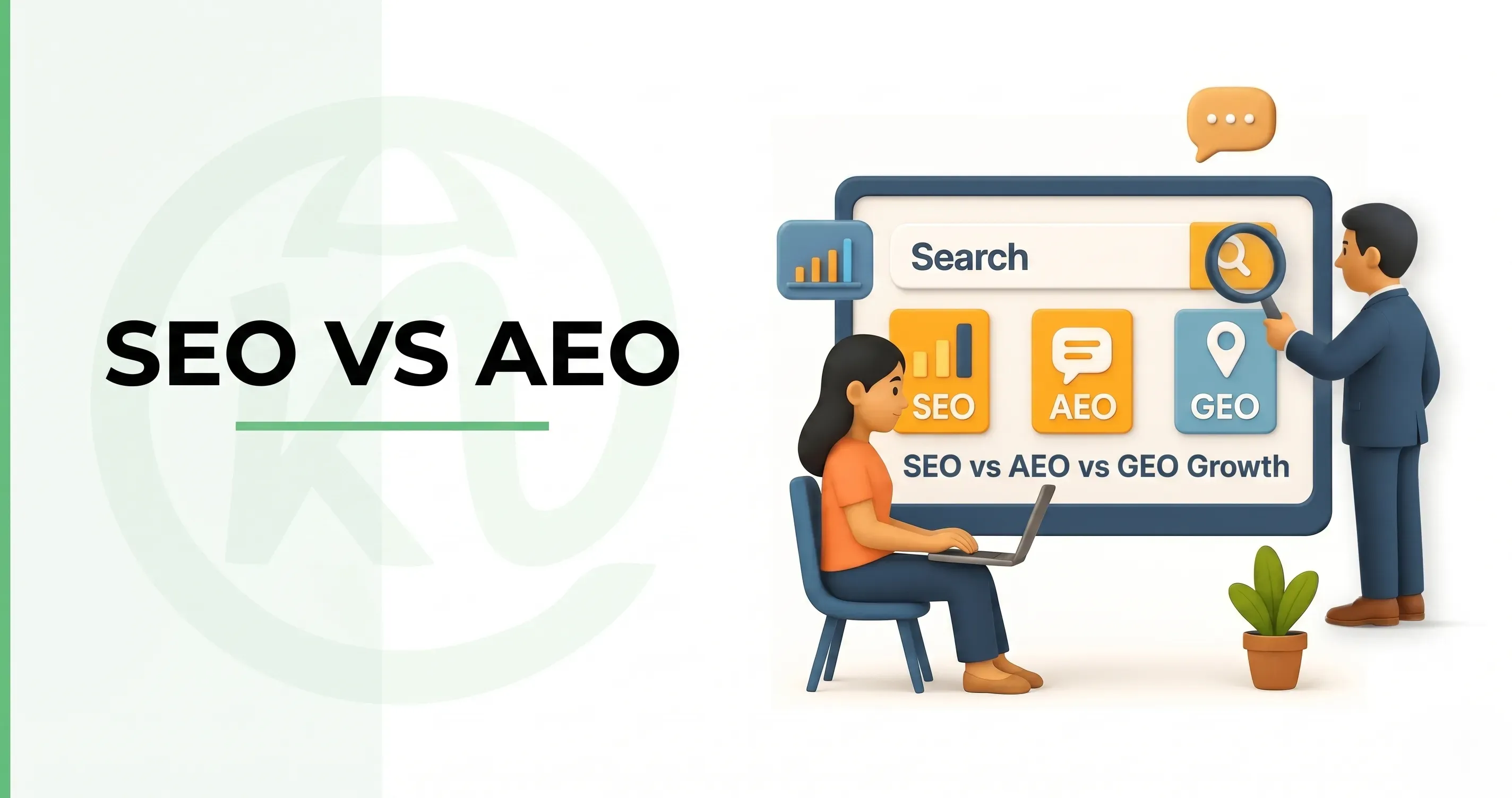
SEO vs AEO vs GEO: Key Differences Every Marketer Must Know in 2026
The digital marketing landscape has never moved faster. Just when brands mastered the art of ranking on Google, the rules of the game began to shift again. Today, simply "showing up" on a search results page is no longer enough. Users aren't just searching; they're asking, conversing, and expecting instant, intelligent answers.
This seismic shift has introduced three distinct but interrelated disciplines: SEO (Search Engine Optimization), AEO (Answer Engine Optimization), and GEO (Generative Engine Optimization). While they share a common DNA getting your content in front of the right audience they serve fundamentally different purposes, demand different tactics, and operate in completely different environments.
If you're a marketer, business owner, or content strategist in 2025, understanding the distinction between these three isn't optional. It's survival.
Let's break them down.
What Is SEO? The Foundation You Already Know
Search Engine Optimization is the practice of optimizing your website and content to rank higher in traditional search engine results pages (SERPs), most notably Google, Bing, and Yahoo.
SEO has been the cornerstone of digital marketing for over two decades. At its core, SEO revolves around three pillars:
Technical SEO — Ensuring your website is fast, crawlable, mobile-friendly, and structurally sound. Think Core Web Vitals, schema markup, canonical tags, and site architecture.
On-Page SEO — Crafting content that targets specific keywords your audience is searching for. This includes optimizing title tags, meta descriptions, headers, internal links, and body content around search intent.
Off-Page SEO — Building domain authority through backlinks, brand mentions, social signals, and digital PR.
The goal of SEO is deceptively simple: rank on Page 1. More specifically, rank in one of the top three positions, where the overwhelming majority of clicks live.
SEO measures success through organic traffic, keyword rankings, click-through rates (CTR), and ultimately, conversions. It's a long game one that can take months to bear fruit but when it does, the compounding returns are unmatched.
Who needs SEO? Every business with an online presence. Period.
What Is AEO? Optimizing for the Answer, Not the Click
Answer Engine Optimization is the practice of structuring and crafting your content so it becomes the direct answer that search engines and virtual assistants surface often without the user ever clicking through to your website.
Sound counterintuitive? It is and that's exactly what makes AEO so fascinating and challenging.
Think about the last time you Googled something and got your answer right there on the results page. A definition. A recipe. A "how-to" list. A quick calculation. You got what you needed without visiting any website. That response whether it appeared in a Featured Snippet, a Knowledge Panel, a People Also Ask box, or through a voice assistant like Siri or Alexa was the result of AEO.
The Core Tactics of AEO
Structured Data and Schema Markup: AEO lives and dies by structured data. When you mark up your content with schema vocabulary (FAQ schema, HowTo schema, Article schema, etc.), you're essentially whispering to Google: "This content is the answer to this question." Search engines love clarity, and schema provides exactly that.
Question-Based Content: AEO content is built around natural language questions. Not just "best running shoes" but "What are the best running shoes for flat feet?" the kind of conversational query that mirrors how real people ask questions, especially by voice.
Concise, Authoritative Answers: The sweet spot for a Featured Snippet answer is typically 40–60 words precise, direct, and authoritative. Your content should answer the question in the first paragraph, then elaborate.
Voice Search Readiness: With smart speakers and voice assistants now integrated into billions of devices, AEO is deeply tied to voice search. Voice queries are longer, conversational, and question-driven exactly the kind of content AEO targets.
Who needs AEO? Businesses in information-rich industries healthcare, finance, legal, education, e-commerce where users are asking specific questions and expecting instant answers. Also essential for brands investing in local SEO and voice search visibility.
What Is GEO? The Newest Frontier in Content Optimization
Generative Engine Optimization is the emerging practice of optimizing your content to be discovered, cited, and surfaced by AI-powered generative tools think ChatGPT, Google's AI Overviews (formerly SGE), Perplexity AI, Microsoft Copilot, and other large language model (LLM)-based platforms.
This is the newest and, arguably, most disruptive of the three disciplines.
Here's the reality: millions of users are now starting their search journeys not on Google, but inside AI chatbots. They type a detailed question, and the AI generates a comprehensive, synthesized response pulling from dozens of sources across the web, without the user ever performing a traditional search.
The stakes couldn't be higher. If your brand isn't being cited, referenced, or recognized by these AI systems, you are effectively invisible to an increasingly large segment of your audience.
The Core Tactics of GEO
Establishing Topical Authority: AI models are trained to trust sources that demonstrate deep expertise in a subject. This means building content clusters a hub-and-spoke model where a pillar page on a broad topic is supported by numerous in-depth articles on subtopics. The more comprehensive your coverage, the more likely an LLM recognizes you as an authoritative voice.
E-E-A-T on Steroids: Experience, Expertise, Authoritativeness, and Trustworthiness Google's quality guidelines are deeply embedded in how AI models evaluate and prioritize sources. For GEO, this means clear author bylines, credentials, original research, data citations, and transparent sourcing.
Being Cited Across the Web: AI systems learn from what the internet considers credible. If reputable publications, industry blogs, and news outlets cite your content, the probability of an LLM surfacing your information dramatically increases. Digital PR and brand building become core GEO strategies.
Structured, Scannable Content: Generative AI models favor content that is logically structured, factually dense, and easy to parse. Use clear headers, bullet points, numbered lists, comparison tables, and definitions. Avoid fluff AI has no patience for it.
Original Data and Unique Insights: One of the most powerful GEO tactics is publishing proprietary data surveys, studies, case studies, or original research. AI systems love citing statistics, and if yours are unique, they become highly citable assets.
Who needs GEO? Forward-thinking brands in competitive industries. If your customers are early tech adopters, professionals, or researchers, there's a strong chance they're already using AI tools to answer questions your business could be solving.
SEO vs AEO vs GEO: The Side-by-Side Breakdown
Factor | SEO | AEO | GEO |
Primary Goal | Rank in SERPs | Appear as a direct answer | Get cited by AI tools |
Platform | Google, Bing | Google, voice assistants | ChatGPT, Perplexity, SGE |
Content Type | Keyword-optimized articles | Q&A, FAQ, structured content | Expert-driven, cited content |
User Action | Click to website | Zero-click answer | AI-generated response |
Key Tools | Keywords, backlinks, technical SEO | Schema markup, featured snippets | E-E-A-T, topical authority, citations |
Success Metric | Organic traffic, rankings | Snippet appearances, voice hits | Brand mentions in AI outputs |
Maturity | Established (25+ years) | Growing (5–8 years) | Emerging (1–3 years) |
Do You Have to Choose? The Case for an Integrated Strategy
Here's the honest truth most marketing guides won't tell you: you don't choose between SEO, AEO, and GEO. The best brands pursue all three simultaneously.
They are not competing strategies. They are complementary layers of a modern search visibility ecosystem.
A strong technical and content foundation built through SEO makes your site more crawlable and credible which directly feeds AEO and GEO performance. Content optimized for AEO with schema markup and structured answers is also more likely to be scraped and surfaced by AI systems. And the brand authority you build through GEO via citations, expert content, and topical depth sends powerful trust signals back to traditional search engines.
Think of it as a triangle of visibility: SEO earns you rankings. AEO earns you answers. GEO earns you AI recognition.
The brands winning in 2025 and beyond are the ones investing across all three vertices of that triangle.
Final Thoughts: Where Search Is Heading
The evolution from SEO to AEO to GEO mirrors a fundamental shift in how humans interact with information. We moved from typing keywords to asking questions to having full conversations with AI. Each evolution demanded a new layer of optimization strategy.
The marketers who recognize this early who start building topical authority, creating question-centric content, and optimizing for AI discoverability right now will have an enormous head start over those who wake up to this reality two years too late.
The search landscape isn't fragmenting. It's expanding. Your strategy should too.