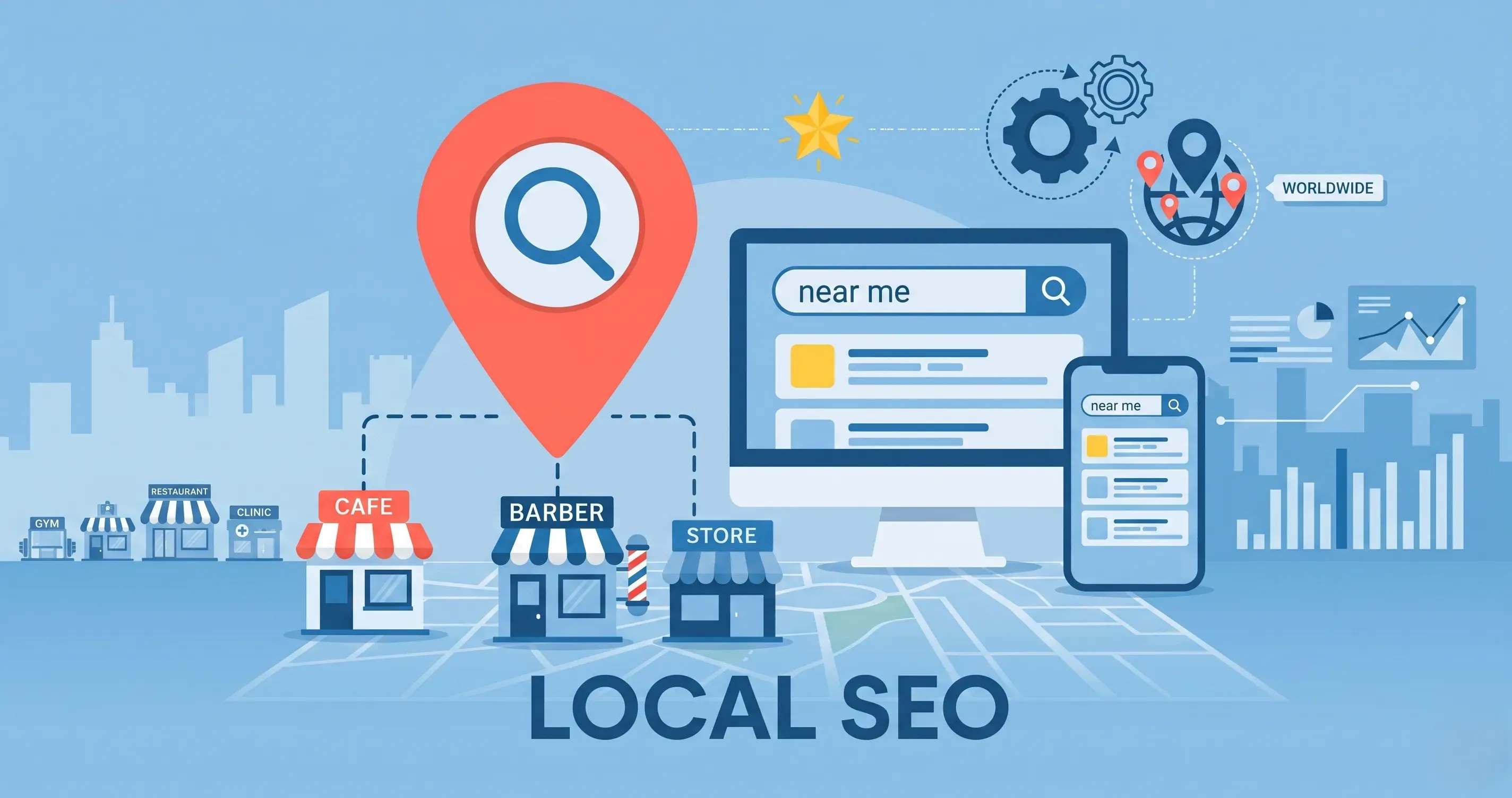
Local SEO Checklist for Small Businesses: The Complete 2026 Guide
Introduction
When someone near your business types "coffee shop near me," "emergency plumber in [your city]," or "best dentist open Sunday," Google returns three local results prominently at the top of the page with a map. Those three positions capture the vast majority of clicks. Below them, everyone else competes for scraps.
46 percent of all Google searches have local intent. 53 percent of all website traffic comes from organic search. If you are not optimized for local search, you are invisible to half your potential customers. Hike SEO
Nearly 80 percent of smartphone searches for local businesses lead to an offline purchase. Local searches lead to purchases 28 percent of the time. LocaliQ
For small businesses competing against larger brands with bigger marketing budgets, local SEO is the most effective equalizer available. You cannot outspend a national chain on advertising. But you can absolutely outrank them locally. This checklist covers every step of the process, organized by priority, so you can build a local search presence that drives consistent, high-intent traffic to your business.
Step 1: Set Up and Optimize Your Google Business Profile
Your Google Business Profile, formerly known as Google My Business, is the single most important asset in local SEO. Without it, you cannot appear in the Google Map Pack, and you are essentially invisible in local search.
A complete and verified Google Business Profile serves as the strongest authority signal for local searches, providing the structured data that directly influences how your business is understood and presented in local search results. Google Business Profile's importance stems from its control over the local pack results, the three businesses that prominently appear in map results, often referred to as the Google 3-Pack.
Claim and Verify Your Profile
Go to business.google.com and claim your business. If your business already has a profile created automatically by Google, claim ownership of it. Google verifies business ownership through a postcard sent to your address, a phone call, or in some cases via video verification. Do not skip this step. An unverified profile has severely limited visibility.
Complete Every Section
Multiple components of your Google Business Profile can give your local SEO a boost. Make sure all information is accurate. Your hours of operation, business website, phone number, and address must be correct. Fill out all sections. It is best to add as much information as possible to present the best picture of your business to prospective customers. Add the right business categories. Many SEO experts believe the primary category you choose has the most impact on your local search rankings, so choose wisely.
Complete these fields in full: business name, address, phone number, website URL, business hours including holiday hours, service areas if you serve customers at their location, business description including your primary keywords naturally, and services or products with descriptions and pricing where applicable.
Upload Photos Consistently
Add high-quality photos of your team, business, and completed projects. Visual content is increasingly important for local search visibility and user engagement.
Add a minimum of ten photos when you first set up the profile: an exterior shot showing your signage and location, interior shots showing your space, team photos, product or service photos, and ideally photos showing real customers experiencing your business with permission. Continue adding new photos regularly. Profiles with more recent photos signal active management.
Use Google Posts Weekly
The Posts feature allows you to publish updates, offers, events, and new product announcements directly to your Google Business Profile. These posts appear in your knowledge panel in search results and signal to Google that your profile is actively managed. Post at minimum twice per month, and ideally once per week.
Step 2: Nail Your NAP Consistency Across the Web
NAP stands for Name, Address, and Phone number. It is the foundational data that tells search engines who you are and where you are located.
Search engines want to make sure they are showing searchers the most accurate and useful information. They do this by using signals from across the web. If they see that all the crucial information about your business, specifically your Name, Address, and Phone Number, is consistent across the internet, they have high confidence that the information is accurate.
Fixing mismatched name, address, and phone details happens before chasing rankings. A single mismatched detail might be enough to throw off search engines when listings show slightly different information, and confidence in your business drops.
Your NAP must be identical everywhere it appears. Not similar. Identical. "Street" and "St" are different. "Suite 100" and "Ste 100" are different. "Company Name LLC" and "Company Name" are different. Pick one format and use it everywhere.
Conduct an audit of your existing online presence by searching your business name along with your city and reviewing every listing that appears. Document any inconsistencies and correct them systematically, starting with your most authoritative listings.
Step 3: Build Local Citations
Citations are mentions of your business information on other websites, primarily business directories. They build the web of consistent signals that search engines use to confirm your business legitimacy and location relevance.
Local SEO is more essential than ever in 2026, with nearly half of all Google searches having local intent and AI-driven search evolving fast, showing up in local results can make or break your visibility.
Start with the highest-authority general directories. Every local business should be listed on Google Business Profile, Bing Places for Business, Apple Maps, Yelp, Facebook, and the Better Business Bureau. These are the foundational citations that carry the most weight and appear most frequently in search results.
In addition to general citations, there are likely more industry-specific websites where you can list your business. Often, these websites rank high in local search results. For example, in the legal niche there are several common local profiles like Super Lawyers that can be created for the law firm or attorneys. Often, you can find these niche websites by searching your keyword plus city name. In most cases, you will be able to add your business or a team member for free.
After general and industry directories, build local citations: your city's chamber of commerce website, local business associations, local news websites that have business directories, and neighborhood or community websites relevant to your area. These locally-specific citations send particularly strong local relevance signals.
Software like BrightLocal automates the process to make building citations easy. For businesses with limited time, citation management tools like BrightLocal or Yext can build and monitor citations across hundreds of directories simultaneously.
Step 4: Build and Manage Customer Reviews
Google considers reviews a ranking factor, but more importantly, your customers trust reviews more than ads. 63.6 percent of consumers are likely to check Google Reviews before visiting a physical business.
Reviews influence your local ranking through two mechanisms simultaneously. They are a direct ranking signal that Google uses to evaluate your business authority. And they influence click-through rate in search results because users scan star ratings before clicking, making high-rated businesses significantly more likely to receive the click even when they appear lower in results.
How to Generate More Reviews
The most effective review generation strategy is simply asking at the right moment. The right moment is immediately after a positive customer experience, while the satisfaction is fresh and the customer is still engaged with your business.
Create a direct Google review link from your Google Business Profile dashboard and share it via email, text message, printed receipts, or a card left with delivered products. The fewer steps between the customer and leaving a review, the higher the completion rate.
Actively encourage happy customers to leave reviews and make sure you respond professionally to all feedback, both positive and negative, to show engagement and build trust.
How to Respond to Reviews
Respond to every review: positive, neutral, and negative. Responding to positive reviews thanks customers publicly and reinforces positive associations with your brand. Responding to negative reviews demonstrates professionalism and gives you the opportunity to address the concern publicly, which often matters more to prospective customers reading the exchange than the original complaint itself.
Google lists responding to reviews as a way to improve your local ranking on Google. LocaliQ
Keep responses genuine and avoid template responses that feel automated. Address the specific content of the review. For negative reviews, acknowledge the concern, offer a resolution, and invite the customer to contact you directly to resolve the issue.
Step 5: Optimize Your Website for Local Search
Your Google Business Profile handles your presence in the Map Pack, but your website handles your organic local search rankings and provides the deeper content that converts visitors into customers.
Local Keyword Research
It is important to know the types of local searches you want your business to rank for. Conduct local keyword research to build your keyword list. You want your SEO keywords to be related to your business, your products or services, and your location so you can target searchers in your area. You should also identify some long-tail keywords, which are longer and more specific phrases customers are using to find businesses like yours. LocaliQ
For every core service you offer, identify three to five keyword variations: the service alone, the service plus your city, the service plus your neighborhood or district, and question-format versions like "how much does X cost in Y." These form the basis of your page and content optimization strategy.
Create Location-Specific Pages
Every geographic area you serve should have a dedicated page on your website. If you serve multiple cities or neighborhoods, each location deserves its own page with unique, genuinely useful content rather than duplicate content with the city name swapped out.
Develop geo-targeted pages for each service area to improve relevance. Include local keywords and compelling calls to action. Markterior
Each location page should include your NAP for that location, a description of your services in that area, local customer testimonials or case studies where possible, and information specific to that location such as directions, parking, nearby landmarks, or area-specific offers.
On-Page SEO for Local
Include your primary local keyword in your page title tag and within the first one hundred words of your page content. Include your city and service in your meta description. Use header tags that naturally incorporate location and service terminology. Add your full NAP to your website footer so it appears on every page, and create a dedicated Contact Us page with complete location information.
Add Local Business Schema Markup
Schema enhances visibility in rich results and AI-generated summaries. Markterior
LocalBusiness schema markup is structured data you add to your website that explicitly tells search engines your business name, address, phone number, hours, and other key information. It is one of the clearest signals you can give Google about your local business details and reduces any ambiguity in how your information is interpreted. Use Google's free Structured Data Markup Helper to generate the code and test it with Rich Results Test after implementation.
Step 6: Build Local Backlinks
Earn high-quality backlinks from local news sites, newspapers, community organizations, charities, chambers of commerce, or industry associations. These local backlinks build authority and local relevance. Hike SEO
Local backlinks carry significant weight in local SEO because they demonstrate that your business is recognized and referenced by other legitimate local entities. They are harder to earn than directory citations but produce stronger ranking improvements.
The most accessible local backlink opportunities include: joining your local chamber of commerce and getting listed on their member directory, sponsoring local events, sports teams, or charities that publish sponsors on their websites, being featured in local news coverage by proactively reaching out with newsworthy stories or expert commentary, partnering with complementary local businesses for mutual referrals and web mentions, and speaking at or hosting local community events that get covered online.
A family law attorney builds authority by earning mentions in local news coverage, getting listed on state bar association websites, and publishing comprehensive guides to divorce laws specific to their state. Hike SEO
Step 7: Ensure Technical SEO Foundations Are Solid
Technical issues can undermine all your other local SEO work by making your pages inaccessible to search engines or frustrating the users who find you.
Mobile Optimization
In 2026, we are witnessing a dramatic evolution of Local SEO with the inclusion of AI-powered searches and voice queries like Hey Google, find a plumber near me. Mobile-first indexing has become critical.
Most local searches happen on mobile devices. Your website must load quickly, display correctly on small screens, and make it trivially easy to call you or get directions with a single tap. Test your website on real mobile devices, not just browser emulators.
Page Speed
Google's PageSpeed Insights tool provides specific, actionable recommendations for your site. The highest-impact fixes for most small business websites are compressing images before uploading, enabling browser caching, and removing unnecessary third-party scripts. Pages that load in under three seconds consistently outperform slower pages in both rankings and conversion rates.
Consistent NAP in Footer
Place your complete NAP in the footer of every page. This makes it immediately accessible to visitors on any page and ensures search engines find consistent information throughout your site.
Fix Duplicate Content
If your website has multiple pages targeting the same keywords or the same city, use canonical tags or consolidate pages to avoid diluting your ranking authority across multiple similar pages.
Step 8: Optimize for Voice Search
Voice search usage has been increasing, with queries like Hey Google, find a plumber near me becoming increasingly common. Voice search requires a different approach because voice queries are more conversational and question-based than typed searches.
Voice search optimization for local businesses means creating content that answers the exact questions customers ask verbally. Create an FAQ section on your website that addresses common questions in natural language: "What are your hours on Sundays?", "Do you offer free estimates?", "Where are you located?", and "What areas do you serve?" These natural language answers position your content for voice assistant responses.
Step 9: Track Your Local SEO Performance
The tools matter less than the system. A business that manually posts to Google Business Profile, requests reviews, and updates directories monthly will outrank a business with expensive software but no execution.
Track your performance through Google Business Profile Insights, which shows how many users found you through search and maps, how many requested directions, and how many clicked to call. Google Search Console shows which search queries are driving impressions and clicks to your website. Google Analytics shows how local traffic behaves on your site and whether it is converting into calls, form submissions, or purchases.
Review your performance monthly. Look for trends in which searches are generating the most impressions and whether your click-through rate is improving. Identify which pages are driving the most local traffic and create more similar content. Document any changes you make so you can attribute performance improvements to specific actions.
Step 10: Maintain Consistency Over Time
Local SEO is ongoing. You need to post monthly, respond to reviews, and build citations continuously. It is a system, not a checklist.
The businesses that dominate local search are not necessarily the ones that did the most work in a single sprint. They are the ones that built a steady, consistent routine: posting weekly to Google Business Profile, responding to every review within 24 hours, requesting reviews from satisfied customers after every job, checking and updating their listing information seasonally, and adding new location or service pages as their business expands.
The small businesses winning in 2026 are not using generic SEO strategies. They are using a deliberate system to control their local search visibility. They have optimized their Google Business Profile. They have built consistent citations. They have earned real reviews. They have added schema markup to their website.
Local SEO Quick-Start Checklist
Use this as your action plan to implement everything covered in this guide:
Google Business Profile: Claim and verify, complete all sections, add 10-plus photos, set up weekly posting schedule, create review request link.
NAP Consistency: Audit existing listings, document your exact NAP format, correct all inconsistencies.
Citations: Submit to Google, Bing, Apple Maps, Yelp, Facebook, BBB, chamber of commerce, and five to ten industry-specific directories.
Reviews: Create direct review request link, implement post-service review request system, respond to all existing reviews.
Website: Add location pages for each service area, implement LocalBusiness schema, add NAP to footer, complete local keyword research, optimize title tags and meta descriptions.
Backlinks: Join chamber of commerce, identify three to five local link opportunities, reach out to local news for coverage.
Technical: Run PageSpeed Insights, fix mobile issues, check for duplicate content.
Tracking: Connect Google Search Console, set up Google Analytics conversion tracking, review GBP Insights monthly.
Conclusion
For small businesses competing against larger brands with massive marketing budgets, local SEO is the equalizer. You cannot outspend national chains, but you can outrank them locally.
Local SEO continues to deliver one of the highest returns on investment, especially for small and service-based businesses targeting local customers. Most small businesses see measurable improvements within three to six months, depending on competition and optimization efforts.
Start with the Google Business Profile setup and NAP consistency audit since these produce the fastest visible improvements. Then build your citation and review foundations. Layer in website optimization and backlink building as your capacity allows. The entire system takes four to eight weeks to implement properly, but the compounding benefits of getting it right will drive customers to your business for years.