Content Marketing Funnel: How to Create Content for Every Stage of the Buyer's Journey
Publishing content without a funnel strategy is like opening a store and hoping people wander in. A content marketing funnel gives every blog post, video, and email a job to do attracting the right people, nurturing their trust, and guiding them toward a decision they feel good about.
Table of Contents
Understanding the content marketing funnel
Why most content strategies fail
Stage 1: Top of Funnel (TOFU) Attract and Educate
Stage 2: Middle of Funnel (MOFU) Engage and Nurture
Stage 3: Bottom of Funnel (BOFU) Convert and Close
Stage 4: Post-Funnel Retain and Delight
How to build your content calendar around the funnel
Mapping content to keywords and search intent
Measuring performance at each stage
Advanced funnel tactics that most brands overlook
Conclusion
Understanding the Content Marketing Funnel
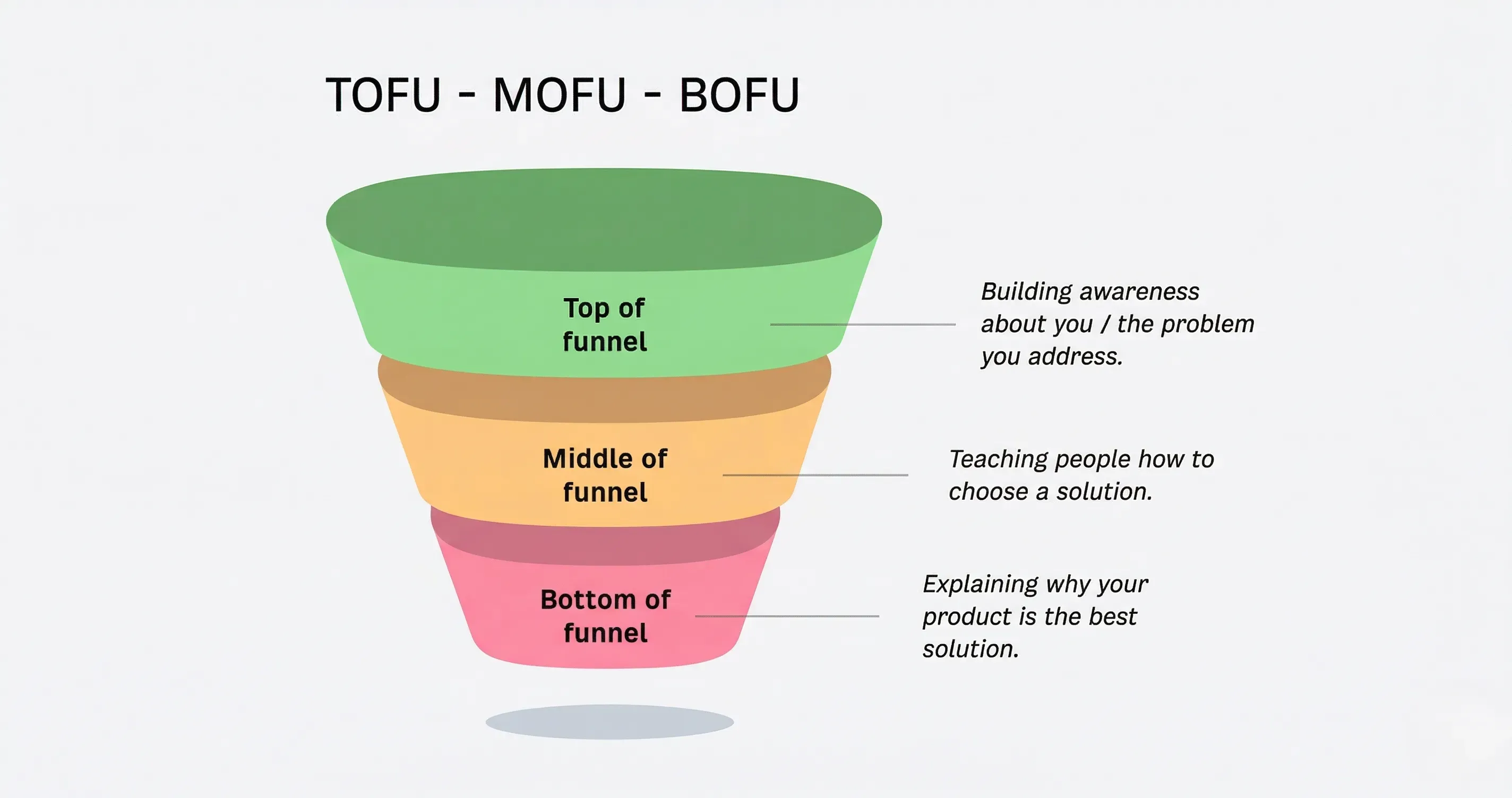
The content marketing funnel is a model that describes the journey a prospective customer takes from first hearing about your brand to making a purchase and beyond. It is called a funnel because the audience naturally narrows at each stage: many people discover your content at the top, fewer engage deeply in the middle, and a smaller (but higher-intent) group reaches the point of decision at the bottom.
What makes the funnel model so powerful is that it forces you to think from the customer's perspective rather than your own. Instead of asking "what do we want to say?" you ask "what does our audience need to hear right now, given where they are in their journey?" That shift in thinking is what separates mediocre content programs from genuinely effective ones.
The traditional marketing funnel has three stages: Awareness, Consideration, and Decision. Modern content marketers add a fourth Retention because the relationship with a customer does not end at the sale. In fact, the post-purchase experience is often where the most valuable long-term growth happens.
70%
of buyers self-educate before talking to sales
47%
consume 3–5 pieces of content before contacting a company
3x
more leads generated by content vs. outbound marketing
62%
lower cost per lead compared to traditional methods
Why Most Content Strategies Fail
The single biggest reason content strategies underperform is a lack of intentional funnel coverage. Most brands over-invest in one stage and neglect the others. Some publish dozens of awareness-stage blog posts but have nothing in place to capture or nurture the leads those posts generate. Others build elaborate sales pages without first establishing the trust and credibility needed to make those pages believable.
Another common failure is treating all content as promotional. Content that is purely self-serving talking about your product, your awards, your company news fails to provide value to the reader. Effective funnel content is, first and foremost, genuinely useful. The brand benefit (awareness, lead capture, conversion) is a byproduct of being the most helpful resource in your niche.
The 3 root causes of content funnel failure
Investing only in TOFU content without a nurturing or conversion layer below it
Creating content that serves the brand's agenda rather than the audience's questions
Failing to measure stage-specific KPIs so you never know what is actually working
Stage 1 Top of Funnel (TOFU): Attract and Educate
Awareness StageGoal: reach new audiences and establish topical authority
At the top of the funnel, you are speaking to strangers. These are people who do not know your brand, may not even fully understand their problem yet, and are certainly not ready to be sold to. They are curious, searching for answers, watching videos, listening to podcasts and your content has one job at this stage: be genuinely useful to them.
TOFU content is the widest part of your funnel. It casts the broadest net and brings the largest volume of people into your ecosystem. This is where organic search, social media, and content distribution channels do their best work. The tone should be educational, accessible, and free of any promotional pressure.
Search engine optimization is critical at this stage. TOFU content typically targets informational keywords queries that start with "what is," "how to," "best ways to," or "why does." These keywords tend to have high search volume and lower commercial intent, which means they attract large audiences who are in early-stage learning mode. Your goal is to rank for these queries and be the first educational resource your future customer encounters.
Blog posts and articlesComprehensive how-to guides, listicles, and explainer pieces targeting informational search queries
Short-form videoYouTube Shorts, Instagram Reels, and TikToks answering common industry questions in 60–90 seconds
InfographicsVisual summaries of complex data, processes, or comparisons that earn backlinks and social shares
PodcastsLong-form audio content for commuters and multitaskers who prefer to learn while on the go
Social media postsEducational carousels, quote graphics, and micro-content designed for sharing and discovery
YouTube long-formDeep-dive tutorials and explainer videos that establish authority and build a subscribed audience
Real-world TOFU example
A project management software company publishes a 2,500-word blog post titled "What Is Agile Project Management? A Complete Beginner's Guide." The post ranks on page one for a keyword with 18,000 monthly searches. It introduces thousands of people to the brand who are learning about Agile for the first time none of whom are ready to buy software yet, but all of whom are potential future customers.
This is TOFU done right: maximum reach, zero sales pressure, genuine value.
TOFU best practices
Write for informational intent avoid product mentions in educational articles
Optimize for featured snippets by answering the core question within the first 100 words
Repurpose each blog post into 5–10 social media posts, a short video, and an email newsletter
Build internal links from TOFU content to MOFU landing pages and lead magnets
Use compelling headline formulas: numbers, questions, and power words dramatically improve click-through rates
Stage 2 Middle of Funnel (MOFU): Engage and Nurture
Consideration StageGoal: capture leads and build trust through deeper value
Middle-of-funnel content is where the relationship begins to deepen. Your audience now knows you exist. They have found value in your TOFU content and are beginning to research solutions more seriously. They are evaluating options, comparing approaches, and asking more specific questions. Your job at this stage is to help them think through their options while establishing your brand as the most credible and helpful choice.
The most important strategic shift at MOFU is the introduction of lead capture. While TOFU content is typically freely accessible, MOFU content is often exchanged for contact information an email address, a phone number, a name and company. This exchange is called a lead magnet, and it marks the moment a visitor becomes a lead. From this point forward, you can communicate with them directly through email and nurture them toward a decision.
The quality of your lead magnet determines the quality of your leads. Generic ebooks and PDF checklists no longer perform as well as they once did. Today's most effective MOFU offers are hyper-specific, immediately actionable, and genuinely save the reader significant time or effort. Templates, calculators, audit tools, and on-demand webinars consistently outperform generic downloadable guides.
Email nurture sequencesAutomated 5–10 email series that deliver value over days or weeks, gradually building trust and moving leads toward a decision
Lead magnetsEbooks, templates, checklists, audit tools, and toolkits offered in exchange for contact information
WebinarsLive or pre-recorded deep dives that demonstrate expertise and allow real-time Q&A one of the highest-converting MOFU formats
Case studiesDetailed success stories structured around Problem → Solution → Result, ideally matching the prospect's industry or company size
Comparison contentHonest "X vs Y" guides and "best alternatives to Z" articles that help prospects evaluate their options
Product demo videosRecorded walkthroughs of your product in action educational rather than promotional, focused on solving specific problems
"The best MOFU content doesn't feel like marketing it feels like consulting. You are helping your prospect think more clearly about their problem, and in doing so, you position your brand as the natural solution."
Email nurture sequences deserve special attention because they are the most powerful MOFU tool available to most marketers. A well-crafted nurture sequence can take a cold lead someone who downloaded a free template and has never spoken to your sales team and move them from skeptic to ready-to-buy in a matter of weeks. The key is personalization: segment your list by what they downloaded, what pages they visited, and what pain points they indicated, then send content that speaks directly to their specific situation.
MOFU best practices
Keep lead capture forms to 2–3 fields maximum every additional field reduces conversion rate by 10–15%
Write case studies using the Problem → Solution → Result narrative structure
Segment your email list by lead magnet topic so nurture emails match the lead's specific interest
Use comparison content honestly acknowledging weaknesses builds more trust than pretending you have none
Follow up webinar registrants with a replay email within 24 hours non-attendees convert at surprisingly high rates
Stage 3 Bottom of Funnel (BOFU): Convert and Close
Decision StageGoal: remove final objections and inspire confident action
Bottom-of-funnel content is for people who are ready to buy or very close to it. They have done their research, narrowed down their options, and now they need one final thing: confidence. Confidence that your product is right for their specific situation, that the price is justified, that other people like them have succeeded with it, and that the risk of trying it is low.
BOFU content is the smallest volume in your funnel but has the highest commercial impact. A single well-crafted testimonial can remove an objection that a hundred blog posts could never address. An ROI calculator that shows a prospect exactly how much time or money your product saves them can be the decisive factor in a purchase decision. These assets work around the clock, converting visitors who are ready to act without any human sales intervention.
Social proof is the cornerstone of effective BOFU content. People trust other people more than they trust brands. Reviews, testimonials, case study results, user-generated content, and third-party ratings on platforms like G2, Trustpilot, or Capterra carry disproportionate weight at the decision stage. If you invest in nothing else at BOFU, invest in systematically collecting and displaying authentic customer success stories.
Customer testimonialsShort, specific quotes from real customers addressing the exact objections your prospects have
Free trials and demosLetting prospects experience the product firsthand is the most powerful conversion tool available
ROI calculatorsInteractive tools that quantify the value of your solution in terms of time saved, revenue gained, or costs reduced
Transparent pricing pagesBenefit-focused pricing content that answers "is it worth it?" before the prospect has to ask
Detailed FAQ pagesPre-emptive answers to the top 10–15 questions that prevent purchase including questions about competitors
Limited-time offersHonest urgency-based content that gives prospects who are on the fence a concrete reason to act now
BOFU in action: the power of specificity
A generic testimonial says: "This software is great. Highly recommend." A powerful BOFU testimonial says: "Before switching, our team was spending 12 hours a week on manual reporting. Within 30 days of using this tool, that dropped to under 2 hours. We reinvested those 10 hours into strategy and grew revenue by 23% in Q3."
The second version addresses a specific pain point, provides a concrete timeline, and quantifies the outcome. It speaks directly to the prospect's internal calculation: "Will this work for me the way it worked for them?"
BOFU best practices
Use retargeting ads to serve BOFU content to MOFU leads who have not yet converted
Feature case studies that match the prospect's industry, company size, or specific use case
Add live chat or a chatbot to BOFU landing pages people have final questions and want immediate answers
A/B test your primary CTAs: "Start Free Trial" typically outperforms "Sign Up" by 30–40%
Make your risk reversal clear: money-back guarantees, no-credit-card trials, and free onboarding remove purchase anxiety
Stage 4 Post-Funnel: Retain and Delight
Loyalty StageGoal: maximize lifetime value and generate referrals
The funnel does not end at the sale. In fact, for most businesses, the post-purchase phase is where the real opportunity lies. Acquiring a new customer costs five to seven times more than retaining an existing one and loyal customers who become advocates generate referrals, reviews, and word-of-mouth that no paid advertising budget can replicate.
Post-funnel content serves two purposes: it helps customers get maximum value from your product (increasing retention), and it cultivates the kind of emotional connection with your brand that transforms satisfied customers into enthusiastic promoters. Onboarding sequences, tutorial libraries, community spaces, customer newsletters, and loyalty programs are all tools in the retention content arsenal.
The most overlooked retention content strategy is the customer success story pipeline. When you systematically identify happy customers and turn their results into case studies, video testimonials, and co-created content, you create BOFU assets that sell for you while simultaneously deepening your relationship with those customers. The customer feels honored and appreciated; you get powerful social proof. It is a genuine win for both parties.
Onboarding email seriesStep-by-step sequences that help new customers achieve their first meaningful result quickly and confidently
Tutorial content libraryVideo walkthroughs, help docs, and knowledge bases that answer product questions before customers need to ask
Customer communitySlack groups, forums, or Facebook communities that connect customers with each other and foster peer-to-peer learning
Customer newsletterRegular updates featuring product tips, industry insights, and exclusive content designed for existing customers only
Referral program contentContent-driven campaigns that make it easy and rewarding for happy customers to recommend you to their network
Loyalty and VIP contentEarly access to new features, exclusive webinars, and behind-the-scenes content that rewards long-term loyalty
How to Build Your Content Calendar Around the Funnel
One of the most practical applications of the funnel model is using it to structure your content calendar. Instead of simply brainstorming "content ideas," you plan content by stage ensuring that every week, every month, and every quarter, you are producing assets that serve every part of your audience's journey.
A healthy content mix for most businesses looks something like this: 60% of content should serve the TOFU stage (broad reach, SEO, and awareness), 25% should serve the MOFU stage (nurturing, lead capture, and deeper engagement), and 15% should serve the BOFU and retention stages (conversion, social proof, and loyalty). These ratios shift based on your business model, sales cycle length, and audience size but as a starting benchmark, they reflect how a sustainable content engine is balanced.
Audit your existing contentCategorize everything you have already published by funnel stage. Most brands discover they have a TOFU surplus and almost nothing at MOFU and BOFU.
Identify the gapsFind the stages that are underserved and prioritize content creation there first. A single MOFU lead magnet can unlock the value of all your existing TOFU traffic.
Map keywords to stagesResearch your target keywords and sort them by intent: informational (TOFU), commercial (MOFU), transactional (BOFU). Build your editorial calendar around this keyword map.
Build a content repurposing systemEvery piece of pillar content should be atomized into multiple formats. A long-form blog post becomes a webinar topic, a podcast episode, 10 social posts, and an email newsletter each serving a slightly different audience and platform.
Set stage-specific publishing cadencesCommit to consistent publishing at every stage: weekly TOFU content, bi-weekly MOFU nurture emails, monthly BOFU reviews or case studies, and quarterly retention campaigns.
Mapping Content to Keywords and Search Intent
Search intent is the "why" behind a search query the underlying goal the searcher is trying to accomplish. Google's algorithm has become highly sophisticated at identifying intent, and your content must match the intent of your target keyword to rank well and satisfy readers.
There are four primary types of search intent, and they map neatly onto the content funnel. Informational intent ("how does SEO work") maps to TOFU. Commercial investigation intent ("best SEO tools for small business") maps to MOFU. Transactional intent ("buy SEMrush subscription") maps to BOFU. Navigational intent ("SEMrush login") signals an existing customer a retention stage signal.
When you plan content with intent in mind, you stop writing content that confuses your reader. You stop publishing product comparisons to informational audiences and stop writing basic explainer articles to audiences who are ready to buy. Every piece of content has a clear job, a clear audience, and a clear next step built into it.
Measuring Performance at Each Stage
The most common content measurement mistake is applying the same metrics to all content regardless of its funnel stage. A TOFU blog post should not be judged by its direct revenue attribution. A BOFU landing page should not be judged purely by its organic traffic. Each stage has its own success criteria.
Funnel Stage | Primary KPIs | Secondary KPIs |
TOFU | Organic traffic, impressions, new users, social reach | Time on page, bounce rate, backlinks earned, branded search volume |
MOFU | Lead captures, email open rate, click-through rate | Webinar attendance, content downloads, lead quality score |
BOFU | Conversion rate, trial signups, demo requests, CPA | Sales cycle length, revenue influenced, deal size |
Retention | Churn rate, NPS, customer LTV | Referral volume, product adoption, repeat purchase rate |
Advanced Funnel Tactics Most Brands Overlook
1. The Content Bridge
Every piece of TOFU content should have a natural bridge to the next stage built into it. This is not a hard sell it is a relevant, low-friction next step that makes sense given what the reader just learned. If someone reads your guide on "how to build a content strategy," the bridge might be a free content strategy template offered at the end of the article. The reader just learned why they need a strategy; the template helps them build one. The conversion feels helpful, not pushy.
2. The Retargeting Layer
Content alone, no matter how good, will not reach everyone who needs it. Retargeting allows you to serve MOFU and BOFU content as ads to people who have already consumed your TOFU content. Someone who read your "what is X" article can be served a case study or a webinar invitation as they browse other websites or scroll through social media. This creates a seamless funnel experience that follows the prospect at the pace they are comfortable with.
3. Interactive Content at Every Stage
Interactive content quizzes, assessments, calculators, and configurators converts at two to three times the rate of static content. At TOFU, a quiz like "What type of marketer are you?" generates awareness and shareability. At MOFU, a self-assessment like "How mature is your content strategy?" captures leads while delivering immediate personalized value. At BOFU, an ROI calculator removes the financial uncertainty that often delays a purchase decision. Interactive content works at every stage and is still dramatically underused by most brands.
4. The Customer Content Loop
Your happiest customers are your best content creators most brands simply never think to ask them. Implement a systematic process for collecting customer stories, inviting customers to contribute to your blog, featuring customer work in your social content, and co-hosting webinars with power users. This creates authentic content that resonates powerfully with prospects, while simultaneously deepening your relationship with existing customers. The customer content loop is how the most effective brands turn their funnel into a self-reinforcing flywheel.
Conclusion
A content marketing funnel is not a campaign it is an infrastructure. It takes time to build, requires consistent investment, and delivers compounding returns that accelerate over months and years rather than days and weeks. The brands that understand this and commit to full-funnel content creation are the ones that build durable, scalable growth engines that work for them around the clock.
Start where you are. If you have only TOFU content, add one MOFU lead magnet this week. If you have leads but no nurture sequence, build a five-email onboarding series. If you have conversions but no retention content, launch a customer newsletter. Every piece you add to the funnel makes the whole system stronger.
The question is not whether content marketing works. The evidence is overwhelming that it does. The question is whether your content is doing a specific, intentional job for a specific person at a specific stage of their journey or whether it is simply adding to the noise.