Content Clusters and Topical Authority: The Full Guide for 2026
Introduction
For years, SEO was treated as a collection of isolated keyword battles. Find a high-volume term, publish a page optimized for it, build a few links, and wait. That approach produced diminishing returns as Google's algorithms grew more sophisticated at evaluating the depth and coherence of a site's topical knowledge.
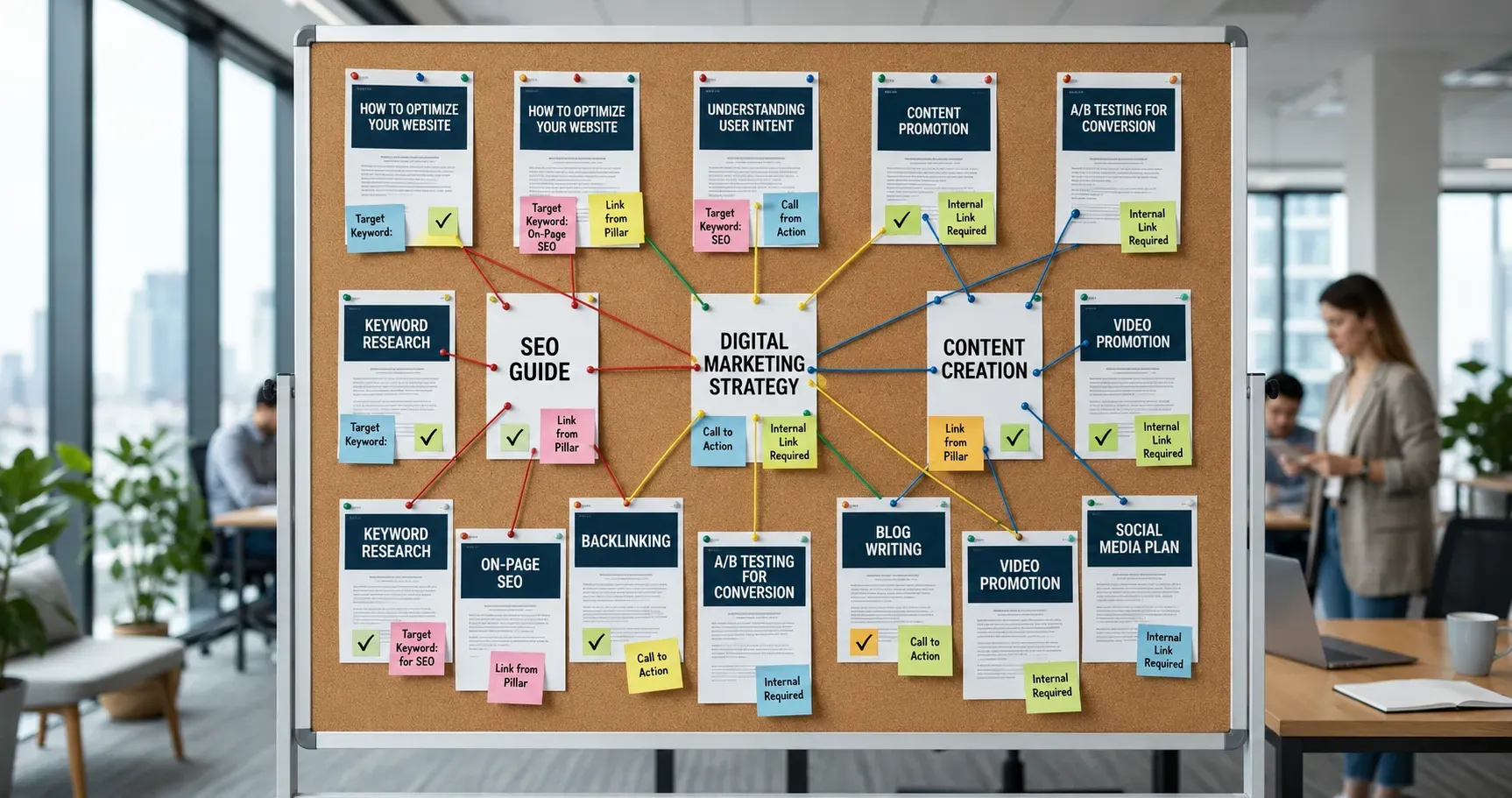
The dominant SEO architecture in 2026 is the content cluster: a structured network of a pillar page and supporting cluster pages that collectively signal to Google that your site is a genuine authority on a topic rather than a keyword-optimized document farm.
A site with 20 interconnected articles on email marketing will consistently outrank a site with one 5,000-word guide, even if the single article is technically superior. The mechanism is not mysterious. Google's Helpful Content system evaluates topical depth, E-E-A-T signals, and the structural coherence of a site's internal link graph. A cluster satisfies all three simultaneously.
Businesses transitioning from keyword-focused SEO to topic cluster models report traffic increases ranging from 50 to 300 percent within 6 to 12 months.
This guide covers the complete architecture: what topical authority is, how content clusters are structured, how to build your first cluster, how internal linking works, how to measure performance, and how to scale the system into a competitive moat.
What Is Topical Authority and Why It Dominates in 2026
Topical authority means a website is recognized by search engines as a trusted expert on a specific subject. Instead of ranking a single page for a keyword, Google evaluates whether your entire site consistently covers one topic in depth and with clear structure.
In 2026, topical authority is critical because Google and AI-driven search tools no longer reward scattered content. Publishing random articles across unrelated topics weakens trust. When your site focuses on one subject and answers all related questions, search engines see confidence and expertise.
The shift was crystallized by Google's March 2026 Core Update. The fundamental principle Google is now enforcing is that a site with 20 interconnected articles on a specific subject will consistently outrank a site with one 5,000-word guide on the same subject, even if the single article is technically superior in isolation.
For AI search surfaces, the authority signal works through a parallel mechanism. When ChatGPT, Perplexity, or Google AI Overviews need to cite a source on a specific topic, they draw from sources their training data and real-time retrieval systems recognize as consistently accurate and comprehensive on that subject. A site with deep, structured, frequently updated content on a specific topic becomes the default reference, while surface-level content earns zero citations.
This makes topical authority the foundation of both traditional SEO and GEO simultaneously.
The Pillar-Cluster Architecture: How It Works
The content cluster model, also called the hub-and-spoke model, organizes content into a three-tier hierarchy that Google's crawlers can map into a topical authority signal.
The Pillar Page
The pillar page is a long-form, high-level resource that frames the topic, defines scope, and links to every subtopic. It attracts broad, competitive queries and intent-rich visitors.
The pillar page requires 3,000 to 5,000 words of comprehensive coverage. It must address the full topic at a high level, link to every cluster page, and serve as the canonical authority on the subject. Thin pillar pages undermine the entire cluster's authority signal.
Think of the pillar page as the index and narrative for the entire topic. It covers every subtopic briefly without going so deep on any one area that it eliminates the need for cluster pages. Each section of the pillar includes a summary and a link to the relevant cluster page where readers can go deeper.
For structure, use a clear H2 and H3 hierarchy, a floating table of contents, and concise section summaries that link to the relevant spokes. Aim for expansive coverage without duplicating spoke content. Summarize each subtopic in 100 to 200 words and link out for details.
The Cluster Pages
Cluster pages are focused articles answering specific questions, use cases, comparisons, or how-tos. They capture long-tail and mid-tail queries and ladder up to the pillar.
Each cluster page targets a specific search intent within the broader topic. The cluster page on a marketing automation cluster might cover email sequence automation, while a different cluster page covers CRM integration and another covers abandoned cart automation. Each serves a distinct query, avoids competing with the pillar, and links back to the central hub.
A strategic CMS concept provides the technical foundation. Structured data, FAQ sections, and clearly organized subheadings help Google recognize the topical depth of a piece and serve it for matching search queries.
The Internal Links
Internal links flow in three directions: hub to spoke, spoke to hub, and spoke to spoke, spreading authority and improving discovery.
Every cluster page must link back to the pillar using anchor text that includes the pillar's target keyword. Bidirectional linking, pillar to cluster and cluster to pillar, distributes PageRank and reinforces topical signals to crawlers.
Internal linking is the connective tissue that transforms a collection of individual articles into a functioning authority cluster. Without it, you have isolated pages competing against each other rather than a unified signal telling Google your site owns a topic.
How to Build a Topical Map Before Writing a Single Word
A topical map in SEO is a planned outline of all subtopics and questions related to a core subject. It acts as a blueprint for what content your site needs to cover to be seen as an authority. A topical map is created before writing content, not after. It includes main topics, subtopics, supporting questions, comparisons, and FAQs.
Building your topical map is the most important step in the entire content cluster process and the one most commonly skipped. Teams that jump straight to writing pillar pages without a comprehensive topical map consistently produce incomplete clusters with gaps that undermine the authority signal.
Step 1: Choose a Topic Narrow Enough to Own
Pick a topic broad enough to support multiple subtopics, but specific enough to own.
The niche selection principle applies directly here. You cannot build topical authority on marketing. You can build it on email marketing for e-commerce brands or project management software for remote engineering teams. The narrower the topic, the faster you achieve genuine authority status, and the more achievable the first cluster is for sites that are not yet established in a broad competitive space.
Step 2: Research Every Question Your Audience Asks
Use Google's People Also Ask boxes, YouTube autocomplete, Reddit discussions in your niche, and keyword research tools like Semrush and Ahrefs to identify every question your target audience asks about your topic. These questions become your cluster page topics.
Group these questions into logical subtopic categories. Each category represents a cluster. Each individual question within the category represents a cluster page.
Step 3: Identify What Competitors Have Missed
Content gap analysis reveals the highest-ROI cluster additions. Mapping your existing coverage against competitor cluster structures identifies missing subtopics. Pages addressing gaps competitors have not covered capture long-tail traffic and strengthen the pillar's E-E-A-T signals simultaneously.
Run competitor URLs through Ahrefs' Content Gap tool or Semrush's Topic Research to identify keywords your competitors rank for that you do not cover. Many of these will be missing cluster pages that your architecture can address.
Step 4: Map URLs Before Creating Content
Translate your content strategy into clean URLs, breadcrumbs, and navigation. Clear information architecture improves crawling and helps users understand where they are in the topic. The recommended pattern is using blog/pillar-slug for the pillar page and blog/pillar-slug/subtopic-slug for cluster pages. Keep slugs short, readable, and consistent.
Planning your URL structure before creating content prevents the technical debt of restructuring later. A well-planned cluster URL structure signals hierarchy to Google and makes your internal linking logic clean and consistent.
Building Your First Pillar Page
The pillar page is the most important asset in your cluster. It represents the highest-traffic potential page in the cluster and the one that distributes authority across all the spoke pages through internal links.
A strong pillar page covers five structural elements.
The comprehensive overview covers every subtopic within the cluster at a high level. Aim for 3,000 to 5,000 words that give readers a complete understanding of the topic without requiring them to read every cluster page.
The clear heading hierarchy uses H2 headings for each major subtopic section, H3 headings for sub-points within sections, and a table of contents that links to each H2 section for easy navigation.
The spoke links connect every subtopic section to its corresponding cluster page. Place these links contextually within the relevant section text using descriptive anchor text rather than generic click here.
The E-E-A-T signals include named authorship with credentials, cited external sources, original insights from direct experience, and a clear publication and update date.
The conversion element captures leads or directs readers toward the next step without interrupting the informational flow.
Building Your Cluster Pages
Each cluster article should target a specific intent, not repeat the pillar.
The cluster page focuses on one specific aspect of the broader topic, answering the question with enough depth that a reader completely satisfies their search intent without leaving. Length varies by query complexity, from 800 words for simple definitional questions to 2,500 words for comprehensive how-to guides.
Every cluster page must contain four internal link types. A prominent link back to the pillar page using keyword-rich anchor text establishes the hub relationship. Links to two to three other cluster pages in the same cluster build spoke-to-spoke relationships. Links from the pillar page pointing to this cluster page must exist before the cluster page is indexed. Optional links to other relevant content outside the cluster connect your cluster to related topic areas.
Use related reading modules mid-article and at the end to encourage depth. Connect semantically related spokes laterally to avoid dead ends.
Internal Linking: The System That Makes Clusters Work
Internal linking is not optional for topical authority SEO. It is the glue that holds topic clusters together and allows authority to grow across the entire site.
The most important internal linking principles for content cluster architecture are specificity of anchor text, bidirectionality, and systematic coverage.
Anchor text should describe what the linked page is about rather than using generic phrases. "Read our guide to email subject line optimization" tells Google what the linked page covers. "Click here" tells Google nothing.
Bidirectional linking, pillar to cluster and cluster to pillar, distributes PageRank and reinforces topical signals to crawlers. Both directions must exist. A pillar that links to cluster pages but has no cluster pages linking back is receiving authority from nowhere.
Systematic coverage means every cluster page links to the pillar and at least two to three other cluster pages. No cluster page should be an orphan that receives no internal links. Orphan pages cannot receive authority from the cluster and cannot contribute to the cluster's signal.
The links only count if Google can crawl them and the pages render cleanly. A cluster sitting on a crawl-broken site routes authority to dead ends. Before you wire the topology, run a structural pass using a technical SEO audit to cover the crawlability prerequisites.
The Compounding Effect: Why Clusters Get Stronger Over Time
A notable common pattern emerges: Success accelerates with growing authority. The first cluster articles typically take the longest to build rankings, while later content benefits from the already established topical strength and becomes visible significantly faster.
This compounding effect is the strategic reason to invest in content clusters over isolated keyword optimization. The 40th article in an established cluster benefits from the authority built by the previous 39. An isolated article has only its own quality and backlinks to work with.
A language learning platform grew from 10,000 to over 200,000 monthly visitors in just five months through consistent topic clustering. The critical factor was not the sheer volume of content but the strategic interconnection and content quality of each individual page.
A B2B software provider systematically built thematic clusters around HR-relevant topics over 18 months. The result was a 17x increase in organic traffic. Particularly noteworthy: The growth curve accelerated with each new cluster, as existing authority benefited new content.
Content Clusters and AI Search: The GEO Connection
AI-powered search engines prefer organized and connected content, and isolated pages are less likely to be used for AI-driven search results or summaries. Topic cluster strategies increase the chance of your content being cited in AI Overviews.
With AI Overviews appearing in roughly 20 to 25 percent of searches as of early 2026, the architecture choice compounds across more of the result page every quarter. The practical move is to write cluster articles in clean, self-contained passages, with clear definitions, structured steps, and entity-rich phrasing, so an answer engine can lift a coherent chunk without losing the thread.
This alignment between topical authority for traditional SEO and citation-readiness for AI search is what makes the cluster model the most durable content investment available in 2026. The same depth that wins a Google ranking is what makes a passage quotable in an AI-generated answer.
AI fundamentally changed how search engines evaluate content. If your content cannot answer follow-up questions, comparisons, and edge cases, AI will choose someone else. A comprehensive cluster architecture that covers a topic from every angle is exactly what AI systems are looking for when selecting sources to cite.
Measuring Content Cluster Performance
Performance measurement for content clusters requires tracking metrics across the cluster as a unit rather than evaluating individual pages in isolation.
The cluster-level metrics that indicate whether your topical authority strategy is working are organic impressions growth for the full set of cluster URLs month over month, average position improvement for the pillar page on its primary target keyword, the number of long-tail keywords where cluster pages appear in the top ten, internal traffic flow from cluster pages to the pillar and between cluster pages, and the rate at which new cluster pages achieve first-page rankings compared to your pre-cluster baseline.
Content clusters do not produce overnight results. The authority signal accumulates as Google indexes more cluster pages and as internal links pass equity through the structure. Sites that sustain cluster publishing for 12 or more months see 40 percent higher organic traffic than comparable single-page strategies.
The three to twelve month window before significant results is the period where most content cluster programs are abandoned prematurely. Build performance reviews into your quarterly planning specifically to evaluate cluster-level metrics rather than individual article performance to give the system enough time to work.
Common Content Cluster Mistakes to Avoid
Three mistakes must be avoided. Weak internal linking: if cluster pages do not clearly link to their pillar pages, search engines can get confused, reducing ranking potential, so strong internal linking is necessary to help both users and search engines. Keyword overlap known as cannibalization: multiple pages must not target the same keywords. If cluster pages compete for the same keyword, it lowers ranking potential, so every page must have a clear search intent. Thin content: creating low-quality, AI-generated content no longer works in 2026. Search engines only favor websites with high-value and original content, so AI can only support content creation but cannot replace human writers.
Additional cluster mistakes include publishing random, unconnected content, over-optimizing keywords instead of meaning, and ignoring updates on old cluster pages.
The most expensive mistake is building an incomplete cluster. A pillar page with three cluster pages has little authority signal. A pillar page with fifteen to twenty interconnected cluster pages has a significant one. The difference in ranking results between an incomplete and complete cluster is not linear. It is compounding.
Scaling: From One Cluster to a Topic Empire
Once your first cluster demonstrates measurable performance improvement, the scaling process follows a predictable path.
Identify the next topic cluster adjacent to your first. It should share enough semantic proximity that your existing domain authority provides a head start, while being specific enough to avoid competing with your established cluster.
New content maintains velocity. Even with a mature cluster, publishing one to two new articles per month signals ongoing expertise and creates new internal linking opportunities. Trend-driven content such as topic updates for the current year serves dual purposes: it demonstrates current awareness and refreshes the cluster's freshness signal.
Connect clusters to each other through strategic cross-cluster linking where the topics genuinely relate. A marketing automation cluster and an email marketing cluster share enough semantic overlap that linking between them strengthens both. Forcing connections between unrelated clusters dilutes the authority signal rather than amplifying it.
The compounding effect of consistent topical authority investment is real. Sites that maintain disciplined cluster publishing and internal linking for twelve or more months report dramatic improvements in competitive rankings, with multiple cluster pages simultaneously ranking for hundreds of related long-tail queries that no individual article could capture alone.
Conclusion
Topical authority compounds rankings because each new page strengthens the entire topic ecosystem. Unlike traditional SEO, results build on each other. When your site is trusted for a topic, new pages rank faster and with fewer links. Older pages gain stability as new content reinforces relevance. Over time, your site becomes the default choice for that subject.
The content cluster strategy is the most durable SEO investment available in 2026 because it satisfies every evaluation layer simultaneously. It signals topical depth to Google's Helpful Content system. It demonstrates E-E-A-T through comprehensive, structured coverage by named experts. It builds the citation authority that AI search systems use to select which sources to include in generated answers.
In 2026, SEO is not about ranking pages. It is about owning topics. If your content strategy is not built around clusters, you are invisible to AI-driven search, no matter how good your writing is.
Start with your topical map. Identify the topic you can realistically own given your current domain authority, content resources, and audience specificity. Build your first pillar page. Publish your first five cluster pages with complete internal linking in both directions. Measure cluster-level performance over three to six months. Then build the next cluster on the authority your first one established.
The sites dominating their niches in 2026 built their clusters two years ago. The sites that will dominate in 2028 are the ones building them now.