AI-Powered A/B Testing: How to Do It Right in 2026
Introduction
Running A/B tests is no longer the difficult part. The hard part is building your experiments on the right foundation, and using AI to genuinely improve outcomes rather than just speed up a broken process.
In 2026, easy access to experimentation tools has lowered the barrier to running A/B tests. Execution is now cheap, and AI can now generate ideas, build variants, write code, and summarize results in seconds. The competitive edge comes from rigor, transparency, disciplined decision-making, and building a process your team can consistently trust.
The marketing teams winning with AI-powered A/B testing are not simply automating more tests. They are using AI to generate better hypotheses, produce more creative variants faster, allocate traffic more efficiently during live tests, and extract insights from data that would have taken days to analyze manually. AI changes the pace of experimentation to the degree that A/B testing can be replaced by other real-time methods of experimentation and personalization, redirecting energy toward what is working while phasing out what is not.
This guide covers the complete AI-powered A/B testing workflow: how AI actually improves the process, how to build a hypothesis foundation that AI cannot undermine, the specific platforms worth using, the advanced techniques like multi-armed bandits and Bayesian testing, and the guardrails that prevent automated experimentation from damaging your brand or violating privacy laws.
Why Traditional A/B Testing Has Reached Its Limits
Before understanding what AI adds, it helps to understand what traditional A/B testing cannot do on its own.
Marketers often wait weeks for A/B test results, only to find the winning variant is already outdated. Customer behavior shifts faster than traditional testing can keep up.
Traditional A/B testing works on a fixed split: you divide your traffic evenly between a control and a variant, wait for statistical significance, declare a winner, and implement it. This approach has three structural problems that compound at scale.
First, it is slow. Reaching statistical significance with even splits often requires weeks of data collection, during which the losing variant continues receiving half your traffic. Second, it is sequential. You test one hypothesis at a time, which means your experimentation velocity is limited by the number of tests you can run serially. Third, it treats all users as equivalent. A variant that wins for your entire audience may actually lose for specific high-value segments and win only because it performs marginally better for the majority.
AI addresses all three problems directly.
What AI Actually Does in the A/B Testing Process
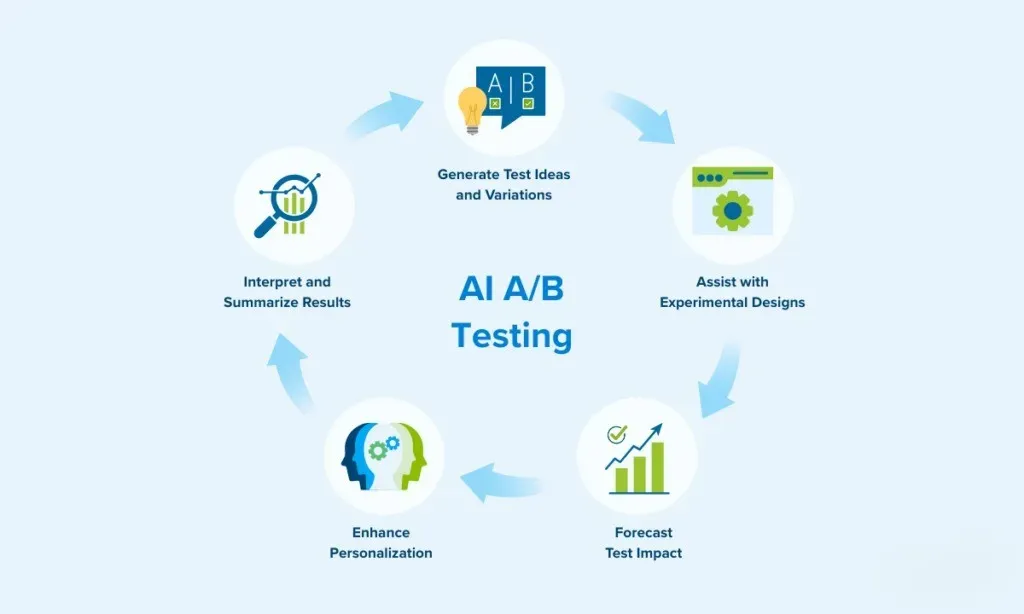
AI can be applied to tasks and processes across all workflow stages. There are three key areas leveraging AI in A/B testing: test ideation where AI can generate hypotheses or copy and design ideas for test variations, data analysis and modelling where AI can build propensity models and analyze test data, and personalization where AI can perform real-time predictive targeting or create personalized experiences.
Understanding which stage of your testing process AI improves most is the starting point for building a useful AI testing program.
Stage 1: Hypothesis Generation and Test Ideation
Generative AI tools rapidly produce multiple headline variations, call-to-action button options, or basic layout designs based on your specifications and brand guidelines.
The most immediate practical value of AI in A/B testing is hypothesis generation speed. A human marketer can generate three to five testable hypotheses in a brainstorming session. An AI system connected to your heatmap data, session recordings, and conversion funnel can generate fifty hypotheses in seconds, ranked by predicted impact based on behavioral signals.
Heatmaps can show whether users are engaging with a pricing section, missing a key call to action, or focusing on elements that are lower value for conversion. Teams can use those insights to create stronger A/B test variants, such as changing layout hierarchy, repositioning buttons, or refining on-page messaging.
The hypothesis generation workflow that produces the best test results combines behavioral data inputs with AI synthesis. Feed your analytics platform data, session recording insights, and user research findings into an AI tool. Ask it to generate hypotheses organized by potential impact and implementation effort. Review the output with human judgment to select those that align with your strategic priorities and brand constraints.
Stage 2: Variant Creation
Traditional A/B testing creates a bottleneck at variant production. If your test requires a designer to mock up alternatives and a developer to implement them, your testing velocity is limited by available design and engineering capacity.
AI-aided visual editors for fast mockups, like Kameleoon's Graphic Editor, let you turn ideas into testable variants quickly without waiting on engineering. You can mockup layouts, adjust copy, or rearrange page elements and launch tests almost immediately by either using the drag-and-drop editor or prompt-based experimentation.
Prompt-based experimentation, where you describe the change you want in natural language and the AI implements it directly in the testing environment, compresses the time between hypothesis and live test from days to hours. This shift enables testing velocity that was previously only achievable at companies with large dedicated experimentation teams.
Stage 3: Traffic Allocation and Real-Time Optimization
Faster analysis: AI-powered systems can process batched or streaming data quickly to highlight performance patterns or change parameters while experiments are still running. This compresses testing cycles from weeks into days or even hours.
The most significant AI contribution to A/B testing mechanics is dynamic traffic allocation. Rather than maintaining a fixed split throughout a test, AI-powered systems continuously evaluate incoming performance data and adjust traffic allocation toward better-performing variants in real time.
Stage 4: Results Analysis and Insight Extraction
AI distinguishes subtle correlations within large datasets, helping you prioritize and evaluate the right variants. Thus, you get results faster and make smarter decisions without getting bogged down by lengthy analysis.
Post-test analysis is where many teams leave significant value on the table. A traditional analysis answers the question of which variant won. An AI-powered analysis answers which variant won for which segments, what behavioral signals predict which users respond to which variant, and what the winning variant's characteristics suggest about other tests worth running.
The Foundation That AI Cannot Fix: Data Quality and Hypothesis Rigor
Understanding what AI cannot do in A/B testing is as important as understanding what it can.
Running A/B tests is not the difficult part anymore. The hard part is building your experiments on the right foundation. Garbage In, Garbage Out means exactly what it sounds like: if your inputs are weak, your conclusions will be, too. In experimentation, this happens when you build hypotheses on shallow research, messy tracking, or AI outputs that were never validated. For example, if you use AI-generated buyer personas to run experiments instead of studying your real customers, your test results may optimize for an audience that does not actually exist. Before applying any AI to your testing program, validate your measurement infrastructure. Every conversion event must fire correctly and only once. Your attribution model must reflect actual conversion paths rather than last-click bias. Your segment definitions must be meaningful and consistently applied across all tests.
AI that operates on inaccurate tracking data will optimize confidently toward incorrect conclusions. A platform that identifies a winning headline based on double-counted conversion events is making decisions with corrupted data that no algorithm sophistication can compensate for.
Multi-Armed Bandit Testing: AI Traffic Allocation in Practice
The multi-armed bandit algorithm is the most practically impactful AI technique in modern A/B testing. Understanding how it works explains both its advantages and the situations where traditional fixed-split testing remains the better choice.
Multi-armed bandit algorithms dynamically allocate traffic toward better-performing variations during the experiment, maximizing business value while still gathering statistical evidence.
The traditional A/B test exposes 50 percent of your traffic to a variant that may perform significantly worse than the control throughout the entire test duration. The multi-armed bandit progressively reduces traffic to underperforming variants and increases it to better-performing ones, converting the testing phase from a pure learning exercise into a partially optimized experience.
Amma, a pregnancy tracker app, used a multi-armed bandit algorithm to reduce user turnover. The algorithm automated and optimized push notifications in real-time, increasing retention by 12 percent across iOS and Android users. The team also gained a better understanding of their user base.
Multi-armed bandit testing is most appropriate for ongoing optimization where speed matters more than certainty, for testing many variants simultaneously where pure A/B testing would require too much time, and for use cases where exposing users to underperforming variants has meaningful business cost.
Traditional fixed-split A/B testing remains preferable when you need definitive statistical confidence for a significant irreversible decision, when organizational stakeholders require textbook statistical rigor to trust results, and when you are testing a small number of variants with sufficient traffic to reach significance quickly.
Bayesian vs. Frequentist Approaches to AI-Powered Testing
The industry is moving toward Bayesian frameworks as they provide simpler, less restrictive, and more intuitive approaches to A/B testing compared to frequentist methods.
The statistical framework underlying your tests determines how you interpret results and what confidence level you need before acting.
Traditional A/B testing uses frequentist statistics, which answer the question: if the null hypothesis is true, how likely are we to see results this extreme? You run the test until it reaches a predetermined significance threshold, typically a p-value below 0.05, then declare a winner.
Bayesian A/B testing answers a different question: given the data we have collected, what is the probability that variant B is better than variant A by at least a meaningful amount? Bayesian results are expressed as probability statements that are more intuitively useful for business decisions and can be acted on before reaching strict frequentist significance thresholds.
For most marketing teams, Bayesian testing produces more actionable results with less data and makes it easier to explain findings to non-technical stakeholders. The output statement variant B has a 94 percent probability of being better than variant A by at least 5 percent is more decision-useful than the p-value below 0.05 statement that frequentist testing produces.
Personalization as AI-Powered Testing's Next Level
Personalization from segments to individuals: AI can test and refine variants for micro-segments or even single customers. Creative, offers, and timing are matched to live signals, making each interaction more relevant.
Traditional A/B testing produces one winner for all users. AI-powered personalization testing produces a winner for each user based on their specific behavioral profile, demographic signals, and contextual context.
AI-powered testing platforms use machine learning algorithms to analyze user interactions including clicks, time spent, conversions, and more. These platforms continuously learn from real-time data and adjust traffic distribution dynamically, pushing more users to the better-performing version even while the test is still live.
The practical implementation starts with segment-level testing before individual-level personalization. Identify three to five user segments with meaningfully different behavioral patterns and test whether different variants outperform the global winner within each segment. A checkout experience optimized for mobile first-time buyers may differ significantly from what works for desktop returning customers, even though the single-winner test shows one variant performing marginally better overall.
Unbounce's AI-powered Smart Traffic feature routes visitors to the page variant most likely to convert, often after just 50 visits. Unlike traditional A/B testing, it is much faster and flexible, especially for campaigns with lower traffic.
The Best AI-Powered A/B Testing Tools in 2026
By 2026, nearly every major split-testing platform claims an AI feature, but the depth of integration varies wildly. Some platforms layered a chatbot onto an existing rules engine. Others rebuilt their entire experimentation pipeline so an LLM can operate it end to end.
Three evaluation questions cut through the marketing claims:
Do you use AI agents in your daily marketing workflow? If yes, prioritize platforms with agent-native architecture. Is privacy and EU compliance a hard requirement? If yes, prioritize platforms with cookieless modes and built-in consent management. Are you replacing an existing enterprise contract or starting fresh? Enterprise replacements narrow to established players while fresh starts allow more flexibility toward newer agent-native platforms.
Optimizely remains the enterprise standard with AI features built into its experimentation pipeline. Its Stats Accelerator uses multi-armed bandit methodology to generate statistically sound results faster and automatically identifies traffic optimization opportunities. Optimizely is well suited for large enterprises, product-led companies that want to test deeply including backend logic, and engineering and product teams who use feature flags and rollouts.
VWO is the practical default for SMB and mid-market teams. Their AI features cluster around heatmap analysis, session-replay summarization, and variant copy suggestions. It remains a solid choice for teams that want a polished interface without agent-native complexity.
Kameleoon is strong on personalization with AI features covering hypothesis suggestions, copy generation, and predictive traffic allocation. Its visual editor with prompt-based experimentation makes variant creation accessible without developer involvement.
Contentsquare provides the deepest behavioral analytics layer. Contentsquare's Sense Analyst automatically scans a page, creates multiple zoning analyses, takes screenshots, and identifies each zone. It then delivers specific UX recommendations to improve page performance, telling you which zones are underperforming, which CTAs are getting ignored, and which layout changes are most likely to lift conversions.
Unbounce excels for marketing teams running paid ad campaigns and landing page optimization specifically.
Fibr AI brings an agentic architecture where every URL becomes an autonomous experience agent with a clear goal to maximize defined conversions and the intelligence to pursue it, including autonomous hypothesis generation where the AI continuously scans your site and its own performance data without waiting for a marketer to have an idea.
Setting Up AI-Powered Tests: The Practical Workflow
The most practical five-step AI testing workflow for marketing teams combines AI efficiency with human strategic judgment.
Step 1: Data audit before automation. Review your tracking setup, conversion event firing, and segment definitions. Document every measurement inconsistency and fix tracking issues before activating any AI testing features. AI optimization built on broken data produces broken results with high confidence.
Step 2: Behavioral data-driven hypothesis generation. Connect your analytics, session recording, and heatmap data to your testing platform's AI features. Ask the system to generate hypotheses based on where users are dropping off, what elements receive engagement that does not translate to conversion, and which pages have the highest exit rates from warm audiences.
Step 3: AI-assisted variant production. Use prompt-based experimentation or the AI visual editor in your chosen platform to produce variants from your prioritized hypotheses. Human review should evaluate variants for brand voice accuracy, compliance with messaging guidelines, and alignment with the specific hypothesis being tested.
Step 4: Intelligent traffic allocation during the test. If your platform supports multi-armed bandit testing and your use case is appropriate for it, enable dynamic traffic allocation. If you need definitive statistical significance for a major decision, use fixed-split testing with pre-calculated minimum sample sizes.
Step 5: AI-powered results analysis. After the test concludes, use your platform's AI analysis to identify segment-level differences in performance, secondary metric impacts beyond your primary conversion goal, and patterns that generate hypotheses for subsequent tests.
Guardrails: What AI Testing Requires From Humans
The strongest AI testing platforms are built with transparency and guardrails in mind. They operate within boundaries set by marketers, drawing on approved content, observing frequency caps, respecting compliance standards, and only testing within the parameters you define.
The human responsibilities that AI cannot replace in an experimentation program are specific and non-negotiable.
Guardrail setting: Humans must define the boundaries. This includes setting the primary KPI, approving the asset library, and establishing brand guidelines that the AI cannot violate. Insight interpretation: The AI identifies correlations and winning combinations. It takes a human marketer to interpret these findings, understand the why from a brand and customer perspective, and turn them into a long-term strategy.
Privacy compliance is the most critical guardrail area. Consent management: The platform must integrate with consent management platforms to ensure it only uses data from users who have provided explicit consent, as required by GDPR, CCPA, and other regulations. Data processing agreements: Always have a signed DPA with your vendor, clarifying their role as a data processor and their obligations to protect user data.
For teams in regulated industries or operating in EU markets, privacy posture should be the first evaluation criterion when selecting a testing platform, not the last.
AI has no empathy and intuitive understanding. It can tell you what is happening, but it cannot always explain why. The interpretation layer that connects test results to strategic understanding requires the human context about your brand, your customers, and your business goals that no AI system currently possesses.
Real-World Results: What AI-Powered Testing Actually Delivers
DPG Media, one of Europe's largest media companies, achieved a 22 percent higher A/B test win rate after using Contentsquare's behavioral analysis to inform their experiments, alongside a 6.6 percent increase in newspaper subscriptions and 7 percent revenue growth. The key factor is quality of input: teams that ground their hypotheses in real behavioral data consistently outperform those that rely on assumptions alone.
The pattern in documented AI testing results is consistent: the improvement comes not from running more tests but from running better-grounded tests. Ashley Furniture used AB Tasty's AI-powered platform and their UX teams used it to better understand customer experiences, solve problems, and design new functionalities. AB Tasty helped cut out Ashley Furniture's redundant checkout procedures. They tested a variation, prompting shoppers to enter their delivery information right after logging in. This tweak increased conversion rates by 15 percent and cut bounce rates by 4 percent.
The common thread: behavioral data informed the hypothesis, AI accelerated the variant creation and analysis, and human judgment directed the strategic implementation.
Common AI A/B Testing Mistakes to Avoid
Running tests simultaneously on the same audience without isolation protocols contaminates results and produces conclusions that cannot be attributed to a single variable. Even AI platforms require test isolation as a prerequisite for valid results.
Ending tests early because an AI platform signals early directional performance undermines the statistical rigor that makes results trustworthy and actionable. Use AI to accelerate analysis, not to justify premature conclusions.
Ignoring secondary metrics when an AI-declared winner produces a conversion lift but degrades customer satisfaction, session length, or return visit rate is equally problematic. Optimize for business outcomes, not individual metric improvements.
Testing without a documentation system that records every hypothesis, variant, result, and learning produces an experimentation program that generates data without building institutional knowledge. AI-generated results that are not systematically documented cannot inform your future testing strategy.
Conclusion
AI-powered A/B testing in 2026 is genuinely more capable than traditional experimentation, but only for teams who approach it correctly. The platforms that have rebuilt their experimentation pipelines around AI enable hypothesis generation at scale, variant creation in hours instead of days, real-time traffic optimization that eliminates the cost of exposing users to losing variants, and analysis depth that human analysts working with traditional tools cannot match.
With the right strategy, the right data, and the right human oversight, you can turn AI-powered experimentation into a durable competitive advantage.
The teams that fail with AI-powered testing are those that automate a broken process without fixing its foundational problems. Inaccurate tracking, untested hypotheses, and missing guardrails produce confident AI conclusions that are wrong in sophisticated ways.
Start with your data foundation. Fix your tracking before activating any AI features. Build behavioral data-informed hypotheses rather than intuition-based ones. Choose a platform whose AI capabilities match your team's maturity and compliance requirements. And maintain the human oversight that defines the strategic boundaries, interprets the results, and connects experimentation learnings to long-term brand and business strategy.
That combination is what separates AI-powered testing programs that compound results from those that add cost to a process that needed fixing, not acceleration.